Tuesday, February 28, 2006
Metanoia
One of the best definitions of repentance I've ever heard: Looking in a new direction for your happiness.


Monday, February 27, 2006
More on Getting Real
It occurred to me that I should perhaps explain the process of examen of conscience, for readers who may not be acquainted with this practice. (Which I think describes a lot, if not most, of my fellow Lutherans.)
What it isn't is the sort of stereotypical confession beloved of television and film, where some sweating individual is crouched in a confessional enumerating a long list of sins: "I confess that I was impatient with my mother when she started telling me how to do dishes even though I'm 45 years old and can do dishes, thank you...I confess that I had an unclean thought while looking at numerous Renaissance paintings of penitent Magdalenes, trying to find a good graphic for my blog...I confess that I ate the chocolate fudge pudding I was going to put in the food bank basket at church..." Nope; not like that.
Examen is part of Ignatian spirituality, and it's remarkably contemporary in feel. The steps of examen may vary slightly, depending on who you're talking to, but ere's one pattern for examen that I've taken from Lisa Dahill's helpful book Truly Present: Practicing Prayer in the Liturgy (Augsburg Fortress):
You start by invoking a sense of God's loving presence, and praying for enlightenment as you seek to understand the patterns of your own thoughts and behaviors, trusting that God wants the best for you and wants to lead you into healing and wholeness.
Next, you express gratitude to God for the good things in your life. Some of the good things may be obvious, big-picture things. But as you examine yourself, you may discover little, easily overlooked points of grace in your life that you can also thank God for.
Your next step is a survey of consciousness and actions...what attitudes and motivations and thoughts and deeds in your life seem to draw you closer to God, and what things seem to pull you away. I journaled this; I drew a line down the pages and did some focused exploration of both dynamics. And perhaps there are areas of your life where you feel God's absence despite your desire to feel God's presence; this is the time to come to grips with that experience.
Your next step is what is traditionally called contrition, but is perhaps more accurately described as bringing all your feelings about what you've just discovered about yourself to the table before God. You may indeed feel contrite; you may also feel frustrated, or relieved, or angry, or defensive, or thankful for insight, or any number of other things. Just as the Psalms lay bare all our human emotions, this part of examen is our opportunity to "let it all hang out" before God.
Finally comes hopeful resolution: Lifting all of this up to God in the trust that God is working a new thing in you, isn't finished yet, and is going to keep reorienting you in a Godward direction.
So, anyhow, that's what I've been working on. And it was a bit like a performance review at work; a few surprises, and actually one positive one pointing in the opposite direction than what I had anticipated...but pretty much hearing in my heart and seeing on paper what I knew already. The anticipation of spelunking deep inside myself was far more uncomfortable than the actual process, which was quite gentle and peaceful -- sort of like my recent dental adventure, come to think of it.
But then The CEO, who'd been helping me through this process, pointed to one systemic attitudinal issue I'd finally had to name to myself, that keeps tripping me up over and over again when I'm dealing with other people.
"So," he said, sounding very rabbinical, "what are you going to do about that?"
I was jolted out of sigh-of-relief mode: "Um...hmmm?"
"That. You know what I want you to do, don't you?"
I had a sudden flashback to those old Saturday Night Live Mr. Bill Claymations: Oh, noooooooooo!
"How about a do-over?" I asked weakly. "Clean slate and all that? Tabula rasa?"
He shook his head.
I whimpered a little. "I'm not used to this."
He looked right into my eyes, and then through me like a laser. "I know." I thought I detected the faintest of smiles lifting the corners of his mouth, but he was still serious enough to make me squirm.
"'Kay," I murmured.
"I'm sorry -- I didn't quite hear that."
"Okay."
"Good. You can start anytime."
The picture below is of me, thinking, "He's right. I know he is. But...oh, noooooooooo!"
"The Penitent," Jules Breton

What it isn't is the sort of stereotypical confession beloved of television and film, where some sweating individual is crouched in a confessional enumerating a long list of sins: "I confess that I was impatient with my mother when she started telling me how to do dishes even though I'm 45 years old and can do dishes, thank you...I confess that I had an unclean thought while looking at numerous Renaissance paintings of penitent Magdalenes, trying to find a good graphic for my blog...I confess that I ate the chocolate fudge pudding I was going to put in the food bank basket at church..." Nope; not like that.
Examen is part of Ignatian spirituality, and it's remarkably contemporary in feel. The steps of examen may vary slightly, depending on who you're talking to, but ere's one pattern for examen that I've taken from Lisa Dahill's helpful book Truly Present: Practicing Prayer in the Liturgy (Augsburg Fortress):
You start by invoking a sense of God's loving presence, and praying for enlightenment as you seek to understand the patterns of your own thoughts and behaviors, trusting that God wants the best for you and wants to lead you into healing and wholeness.
Next, you express gratitude to God for the good things in your life. Some of the good things may be obvious, big-picture things. But as you examine yourself, you may discover little, easily overlooked points of grace in your life that you can also thank God for.
Your next step is a survey of consciousness and actions...what attitudes and motivations and thoughts and deeds in your life seem to draw you closer to God, and what things seem to pull you away. I journaled this; I drew a line down the pages and did some focused exploration of both dynamics. And perhaps there are areas of your life where you feel God's absence despite your desire to feel God's presence; this is the time to come to grips with that experience.
Your next step is what is traditionally called contrition, but is perhaps more accurately described as bringing all your feelings about what you've just discovered about yourself to the table before God. You may indeed feel contrite; you may also feel frustrated, or relieved, or angry, or defensive, or thankful for insight, or any number of other things. Just as the Psalms lay bare all our human emotions, this part of examen is our opportunity to "let it all hang out" before God.
Finally comes hopeful resolution: Lifting all of this up to God in the trust that God is working a new thing in you, isn't finished yet, and is going to keep reorienting you in a Godward direction.
So, anyhow, that's what I've been working on. And it was a bit like a performance review at work; a few surprises, and actually one positive one pointing in the opposite direction than what I had anticipated...but pretty much hearing in my heart and seeing on paper what I knew already. The anticipation of spelunking deep inside myself was far more uncomfortable than the actual process, which was quite gentle and peaceful -- sort of like my recent dental adventure, come to think of it.
But then The CEO, who'd been helping me through this process, pointed to one systemic attitudinal issue I'd finally had to name to myself, that keeps tripping me up over and over again when I'm dealing with other people.
"So," he said, sounding very rabbinical, "what are you going to do about that?"
I was jolted out of sigh-of-relief mode: "Um...hmmm?"
"That. You know what I want you to do, don't you?"
I had a sudden flashback to those old Saturday Night Live Mr. Bill Claymations: Oh, noooooooooo!
"How about a do-over?" I asked weakly. "Clean slate and all that? Tabula rasa?"
He shook his head.
I whimpered a little. "I'm not used to this."
He looked right into my eyes, and then through me like a laser. "I know." I thought I detected the faintest of smiles lifting the corners of his mouth, but he was still serious enough to make me squirm.
"'Kay," I murmured.
"I'm sorry -- I didn't quite hear that."
"Okay."
"Good. You can start anytime."
The picture below is of me, thinking, "He's right. I know he is. But...oh, noooooooooo!"
"The Penitent," Jules Breton

Sunday, February 26, 2006
The Big Getting Real
I'm beginning a thorough and serious examen of conscience before Ash Wednesday. I'm a little afraid -- as I told someone today, things are going to get ugly -- but I want, and need, that YOU ARE HERE marked out on my spiritual roadmap.
Talk about annual performance reviews -- I'm getting one from The CEO.
Talk about annual performance reviews -- I'm getting one from The CEO.
Saturday, February 25, 2006
Sacred Space
Christianity is a faith of paradox, and one of the paradoxes we live with as Christians is a Lord who in a very real sense is a Friend and an Elder Brother; accessible to us, relating to us as individuals, abiding with us personally and in community...but who is also, according to Scripture, the very Word of God; the image of the invisible God; the One in whom through whom and for whom all things were created; the One the great chorus in Revelation sings is worthy to receive blessing and honor and glory and might forever and ever.
It's understandably difficult for us to wrap our heads around this fully human, fully divine Jesus. So historically Christians have tended to overemphasize one Jesus over the other. In the Middle Ages, Jesus was a rather distant and frightening figure; his goodness too good to endure, his suffering too terrible to contemplate. The Eucharist -- God's gift of grace and spiritual nourishment to the people of God -- often became something too precious for common people to partake; "Take and eat" became "See and adore." Saints seemed more human, more able and willing to involve themselves in human affairs than the intimidating Christ of the popular imagination; they increasingly became the middlemen and -women in human interaction with the Divine.
The Reformation came as a needed correction to this loss of the Gospel message. But in the centuries to come the pendulum began to tilt in the other direction, helped on one hand by biblical deconstructionists who approached scholarship with the attitude of "This can't possibly be right," and on the other hand by Pietists whose emphasis on a personal relationship with Jesus and insistence on minimalist worship tended to, for all intents and purposes, dethrone the Cosmic Christ and turn the salvation story into a private me-n-Jesus-under-the-blanket-with-a-flashlight drama, in a cynical and superficial culture (including Christian culture) that has lost its grasp of concepts like sanctity and holiness and mystery.
What today's Gospel lesson said to me as I was reading and rereading it, was that we can't have one Jesus without the other. The very human, flesh-and-blood Jesus we meet earlier in Mark -- the teacher, the healer, the individual who reached out to other individuals, the Jesus who had to contend with blockheaded disciples and intrusive crowds and hostile religious leaders -- is also the Jesus of the Transfiguration, a figure so glorious that his closest friends fall on their faces in awe.
I believe that we are living in a time when people are hungering and thirsting for connection with the numinous, the holy. They want to, as one Catholic cleric put it, celebrate the Mystery. Popular culture can't help them. Sadly, many Christian churches these days can't help them either.
One of my ministerial mentors describes church as "a place where God happens." I think all of us who belong to faith communities need to think about how we create sacred space -- space where God happens -- in our worship services and small groups. Sometimes we need Jesus to be our friend -- but sometimes we also need Jesus to be "Holy, holy, holy, Lord God Almighty." The mystery of our faith is that Jesus is both. But is that truly reflected in how we live...how we speak...how we worship?
"The Transfiguration," Titian
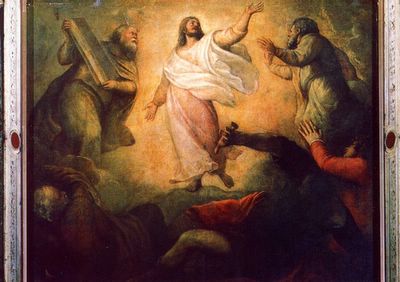
It's understandably difficult for us to wrap our heads around this fully human, fully divine Jesus. So historically Christians have tended to overemphasize one Jesus over the other. In the Middle Ages, Jesus was a rather distant and frightening figure; his goodness too good to endure, his suffering too terrible to contemplate. The Eucharist -- God's gift of grace and spiritual nourishment to the people of God -- often became something too precious for common people to partake; "Take and eat" became "See and adore." Saints seemed more human, more able and willing to involve themselves in human affairs than the intimidating Christ of the popular imagination; they increasingly became the middlemen and -women in human interaction with the Divine.
The Reformation came as a needed correction to this loss of the Gospel message. But in the centuries to come the pendulum began to tilt in the other direction, helped on one hand by biblical deconstructionists who approached scholarship with the attitude of "This can't possibly be right," and on the other hand by Pietists whose emphasis on a personal relationship with Jesus and insistence on minimalist worship tended to, for all intents and purposes, dethrone the Cosmic Christ and turn the salvation story into a private me-n-Jesus-under-the-blanket-with-a-flashlight drama, in a cynical and superficial culture (including Christian culture) that has lost its grasp of concepts like sanctity and holiness and mystery.
What today's Gospel lesson said to me as I was reading and rereading it, was that we can't have one Jesus without the other. The very human, flesh-and-blood Jesus we meet earlier in Mark -- the teacher, the healer, the individual who reached out to other individuals, the Jesus who had to contend with blockheaded disciples and intrusive crowds and hostile religious leaders -- is also the Jesus of the Transfiguration, a figure so glorious that his closest friends fall on their faces in awe.
I believe that we are living in a time when people are hungering and thirsting for connection with the numinous, the holy. They want to, as one Catholic cleric put it, celebrate the Mystery. Popular culture can't help them. Sadly, many Christian churches these days can't help them either.
One of my ministerial mentors describes church as "a place where God happens." I think all of us who belong to faith communities need to think about how we create sacred space -- space where God happens -- in our worship services and small groups. Sometimes we need Jesus to be our friend -- but sometimes we also need Jesus to be "Holy, holy, holy, Lord God Almighty." The mystery of our faith is that Jesus is both. But is that truly reflected in how we live...how we speak...how we worship?
"The Transfiguration," Titian

Friday, February 24, 2006
The Codeman and the Chairman
My dog loves Frank Sinatra.
I tell this to people, and they smile and nod, and I know they're thinking, "She's just a leeetle bit nuts."
But I'm telling you, it's true. When our local public radio station's Saturday morning jazz/swing/blues program plays Sinatra, my dog is right at the radio. One Sunday evening when 60 Minutes did a feature on some newly discovered Sinatra videos, my dog sat right in front of the TV, ear cocked, entranced, for the whole segment.
Tonight, during the replay of the Olympic figure skating exhibition, Sinatra's "My Way" was one of the musical accompaniments. My dog, who had been snoozing in his little doggy bed, popped to attention and listened to the whole song; then settled back down and fell asleep as soon as the music stopped.
The dog has a thing for the Chairman of the Board. Believe me or not.
I tell this to people, and they smile and nod, and I know they're thinking, "She's just a leeetle bit nuts."
But I'm telling you, it's true. When our local public radio station's Saturday morning jazz/swing/blues program plays Sinatra, my dog is right at the radio. One Sunday evening when 60 Minutes did a feature on some newly discovered Sinatra videos, my dog sat right in front of the TV, ear cocked, entranced, for the whole segment.
Tonight, during the replay of the Olympic figure skating exhibition, Sinatra's "My Way" was one of the musical accompaniments. My dog, who had been snoozing in his little doggy bed, popped to attention and listened to the whole song; then settled back down and fell asleep as soon as the music stopped.
The dog has a thing for the Chairman of the Board. Believe me or not.
Something I Learned Today During My Theological Training
A Catholic priest, a Lutheran pastor and a rabbi used to have lunch together every Wednesday at a local cafe.
One Wednesday, as they were eating and talking about their work, the subject of mortality and legacies came up: When they died, what did they want the people in their congregations to say about them as they passed the casket at their respective funerals?
The priest said, "At my funeral, as they passed my casket I'd want them to say, 'He was a faithful servant of God who gave his all to the Church and served the people to the best of his ability.'"
The pastor said, "As they passed my casket I'd want them to say, 'She preached the Word rightly; administered the Sacraments rightly; was a good pastor, a good spouse and a good mother.'"
The rabbi said, "As they passed my casket, I'd want them to say, Look! He's moving!'"
[rim shot]
Actually, I learned all about the structure and themes of the Gospel of Mark. And a sort of condensed, triple-espresso review of the history, purpose and structure of the liturgy. My head is spinning. And more to come tomorrow.
One Wednesday, as they were eating and talking about their work, the subject of mortality and legacies came up: When they died, what did they want the people in their congregations to say about them as they passed the casket at their respective funerals?
The priest said, "At my funeral, as they passed my casket I'd want them to say, 'He was a faithful servant of God who gave his all to the Church and served the people to the best of his ability.'"
The pastor said, "As they passed my casket I'd want them to say, 'She preached the Word rightly; administered the Sacraments rightly; was a good pastor, a good spouse and a good mother.'"
The rabbi said, "As they passed my casket, I'd want them to say, Look! He's moving!'"
[rim shot]
Actually, I learned all about the structure and themes of the Gospel of Mark. And a sort of condensed, triple-espresso review of the history, purpose and structure of the liturgy. My head is spinning. And more to come tomorrow.
Thursday, February 23, 2006
Friday Poetry Blogging
Winter Promises
For those of you who enjoy fantasizing over garden catalogs, check out Garden Bazaar . And if you're an heirloom-variety/OP vegetable geek, look over at my blogroll and check out Bountiful Gardens. The catalog is black and white, but it's loaded with all sorts of wild and wonderful heirloom veggie varieties. I can also vouch for their excellent customer service. Happy garden dreams!
Tomatoes rosy as perfect baby's buttocks,
eggplants glossy as waxed fenders,
purple neon flawless glistening
peppers, pole beans fecund and fast
growing as Jack's Viagra-sped stalk,
big as truck tire zinnias that mildew
will never wilt, roses weighing down
a bush never touched by black spot,
brave little fruit trees shouldering up
their spotless ornaments of glass fruit:
I lie on the couch under a blanket
of seed catalogs ordering far
too much. Sleet slides down
the windows, a wind edged
with ice knifes through every crack.
Lie to me, sweet garden-mongers:
I want to believe every promise,
to trust in five pound tomatoes
and dahlias brighter than the sun
that was eaten by frost last week. -- Marge Piercy
For those of you who enjoy fantasizing over garden catalogs, check out Garden Bazaar . And if you're an heirloom-variety/OP vegetable geek, look over at my blogroll and check out Bountiful Gardens. The catalog is black and white, but it's loaded with all sorts of wild and wonderful heirloom veggie varieties. I can also vouch for their excellent customer service. Happy garden dreams!
In Retreat
I just finished a Stress Day From Hell, in the context of a Stress Week From Hell -- I had my annual performance review this afternoon (positive but extremely anxiety-provoking), followed a few hours later by an equally anxiety-provoking forelock-tugging, hat-in-hand presentation to a local agency that helps fund one of our programs at work. So I'm thrilled to be taking a vacation day and heading off to my quarterly lay ministry retreat tomorrow and Saturday. Actually, I'm just heading down the road a few miles; the location this time is so close that I'm commuting...a fact that may have some of you scratching your heads, thinking, "What sort of retreat is that?"
Well, sometimes I think the same thing. Sometimes I'd love to spend a weekend at a real retreat house, somewhere far away, in solitude and silence.
But our retreats are like concentrated seminary. We're spending the weekend engrossed in the Gospels of Matthew and Mark -- an intrepid seminary professor is coming all the way to the general environs of Outer Podunk to teach us -- and we're also going to learn about the purpose and structure of the liturgy from one of our regional pastoral mentors, an excellent teacher who's just a delight to listen to. We're going to worship; we take turns helping with this. We're going to break out into small groups and talk about Life, the Universe and Everything. My pastor's going to be a resource pastor at this event, which will be kind of cool; the resource pastors preside over our retreat Eucharist and then just hang out with us. We're going to eat, a lot -- dietary asceticism not being a value at these shindigs, thanks to the various church ladies and gents who tend to feed us to the gills.
I admit to enjoying an occasional weekend away from the old homestead. Those of you who travel muchly, perhaps unhappily, might find it either hilarious or sad that I can find delight in sitting up in a hotel bed in my jammies, channel-surfing, or playing with the whirlpool function in the bathtub, or people-watching in the public areas. I'm just very easily amused.
Tomorrow, though, I'm heading home at 9:30 pm -- which will make both my dog and my mother very happy -- and heading back to the theology corral bright and early Saturday. I might even manage a blog entry or two in the middle of all this.
Well, sometimes I think the same thing. Sometimes I'd love to spend a weekend at a real retreat house, somewhere far away, in solitude and silence.
But our retreats are like concentrated seminary. We're spending the weekend engrossed in the Gospels of Matthew and Mark -- an intrepid seminary professor is coming all the way to the general environs of Outer Podunk to teach us -- and we're also going to learn about the purpose and structure of the liturgy from one of our regional pastoral mentors, an excellent teacher who's just a delight to listen to. We're going to worship; we take turns helping with this. We're going to break out into small groups and talk about Life, the Universe and Everything. My pastor's going to be a resource pastor at this event, which will be kind of cool; the resource pastors preside over our retreat Eucharist and then just hang out with us. We're going to eat, a lot -- dietary asceticism not being a value at these shindigs, thanks to the various church ladies and gents who tend to feed us to the gills.
I admit to enjoying an occasional weekend away from the old homestead. Those of you who travel muchly, perhaps unhappily, might find it either hilarious or sad that I can find delight in sitting up in a hotel bed in my jammies, channel-surfing, or playing with the whirlpool function in the bathtub, or people-watching in the public areas. I'm just very easily amused.
Tomorrow, though, I'm heading home at 9:30 pm -- which will make both my dog and my mother very happy -- and heading back to the theology corral bright and early Saturday. I might even manage a blog entry or two in the middle of all this.
Holy Crap!
Check this out: "21 Percent of Americans Holy" .
The very best part of this Barna report: When asked to define "holy," the largest percentage of respondents -- also 21 percent -- said they didn't know what it meant.
Well, alrighty then!
The very best part of this Barna report: When asked to define "holy," the largest percentage of respondents -- also 21 percent -- said they didn't know what it meant.
Well, alrighty then!
Tuesday, February 21, 2006
I Have Become...Comfortably Numb
Thank you, God, for the good gift of DRUGS.
I'm speaking many hours later, after my 8 am appointment with dental destiny.
Amazing, what they can do nowadays. I admit to being a little bit afraid this morning, because I wasn't going to be knocked out for my procedure; the last time I had oral surgery, as I blogged earlier, I was so wacked out on Demerol and Versed that the only thing I remember of the whole thing was Frankie Valli and the Four Seasons on the radio. Now, when I confirmed my appointment, the nurse had assured me that this extraction would be quick and painless, and I'd be able to drive myself to and from, but...I wasn't looking forward to this day.
The medical office had a nice saltwater aquarium -- clownfish and striking little neon blue fish and a big, friendly fish that actually seemed to be watching the action outside the glass. For some reason, in my life the nicer the waiting-room aquariums the worse the experience I've had in the medical office, so this pleasant underwater scene did not comfort me. A young woman came in; I figured a student from the university down the street; she had the look of someone in pain, someone also not particularly thrilled to be sitting in this office at ten minutes to 8:00.
Finally I was ushered by a nurse into the exam room. I got settled, and the doctor -- a kindly, avuncular older man -- gave me a hefty dose of numbzit. I sat alone for 15 minutes, doing the Jesus Prayer; then the doctor returned, tapped my tingling chin, started doing stuff inside my mouth while the nurse handed him things I couldn't see because I had my eyes closed. In what I think was a clever bit of parlor magic translated into dental work, he started counting; he stopped at two, started again and stopped at two again, then asked me an innocuous question that of course I couldn't answer; while I was trying to figure out how to respond the doctor suddenly announced, "It's out!" And that was it. And it turned out that a root canal wouldn't have been doable in my situation anyway, which also helped allay my fear that I hadn't chosen the best alternative.
So far I've been able to handle a late lunch of yogurt, baby food (strained bananas and plums rock...no wonder I was such a fat little kid) and lukewarm tea. Tonight I'm attempting chicken soup, from a big batch I made last night.
I wouldn't say that this would be my preferred way to spend a day off from work, but it wasn't quite as awful as I had imagined. RIP, old molar. Welcome back, strained fruit.
I'm speaking many hours later, after my 8 am appointment with dental destiny.
Amazing, what they can do nowadays. I admit to being a little bit afraid this morning, because I wasn't going to be knocked out for my procedure; the last time I had oral surgery, as I blogged earlier, I was so wacked out on Demerol and Versed that the only thing I remember of the whole thing was Frankie Valli and the Four Seasons on the radio. Now, when I confirmed my appointment, the nurse had assured me that this extraction would be quick and painless, and I'd be able to drive myself to and from, but...I wasn't looking forward to this day.
The medical office had a nice saltwater aquarium -- clownfish and striking little neon blue fish and a big, friendly fish that actually seemed to be watching the action outside the glass. For some reason, in my life the nicer the waiting-room aquariums the worse the experience I've had in the medical office, so this pleasant underwater scene did not comfort me. A young woman came in; I figured a student from the university down the street; she had the look of someone in pain, someone also not particularly thrilled to be sitting in this office at ten minutes to 8:00.
Finally I was ushered by a nurse into the exam room. I got settled, and the doctor -- a kindly, avuncular older man -- gave me a hefty dose of numbzit. I sat alone for 15 minutes, doing the Jesus Prayer; then the doctor returned, tapped my tingling chin, started doing stuff inside my mouth while the nurse handed him things I couldn't see because I had my eyes closed. In what I think was a clever bit of parlor magic translated into dental work, he started counting; he stopped at two, started again and stopped at two again, then asked me an innocuous question that of course I couldn't answer; while I was trying to figure out how to respond the doctor suddenly announced, "It's out!" And that was it. And it turned out that a root canal wouldn't have been doable in my situation anyway, which also helped allay my fear that I hadn't chosen the best alternative.
So far I've been able to handle a late lunch of yogurt, baby food (strained bananas and plums rock...no wonder I was such a fat little kid) and lukewarm tea. Tonight I'm attempting chicken soup, from a big batch I made last night.
I wouldn't say that this would be my preferred way to spend a day off from work, but it wasn't quite as awful as I had imagined. RIP, old molar. Welcome back, strained fruit.
Monday, February 20, 2006
Yes
As surely as God is faithful, our word to you has not been “Yes and No.” For the Son of God, Jesus Christ, whom we proclaimed among you, Silvanus and Timothy and I, was not “Yes and No”; but in him it is always “Yes.” For in him every one of God’s promises is a “Yes.” For this reason it is through him that we say the “Amen,” to the glory of God. 2 Corinthians 1:18-20
Something my pastor said yesterday in his sermon has stayed with me through today.
Because of the way the world works, because of all the NO's we hear from the time we're tiny tots...how difficult it is for us to trust in Christ's YES to us. We stand cringing, our lips quivering, waiting for the accusatory finger and the angry voice...but instead we hear a YES.
Sunday, February 19, 2006
Rushing the Season
I think it must say something about someone's personality if, instead of looking forward to Christmas, s/he looks forward to Lent.
That's where I'm at right now. It may still be the Season of Light, but I'm thinking about the ways in which I am going to observe Lent this year.
One way is by providing some Internet space for people to share their own Lenten journeys, ask questions, and provide some encouragement for those who perhaps aren't being supported in their Lenten observance by their faith community or family or friends. I've set up what's called a dialogue group on Beliefnet for this purpose. If you are not already a member, you do need to register (fairly painless -- you can uncheck all those annoying please-let-us-junk-up-your-e-mail-every-day-with-our-marketing options, and also keep your profile blank, if you'd rather not invest a lot of self-disclosure in that website other than participating in this group) to participate in the dialogue groups. Once you've done that, go to the left-hand sidebar, find "Community," find "Dialogue Groups," find "Christianity" -- and you'll see my group; I use a different nom de plume/nom de guerre over there, but you'll figure it out.
Many people pick a spiritual book other than the Bible to read during the Lenten season. I think this year I am going to read Unfettered Hope: A Call To Faithful Living in an Affluent Society by Marva Dawn, a theologian whose work I've appreciated before. I am more acquainted with her books about the theology of worship; in this book, Dawn tackles the issue of living not only more faithfully but also more hopefully in a society where the various "powers and principalities" tend to create an atmosphere of chaos and despair. I think this book will fit in well with the countercultural thrust of Lent -- a time where, while the rest of the world does its own thing, we keep our eyes focused on Jesus as he in turn "sets his face toward Jerusalem," and like Mary Magdalene in Godspell we ask, "Can you take me with you?"
I'm slowly working out some of my other Lenten disciplines. I want to engage in some quality examen time beforehand to identify some of the issues in my own life that keep me lurching into the ditch on my walk with The CEO, and integrate confronting those into my disciplines. And a lot of it I think is going to stay between The CEO and me.
And, of course, I'm giving up a tooth for Lent.
(That was a joke. Sort of.)
That's where I'm at right now. It may still be the Season of Light, but I'm thinking about the ways in which I am going to observe Lent this year.
One way is by providing some Internet space for people to share their own Lenten journeys, ask questions, and provide some encouragement for those who perhaps aren't being supported in their Lenten observance by their faith community or family or friends. I've set up what's called a dialogue group on Beliefnet for this purpose. If you are not already a member, you do need to register (fairly painless -- you can uncheck all those annoying please-let-us-junk-up-your-e-mail-every-day-with-our-marketing options, and also keep your profile blank, if you'd rather not invest a lot of self-disclosure in that website other than participating in this group) to participate in the dialogue groups. Once you've done that, go to the left-hand sidebar, find "Community," find "Dialogue Groups," find "Christianity" -- and you'll see my group; I use a different nom de plume/nom de guerre over there, but you'll figure it out.
Many people pick a spiritual book other than the Bible to read during the Lenten season. I think this year I am going to read Unfettered Hope: A Call To Faithful Living in an Affluent Society by Marva Dawn, a theologian whose work I've appreciated before. I am more acquainted with her books about the theology of worship; in this book, Dawn tackles the issue of living not only more faithfully but also more hopefully in a society where the various "powers and principalities" tend to create an atmosphere of chaos and despair. I think this book will fit in well with the countercultural thrust of Lent -- a time where, while the rest of the world does its own thing, we keep our eyes focused on Jesus as he in turn "sets his face toward Jerusalem," and like Mary Magdalene in Godspell we ask, "Can you take me with you?"
I'm slowly working out some of my other Lenten disciplines. I want to engage in some quality examen time beforehand to identify some of the issues in my own life that keep me lurching into the ditch on my walk with The CEO, and integrate confronting those into my disciplines. And a lot of it I think is going to stay between The CEO and me.
And, of course, I'm giving up a tooth for Lent.
(That was a joke. Sort of.)
Have a Cookie
My recent flu attack derailed my monthly cookie baking regimen, so this weekend I found myself owing our church raffle winner two months of cookies. (Constant readers will remember that, for the past two years, I have raffled off a year's worth of home-baked cookies.)
I decided to mix up my raspberry bar recipe , but make it a little more February-esque by using black cherry preserves instead of raspberry jam. These turned out quite good; the preserves (a found item in the German section of the new import aisle in our local supermarket) were on the tart side, and the flavor in general was a little more complex and interesting.
What to make for the other batch...pawing around through the family cookbook drawer, I found an Ideals cookie book from the early 70's that one of my aunts gave me when I started getting interested in baking. I'd never tried too many recipes from this particular book, but I did remember one successful, easy-to-make cookie that would make good use of some cream cheese in my refrigerator. So...here is the recipe, submitted for your approval. These cookies are not keepers -- not that that will be a problem -- and should be kept in the refrigerator if you happen to have any left after a day.
Lemon Cheese Balls
1/2 cup butter, softened
1 3-oz package cream cheese, softened
1/2 cup sugar
1 TBS lemon rind
1/2 tsp lemon extract (I really dislike the taste of most extracts, so I squeeze some fresh lemon juice into the dough instead; maybe also a little spot of real vanilla)
1 cup flour
1 tsp baking powder
1/4 tsp salt
1 3/4 cup coarsely crushed cereal (cornflakes, Rice Krispies, etc.)
Preheat oven to 350 degrees. Cream butter and cream cheese; add sugar gradually. Add lemon rind and extract or juice. Sift together flour, baking powder and salt and gradually add to mixture. Chill dough several hours. Shape heaping teaspoons of dough into balls and roll in crushed cereal. Please on ungreased cookie sheet. Bake about 12 minutes. (Cookies will not brown.) Makes about 3 dozen.
I decided to mix up my raspberry bar recipe , but make it a little more February-esque by using black cherry preserves instead of raspberry jam. These turned out quite good; the preserves (a found item in the German section of the new import aisle in our local supermarket) were on the tart side, and the flavor in general was a little more complex and interesting.
What to make for the other batch...pawing around through the family cookbook drawer, I found an Ideals cookie book from the early 70's that one of my aunts gave me when I started getting interested in baking. I'd never tried too many recipes from this particular book, but I did remember one successful, easy-to-make cookie that would make good use of some cream cheese in my refrigerator. So...here is the recipe, submitted for your approval. These cookies are not keepers -- not that that will be a problem -- and should be kept in the refrigerator if you happen to have any left after a day.
Lemon Cheese Balls
1/2 cup butter, softened
1 3-oz package cream cheese, softened
1/2 cup sugar
1 TBS lemon rind
1/2 tsp lemon extract (I really dislike the taste of most extracts, so I squeeze some fresh lemon juice into the dough instead; maybe also a little spot of real vanilla)
1 cup flour
1 tsp baking powder
1/4 tsp salt
1 3/4 cup coarsely crushed cereal (cornflakes, Rice Krispies, etc.)
Preheat oven to 350 degrees. Cream butter and cream cheese; add sugar gradually. Add lemon rind and extract or juice. Sift together flour, baking powder and salt and gradually add to mixture. Chill dough several hours. Shape heaping teaspoons of dough into balls and roll in crushed cereal. Please on ungreased cookie sheet. Bake about 12 minutes. (Cookies will not brown.) Makes about 3 dozen.
Saturday, February 18, 2006
Carrying and Being Carried

Then some people came, bringing to him a paralyzed man, carried by four of them. And when they could not bring him to Jesus because of the crowd, they removed the roof above him; and after having dug through it, they let down the mat on which the paralytic lay. When Jesus saw their faith, he said to the paralytic, “Son, your sins are forgiven.”
Many years ago, after an ice storm like the one that recently hit my part of the world, I fell down my front stairs one morning as I was heading to work. One moment I was gingerly making my way sideways down each step, and then the next moment I was at the foot of the stairs, looking up at the sky, the wind knocked right out of me. For about a minute, I couldn't move; I was numb. And as I lay there on the ice, looking up, wondering how badly I'd injured myself, I felt an additional fear: There's no one here to help me.
Sometimes our paralysis is intellectual or emotional. Writer's block; many of us are familiar with the terror of facing down a blank computer screen. Or maybe, faced with a tough decision or series of decisions, we are so overloaded with information or options or possible outcomes that we simply can't take a next step; we feel our minds crashing like an overstressed CPU. Sometimes our paralysis is caused by a cocktail of physical, mental and emotional factors. But whatever the reason, we find ourselves like the woman in the infamous TV commercial: I've fallen and I can't get up.
This is the situation of the young paralytic in our Gospel lesson. Except -- he has friends. Faithful friends. Persistent friends. Resourceful friends. When they hear that Jesus is in town, and they arrive at Jesus' location only to find a huge, jostling crowd already there, trying to get close to Jesus, they resolve to do whatever it takes to get their friend the help he needs -- even if it means climbing onto the roof, digging through the tiles and lowering their friend through the hole.
It's interesting that I found it hard to find artwork for this post that actually showed the paralytic's friends. Artists seem to prefer focusing on the drama of the paralyzed man suddenly picking up his mat and walking. But if you read the text, the friends aren't just bit players in this story. It's their love, their trust, that Jesus commends.
Not all that long ago I was the person flattened on the mat. Not by anything serious -- I know people going through crises that make my own life seem like a stroll down Easy Street by comparison. No; my problems were more on the scale of being nibbled to death by ducks; every day one more thing -- a health issue; a work setback; an anxiety about my mother; dealing with hostile others. I started greeting the morning in the cynical spirit of Dorothy Parker: What fresh hell is this? I felt myself shutting down. I couldn't move emotionally or spiritually, and even had a hard time making the trip out of bed every day.
And that's when my friends showed up. Not in concert, mind you; most of them don't know one another. And I'm sure many of them weren't all that conscious of the aid they were lending me. But all of them, in their own ways, helped pull me up on the roof and then got me to a place where I could see Jesus. And that was a gift I desperately needed.
I run into a lot of Christian freelancers online who have been so hurt or disillusioned by the Church that they've resolved to go it alone in the world. What I tell them is: It's just too hard. You need other people. Yes, they'll drive you insane sometimes, but you need them.
And it works both ways. I know that I am the least happy and whole when I am suffering a bout of curvatus in se -- self-absorption, solipsism, all me all the time. Sometimes I need to be confronted by someone flat on the mat to startle me out of myself, to help me remember who I am and why I'm here.
Jane Siberry has a song, "Life is the Red Wagon," whose chorus goes, "You pull me/I'll pull for you." This is how it is, to live on the earth. And this is where we meet Jesus, the powerful one who was also the weak and vulnerable one, who heals us when we're not able to pull and blesses us for the pulling.
Artwork by James Tissot
The Chik Turns One!
 I'm terrible at remembering birthdays...so it's no surprise I forgot that this blog was born Feb. 16th last year! Wow. Hard to believe.
Tea'd Off
Well, now that I got my Winter Olympics editorial off my chest, on to kinder, gentler things...namely, tea.
I've never been an enthusiastic tea drinker; I enjoy the very pale, flowery green tea served in Chinese restaurants, but I've never been able to replicate the flavor at home; and I can only drink black tea if it's been majorly amended with milk.
But one of my bosses introduced me to white tea at this year's office Christmas tea. White tea is made from the very youngest tea-leaf buds, when they're coated in white fuzz. It's wonderful; I love it. Since then I've tried the Stash white/green tea mix, and that was good, but my current favorite is Choice brand Organic White Peony tea from my food coop. I enjoy it plain, with some barely-sweet snack like shortbread on the side. (And, by the way, there are no peonies in white peony tea, because peonies are poisonous. So don't be picking flowers out of your perennial bed and trying to make peony tea out of them.)
If you don't think you like tea, try white tea -- tea for non-tea-drinkers. It's a nice warming treat on an extremely cold morning.
I've never been an enthusiastic tea drinker; I enjoy the very pale, flowery green tea served in Chinese restaurants, but I've never been able to replicate the flavor at home; and I can only drink black tea if it's been majorly amended with milk.
But one of my bosses introduced me to white tea at this year's office Christmas tea. White tea is made from the very youngest tea-leaf buds, when they're coated in white fuzz. It's wonderful; I love it. Since then I've tried the Stash white/green tea mix, and that was good, but my current favorite is Choice brand Organic White Peony tea from my food coop. I enjoy it plain, with some barely-sweet snack like shortbread on the side. (And, by the way, there are no peonies in white peony tea, because peonies are poisonous. So don't be picking flowers out of your perennial bed and trying to make peony tea out of them.)
If you don't think you like tea, try white tea -- tea for non-tea-drinkers. It's a nice warming treat on an extremely cold morning.
Saturday Five, With Bonus Rant
Yeah; I'm slow. Anyhow...
Which of the Winter Olympic sports is your favorite to watch?
The freestyle skiing events.
Do you speak Snowboardese?
Dude -- gaffers should probably not speak Snowboardese.
Define Nordic Combined. Don't look it up. Take a guess if you must.
Aha! I know this. It's cross-country skiing combined with ski jumping...right?
Curling. Please discuss.
I love curling, because it is the only Olympic sport that I could conceivably ever do myself. Since I'm built more for strength and endurance than speed and agility, I'd be the one pushing the stone down the ice (I have to admit, I don't know the lingo); I'd let someone else do the thing with the broom.
If you could be a Winter Olympics Champion just by wishing for it, which sport would you choose for winning your Gold Medal?
Again, I think I would only be believable as a curling competitor.
Now for the rant. I have had it up to here [LC gesturing right up to her 5'3" top of head] with all the scoldy, frowny-faced commentator hand-wringing over Lindsey Jacobellis, the American snowboardcross competitor who, just seconds from winning the gold medal, wiped out while making an exuberant grab for her board. She was "hot-dogging"; she let down the team.
Is it just me, or do you think that if Lindsey were a he and not a she there would not be this sort of judgmental broughaha? That Lindsey would be praised for "going for it" and exemplifying that ol' Olympic spirit even if it didn't work out? Ya think? I recall the same sort of criticism being leveled in the past at female figure skaters attempting quad jumps -- they were just showing off, they weren't being team players...I once heard a commentator even opine that a female quad jump would be a "freakish" move that shouldn't be allowed in competition because only some steroid-pumped female anomaly would be able to achieve it. So much for Citius, altius, fortius.
Then, to add to this nonsense, a local newspaper sports columnist recently opined that many women's Olympic sports -- including hockey -- were "novelties" designed to harvest medals for the United States and fill up television time, and not legitimate athletic pursuits. This from someone whose idea of women's athletics is probably ordering his wife to the kitchen in the 25-foot Beer Relay event while he rests his posterior in his La-Z-Boy.
Feh. As far as I'm concerned these "experts" can all biff themselves. Which may not be the correct Snowboardese term, but -- dang -- it felt good to type.
Which of the Winter Olympic sports is your favorite to watch?
The freestyle skiing events.
Do you speak Snowboardese?
Dude -- gaffers should probably not speak Snowboardese.
Define Nordic Combined. Don't look it up. Take a guess if you must.
Aha! I know this. It's cross-country skiing combined with ski jumping...right?
Curling. Please discuss.
I love curling, because it is the only Olympic sport that I could conceivably ever do myself. Since I'm built more for strength and endurance than speed and agility, I'd be the one pushing the stone down the ice (I have to admit, I don't know the lingo); I'd let someone else do the thing with the broom.
If you could be a Winter Olympics Champion just by wishing for it, which sport would you choose for winning your Gold Medal?
Again, I think I would only be believable as a curling competitor.
Now for the rant. I have had it up to here [LC gesturing right up to her 5'3" top of head] with all the scoldy, frowny-faced commentator hand-wringing over Lindsey Jacobellis, the American snowboardcross competitor who, just seconds from winning the gold medal, wiped out while making an exuberant grab for her board. She was "hot-dogging"; she let down the team.
Is it just me, or do you think that if Lindsey were a he and not a she there would not be this sort of judgmental broughaha? That Lindsey would be praised for "going for it" and exemplifying that ol' Olympic spirit even if it didn't work out? Ya think? I recall the same sort of criticism being leveled in the past at female figure skaters attempting quad jumps -- they were just showing off, they weren't being team players...I once heard a commentator even opine that a female quad jump would be a "freakish" move that shouldn't be allowed in competition because only some steroid-pumped female anomaly would be able to achieve it. So much for Citius, altius, fortius.
Then, to add to this nonsense, a local newspaper sports columnist recently opined that many women's Olympic sports -- including hockey -- were "novelties" designed to harvest medals for the United States and fill up television time, and not legitimate athletic pursuits. This from someone whose idea of women's athletics is probably ordering his wife to the kitchen in the 25-foot Beer Relay event while he rests his posterior in his La-Z-Boy.
Feh. As far as I'm concerned these "experts" can all biff themselves. Which may not be the correct Snowboardese term, but -- dang -- it felt good to type.
Friday, February 17, 2006
Friday Poetry Blogging
The Thread
Something is very gently,
invisibly, silently,
pulling at me-a thread
or net of threads
finer than cobweb and as
elastic. I haven't tried
the strength of it. No barbed hook
pierced and tore me. Was it
not long ago this thread
began to draw me? Or
way back? Was I
born with its knot about my
neck, a bridle? Not fear
but a stirring
of wonder makes me
catch my breath when I feel
the tug of it when I thought
it had loosened itself and gone. -- Denise Levertov
Thursday, February 16, 2006
"My Sheep Hear My Voice..."
 "My sheep hear my voice. I know them, and they follow me. I give them eternal life, and they will never perish. No one will snatch them out of my hand." John 10:27-28
 Artwork: "The Good Shepherd," Eric Gill
Yearn To Learn?
Check this out: ELCA's Select Multimedia Learning Resources -- all sorts of interesting stuff, especially for Bible students looking for seminary-quality lectures on DVD or tape. Hey, maybe I'll get "Evangelism For Shy Lutherans." (That was a joke.)
Wednesday, February 15, 2006
Word Cloud

I just made a LutheranChik "word cloud" by running my blog through Snapshirts . This is pretty cool. You can do it too.
"I Know My Own and My Own Know Me..."
 In case you need another reason to follow The Daily Office: Sometimes, when you really need "a word," it's right there.
I needed a word this evening, after finding myself in yet another conversation with people who would rather leave a church than share it with people like me, and after reading human rights reports of individuals churches and governments alike worldwide who would like to amputate me, and other people like me, from the Body of Christ.
And here was the word:
I know my own and my own know me.
And so I am sharing this word with anyone reading who's ever felt as if he or she were being pushed out of the sheepfold, or denied entrance at the gate. And I am also sharing this word with anyone who feels that he or she has been designated an official sheep culler in the Reign of God.
I know my own and my own know me.
Artwork: "The Good Shepherd," Eric Gill
Monday, February 13, 2006
Love and Spiders
I don't know how many of you had the opportunity to catch Nature last night on PBS, but it was all about Martin Nicholas, a wonkish water treatment engineer from the U.K. who is also, in his spare time, a respected amateur arachnologist -- someone who studies spiders.
But he doesn't just study them. He loves them. The man is geeked on spiders. And I can't tell you how much I enjoyed watching him, on this program, as he traveled to the New World to hunt for spiders. He exuded visible, nearly palpable joy every time he found a different species in the wild. He made me love spiders, just seeing him.
Have you ever known someone with a magnificent obsession like this? I have. I used to know someone who loved to quilt as much as Martin Nicholas loves to find spiders. A late uncle of mine was fascinated by Native Americans, and spent many hours on his farm looking for arrowheads; he was fairly well read on the Native Americans who lived in our area, and I think if he'd lived long enough to get connected to the Internet he'd probably be on it all day doing research. A college friend of mine was a train buff who used to work on restoring old locomotive engines and had an encyclopedic knowledge of every train line that ever ran through the state. I work with someone who loves flowers, especially heirloom perennials, who lives with stacks of nursery catalogs, whose yard is a constant work in progress and who travels around the countryside cutting slips from old rambler roses growing on old farmsteads and in cemeteries so that these vintage varieties will be preserved.
Every once in awhile I experience a brief magnificent obsession: English ivies, bread baking, embroidery, tomatoes, Civil War history...you name it. And even though most of these are short-lived, I've not regretted any of them. Like close but transient friendships, these fleeting spurts of concentrated attention have all helped me become who I am; they've added color and texture to my life. They've all been worth it.
Eric Liddell, the famous English runner of Chariots of Fire fame, said, "God made me fast for a reason. When I run, I can feel God's pleasure.” I suspect that God feels pleasure when we take the same delight in the diversity and complexity and beauty of the world, or in the pursuit of a creative pastime, as God takes in God's creative, redeeming and sustaining work.
Love what you love with all your might. Because I think that's what God does.
But he doesn't just study them. He loves them. The man is geeked on spiders. And I can't tell you how much I enjoyed watching him, on this program, as he traveled to the New World to hunt for spiders. He exuded visible, nearly palpable joy every time he found a different species in the wild. He made me love spiders, just seeing him.
Have you ever known someone with a magnificent obsession like this? I have. I used to know someone who loved to quilt as much as Martin Nicholas loves to find spiders. A late uncle of mine was fascinated by Native Americans, and spent many hours on his farm looking for arrowheads; he was fairly well read on the Native Americans who lived in our area, and I think if he'd lived long enough to get connected to the Internet he'd probably be on it all day doing research. A college friend of mine was a train buff who used to work on restoring old locomotive engines and had an encyclopedic knowledge of every train line that ever ran through the state. I work with someone who loves flowers, especially heirloom perennials, who lives with stacks of nursery catalogs, whose yard is a constant work in progress and who travels around the countryside cutting slips from old rambler roses growing on old farmsteads and in cemeteries so that these vintage varieties will be preserved.
Every once in awhile I experience a brief magnificent obsession: English ivies, bread baking, embroidery, tomatoes, Civil War history...you name it. And even though most of these are short-lived, I've not regretted any of them. Like close but transient friendships, these fleeting spurts of concentrated attention have all helped me become who I am; they've added color and texture to my life. They've all been worth it.
Eric Liddell, the famous English runner of Chariots of Fire fame, said, "God made me fast for a reason. When I run, I can feel God's pleasure.” I suspect that God feels pleasure when we take the same delight in the diversity and complexity and beauty of the world, or in the pursuit of a creative pastime, as God takes in God's creative, redeeming and sustaining work.
Love what you love with all your might. Because I think that's what God does.
Because Everyone Deserves Flowers and a Poem on Valentine's Day
Soule of my soule! my Joy, my crown, my friend!
A name which all the rest doth comprehend;
How happy are we now, whose sols are grown,
By an incomparable mixture, One:
Whose well acquainted minds are not as neare
As Love, or vows, or secrets can endeare.
I have no thought but what's to thee reveal'd,
Nor thou desire that is from me conceal'd.
Thy heart locks up my secrets richly set,
And my breast is thy private cabinet.
Thou shedst no teare but what but what my moisture lent,
And if I sigh, it is thy breath is spent.
United thus, what horrour can appeare
Worthy our sorrow, anger, or our feare?
Let the dull world alone to talk and fight
And with their vast ambitions nature fright;
Let them despise so innocent a flame,
While Envy, pride, and faction play their game:
But we by Love sublim'd so high shall rise,
To pitty Kings, and Conquerours despise,
Since we that sacred union have engrost,
Which they and all the sullen world have lost.
-- "L'Amite," Katherine Fowler Philips
P.S. Don't forget the chocolate.

A name which all the rest doth comprehend;
How happy are we now, whose sols are grown,
By an incomparable mixture, One:
Whose well acquainted minds are not as neare
As Love, or vows, or secrets can endeare.
I have no thought but what's to thee reveal'd,
Nor thou desire that is from me conceal'd.
Thy heart locks up my secrets richly set,
And my breast is thy private cabinet.
Thou shedst no teare but what but what my moisture lent,
And if I sigh, it is thy breath is spent.
United thus, what horrour can appeare
Worthy our sorrow, anger, or our feare?
Let the dull world alone to talk and fight
And with their vast ambitions nature fright;
Let them despise so innocent a flame,
While Envy, pride, and faction play their game:
But we by Love sublim'd so high shall rise,
To pitty Kings, and Conquerours despise,
Since we that sacred union have engrost,
Which they and all the sullen world have lost.
-- "L'Amite," Katherine Fowler Philips
P.S. Don't forget the chocolate.

The Great Crack-Up; Or, "I'm Coming Out"
For those of you poised at the edge of your seats to hear the latest installment of What's Wrong With Me, here's what's going on with my back molar.
I got a late appointment at the dentist today. I like my dentist. He's fun, at least as fun as a dentist can be. He pipes the local oldies station all through his office and sings along. He's also a pilot and a World War II buff, so every room is filled with model airplanes and aviation artwork -- never a dull moment sitting there, unlike my doctor's exam room where all I have to look at are Viagra posters and scoldy notices about insurance billing.
They've gotten my history of this problem and taken my X-ray, and I'm sitting there in the chair listening to "Dancing Queen" while examining a framed print of a fighter plane when the dentist comes back in. He is not singing "Dancing Queen."
"You have got a big problem," he tells me somberly.
He shows me the film. There's an ominous dark splotch underneath the root of my tooth. It's an abscess...a big, ugly one. But the molar itself looks fine.
"Have you had any kind of recent head injury?" the dentist asks.
"No..." I think back to my recent parking-lot tumble. "Well, I fell on the ice around Christmastime. But I didn't fall on my head."
"Hmmm. The thing is, if you hit at a certain velocity, with your bite in a certain alignment, you could have significantly damaged something down there, without it showing up right away on an X-ray."
Long story short: No matter how healthy it looks on X-ray now, the tooth is going to die. The dentist told me I could choose a root canal, and all the hassle and cost that that entails, or have the thing extracted. He said, "If I were you, I'd just get it out of there." I said, "That sounds like a plan to me."
So...I am taking massive quantities of antibiotics, and tomorrow morning I have to call an oral surgeon.
Shit.
No one on either side of my working-class extended family has ever been too fastidious about dental health; they all lived under the assumption, I guess, that they'd have dentures by age 30 anyway, so why bother. I've always rebelled against that. I always told myself that, by golly, I'm checking out with the full set of teeth God gave me.
Shit.
I got a late appointment at the dentist today. I like my dentist. He's fun, at least as fun as a dentist can be. He pipes the local oldies station all through his office and sings along. He's also a pilot and a World War II buff, so every room is filled with model airplanes and aviation artwork -- never a dull moment sitting there, unlike my doctor's exam room where all I have to look at are Viagra posters and scoldy notices about insurance billing.
They've gotten my history of this problem and taken my X-ray, and I'm sitting there in the chair listening to "Dancing Queen" while examining a framed print of a fighter plane when the dentist comes back in. He is not singing "Dancing Queen."
"You have got a big problem," he tells me somberly.
He shows me the film. There's an ominous dark splotch underneath the root of my tooth. It's an abscess...a big, ugly one. But the molar itself looks fine.
"Have you had any kind of recent head injury?" the dentist asks.
"No..." I think back to my recent parking-lot tumble. "Well, I fell on the ice around Christmastime. But I didn't fall on my head."
"Hmmm. The thing is, if you hit at a certain velocity, with your bite in a certain alignment, you could have significantly damaged something down there, without it showing up right away on an X-ray."
Long story short: No matter how healthy it looks on X-ray now, the tooth is going to die. The dentist told me I could choose a root canal, and all the hassle and cost that that entails, or have the thing extracted. He said, "If I were you, I'd just get it out of there." I said, "That sounds like a plan to me."
So...I am taking massive quantities of antibiotics, and tomorrow morning I have to call an oral surgeon.
Shit.
No one on either side of my working-class extended family has ever been too fastidious about dental health; they all lived under the assumption, I guess, that they'd have dentures by age 30 anyway, so why bother. I've always rebelled against that. I always told myself that, by golly, I'm checking out with the full set of teeth God gave me.
Shit.
Sunday, February 12, 2006
You Know You're Wasting Too Much Time Watching the Olympics...
...when you find yourself wondering how a couple of snowboarders would do color commentary on a worship service at your church:
"Did you see that assisting minister? Dude, she biffed the corporate confession!"
"Yeah...when she went for a fakie and bonked the font, and then fraggled the presiding. What a noob."
"Dude, even the li'l grommet who lights the candles could do a better job."
"But hey -- the presiding minister got some phat air during the Great Thanksgiving. Sick steez, man."
"He just barges that ritual, dude. Schwank."
"Did you see that assisting minister? Dude, she biffed the corporate confession!"
"Yeah...when she went for a fakie and bonked the font, and then fraggled the presiding. What a noob."
"Dude, even the li'l grommet who lights the candles could do a better job."
"But hey -- the presiding minister got some phat air during the Great Thanksgiving. Sick steez, man."
"He just barges that ritual, dude. Schwank."
Saturday, February 11, 2006
The Reign Versus the Regs
The person who has the leprous disease shall wear torn clothes and let the hair of his head be disheveled; and he shall cover his upper lip and cry out, "Unclean, unclean." he shall remain unclean as long as he has the disease; he is unclean. He shall live alone; his dwelling shall be outside the camp. Leviticus 13:45-46
In my offline life, I work for an agency whose activities are controlled by books full of state and federal regulations -- "the regs." The regs determine, often in excruciating detail, whom we can help, and how. The regs are impersonal and unforgiving. If you need a particular kind of assistance that our organization can provide but you don't meet an eligibility criterion -- perhaps you're a couple of months on the wrong side of an eligibility age, or your income is a few hundred dollars over the guideline -- too bad, so sad. Regs are regs.
This is the situation in which the leper in our Gospel lesson finds himself. Because he suffers from a certain type of skin disease, he has been ritually banished from life in the community. He is not allowed to be near his family or friends; in fact, he is banished to the outskirts of town. He is not allowed to dress like a healthy person. He is not allowed to practice the rituals of his faith. If he does encounter a non-diseased person, he is required to keep a significant distance and loudly warn that person of his uncleanness. He has in fact become for all intents and purposes a "dead man walking."
Why were the Mosaic cleanliness rules so strict and unyielding? They're obviously partly grounded in a nascent understanding of contagious disease and a desire to protect the health of the community, even at the cost of a member of that community. In reading these ancient stories about Moses and the people of Israel, one also comes away with an appreciation for the awe and fear the people felt in the presence of the tabernacle where they believed God lived in their midst, and their terror of offending God by letting the abnormal, the flawed, the diseased too near this holiest of holy places. A diseased person like a leper not only risked God's displeasure by his or her proximity to God's holiness, but also threatened the safety of the entire community, if God decided to punish all of them for the presence of this unacceptable individual.
So he or she is cast out. It's the best solution for the most people. It's the regs. "God said it; we believe it; that settles it."
The leper in our story does an unexpected thing. Instead of trying to keep Jesus away from him and his ritual uncleanness, which is his duty according to the rules, the leper instead calls out to Jesus for help. His plea is almost a dare: "If you choose, you could make me clean."
Jesus' response is also suprising. Most translations of the text say that Jesus was "moved with pity," but some manuscripts instead say that Jesus was moved with anger; that may indeed be the more original version. Why would Jesus be angry? In Mark, Jesus often appears angry at disease itself -- at the pain and suffering of the people around him. Pastor Brian Stoffregen of Crossmarks offers an alternative perspective on the scenario, and suggests instead that Jesus may be angry at the whole system -- a system that dehumanizes the suffering and makes their personhood completely dependent upon the whims of the religious authorities. The leper's initial statement to Jesus can also be translated, "If you choose you could declare me clean," which would hearken back to the official clean bill of health that the leper needed from the priests to be reintegrated into society. Perhaps the leper, on some level, recognizes that Jesus possesses an authority that supersedes that of the priests; or maybe he's just decided that he has nothing left to lose in asking.
But in any event, Jesus responds compassionately: "I do choose"; and then, in a shocking move, Jesus touches the leper and heals him. Imagine the reaction of any people around Jesus as he breaks this social taboo, and in so doing assumes the ritual uncleanness of the leper. What social taboo in our society might be equivalent to this?
Jesus then warns the leper not to not talk to others about this healing, but instead to simply show himself to the priests "as a testimony to them." When I was younger this comment was presented to me as an example of Jesus being a good, obedient "Bible-believing" rabbi who followed all the rules; but I now think that this is an example of Jesus doing exactly the opposite. I think Jesus wanted the religious authorities to know that there was something, someone in their midst who was bigger than the regs; who had come to bring wholeness, and was willing to do whatever it took to achieve that, even if it meant breaking rules and ignoring societal norms.
Kelly Fryer writes that, according to the ethic modeled by Jesus, if we have to choose between leading with a "law" foot or a "love" foot, we choose the "love" foot every time. This sounds so obvious...but how many Christians are actually willing to do this? How many Christians are willing to risk being "wrong," law-wise, in service to love? I've had numerous conversations about various hot-button topics in the Church with Christians who've told me, "Well, if it were up to me I'd be on the other side of the issue...but the Bible says..." In other words, they're going to lead with the "law" foot, because it's safe. It covers their fannies. When I hear statements like this I'm reminded of Dietrich Bonhoeffer's writings, where he talks about a love that's willing to take on the guilt of breaking rules in service to one's neighbor, and I think of his own willingness to do just that, and the price he paid.
If we take the question "What would Jesus do?" seriously, then we must also take seriously the fact that, when the Reign ran up against the regs, Jesus chose the Reign. Do we?
"Jesus Heals a Leper," Rembrandt

The Big Lie
It's a bright, sunny day here in Outer Podunk...I'm listening to Diane Reeves, which is not the worst thing you can be doing with your time on a Saturday...and I'm moodling over the Gospel lesson for tomorrow, Mark 1:40-45, the story of Jesus healing the leper.
As I'm pondering the text, I am experiencing a strange juxtaposition: I keep seeing, in my mind's eye, a shot from the film Bonhoeffer, recently broadcast on PBS, that showed a Lutheran bishop enthusiastically Sieg Heiling with a group of Nazi officials.
But it's really not a strange juxtaposition. Because tomorrow's Gospel story is, in large part, about power -- who and what wield power over individuals' lives in society.
The witness of the Gospels is that Jesus refused to acknowledge the primacy of the "powers and principalities" of his religion, of cultural norm, of the government he lived under. He did not humor the powers; he spoke truth to the powers. And that's how he wound up crucified between two other lawbreakers. You don't get condemned by the authorities of your faith tradition for following the party line. You don't get killed by the government for being an upstanding citizen. You don't get rejected by your peers for adding your "amen" to the choir touting conventional values.
And yet -- this is what the Church has tried to sell Christians for centuries: Your job is to be good, obedient people of faith who listen in submission to what the Bible and ecclesiastical authority figures have to tell you; and to be good, obedient citizens who don't bring scandal to the Body of Christ by challenging authority.
How did it come to this? What on earth does this have to do with the message and model of Jesus of Nazareth?
When I was a kid, I remember hearing in church that the Gospel texts describing how Jesus would send people he'd healed to the religious authorities to have their cures officially recognized, and other texts describing Jesus attending synagogue, were proofs that Jesus perfectly followed the Jewish ritual law, and freely submitted himself to the authority of his faith community. These are untruths, pure and simple. Jesus was constantly flouting the ritual law. (With no indication that he ever underwent the process of ritually purifying himself after every infraction. If he did, one suspects he'd have no time to do anything else.) And his trips to the synagogue all seem to wind up creating turmoil. I mean -- that's all in there, right in the text; you don't have to be a seminary professor to figure it out.
But acknowledging the fact that Jesus not only disregarded the religious sensibilities of his day but also disregarded the actual ritual instructions of Torah, is such dangerous stuff that the institutional Church has been loath to go there. And acknowledging the social implications of Jesus' modeling of the Reign of God -- hierarchies turned upside down, conventional "family values" rejected in favor of a radically inclusive redefinition, ultimate loyalty focused on God alone, even the Scriptures themselves subject to critique by Jesus -- has also been too hot for the Church to handle.
And so we live with film footage of church leaders in the 1930's publicly bootlicking their Nazi masters...and with a current religious milieu where many Christians seem to have either reduced their Christianity to a private faith drama starring "me and Jesus," or have created a Christianity that conveniently reflects their own bourgeois concerns, prejudices, fears and infantile desire to be taken care of by benevolent dictators, whether those be governments all too happy to accept that responsibility or religious authority figures ready to "explain it all." We have Christians who vilify and condemn others based on a slavish devotion to certain Bible texts that conveniently validate their own preexisting bigotries, while ignoring other Scriptures whose messages might demand behavior changes of them...and while denying that fact, as well as the fact that for Jesus love always trumped law, to the point where he purposefully ignored the ritual mandates of Torah, which made him something other than the "Bible believing" moniker that so many Christians assign themselves as a badge of spiritual and moral superiority.
C.S. Lewis describes the Christ-figure Aslan as good but never safe. How willing are any of us to embrace a Christ who is good but never safe -- who is constantly calling us out of our cultural norms, our desire for security and even our cherished assumptions about how God works in the world?
A safe Jesus, a conventional Jesus, one who plays by the rules and gives his blanket benediction to all the powers and principalities in this world that demand our fealty, is a fiction. This Jesus a big lie. It's not the real Jesus. When are we, as a faith community, going to admit that in a voice loud enough for others to hear?
As I'm pondering the text, I am experiencing a strange juxtaposition: I keep seeing, in my mind's eye, a shot from the film Bonhoeffer, recently broadcast on PBS, that showed a Lutheran bishop enthusiastically Sieg Heiling with a group of Nazi officials.
But it's really not a strange juxtaposition. Because tomorrow's Gospel story is, in large part, about power -- who and what wield power over individuals' lives in society.
The witness of the Gospels is that Jesus refused to acknowledge the primacy of the "powers and principalities" of his religion, of cultural norm, of the government he lived under. He did not humor the powers; he spoke truth to the powers. And that's how he wound up crucified between two other lawbreakers. You don't get condemned by the authorities of your faith tradition for following the party line. You don't get killed by the government for being an upstanding citizen. You don't get rejected by your peers for adding your "amen" to the choir touting conventional values.
And yet -- this is what the Church has tried to sell Christians for centuries: Your job is to be good, obedient people of faith who listen in submission to what the Bible and ecclesiastical authority figures have to tell you; and to be good, obedient citizens who don't bring scandal to the Body of Christ by challenging authority.
How did it come to this? What on earth does this have to do with the message and model of Jesus of Nazareth?
When I was a kid, I remember hearing in church that the Gospel texts describing how Jesus would send people he'd healed to the religious authorities to have their cures officially recognized, and other texts describing Jesus attending synagogue, were proofs that Jesus perfectly followed the Jewish ritual law, and freely submitted himself to the authority of his faith community. These are untruths, pure and simple. Jesus was constantly flouting the ritual law. (With no indication that he ever underwent the process of ritually purifying himself after every infraction. If he did, one suspects he'd have no time to do anything else.) And his trips to the synagogue all seem to wind up creating turmoil. I mean -- that's all in there, right in the text; you don't have to be a seminary professor to figure it out.
But acknowledging the fact that Jesus not only disregarded the religious sensibilities of his day but also disregarded the actual ritual instructions of Torah, is such dangerous stuff that the institutional Church has been loath to go there. And acknowledging the social implications of Jesus' modeling of the Reign of God -- hierarchies turned upside down, conventional "family values" rejected in favor of a radically inclusive redefinition, ultimate loyalty focused on God alone, even the Scriptures themselves subject to critique by Jesus -- has also been too hot for the Church to handle.
And so we live with film footage of church leaders in the 1930's publicly bootlicking their Nazi masters...and with a current religious milieu where many Christians seem to have either reduced their Christianity to a private faith drama starring "me and Jesus," or have created a Christianity that conveniently reflects their own bourgeois concerns, prejudices, fears and infantile desire to be taken care of by benevolent dictators, whether those be governments all too happy to accept that responsibility or religious authority figures ready to "explain it all." We have Christians who vilify and condemn others based on a slavish devotion to certain Bible texts that conveniently validate their own preexisting bigotries, while ignoring other Scriptures whose messages might demand behavior changes of them...and while denying that fact, as well as the fact that for Jesus love always trumped law, to the point where he purposefully ignored the ritual mandates of Torah, which made him something other than the "Bible believing" moniker that so many Christians assign themselves as a badge of spiritual and moral superiority.
C.S. Lewis describes the Christ-figure Aslan as good but never safe. How willing are any of us to embrace a Christ who is good but never safe -- who is constantly calling us out of our cultural norms, our desire for security and even our cherished assumptions about how God works in the world?
A safe Jesus, a conventional Jesus, one who plays by the rules and gives his blanket benediction to all the powers and principalities in this world that demand our fealty, is a fiction. This Jesus a big lie. It's not the real Jesus. When are we, as a faith community, going to admit that in a voice loud enough for others to hear?
Friday, February 10, 2006
Friday Poetry Blogging
Those of you who watched the Dietrich Bonhoeffer documentary on PBS this week will recognize part of this poem:
A Poem from Prison: "Who Am I?"
Who am I? They often tell me I would step from my cell's confinement calmly, cheerfully, firmly, like a squire from his country-house.
Who am I? They often tell me I would talk to my warden freely and friendly and clearly, as though it were mine to command.
Who am I? They also tell me I would bear the days of misfortune equably, smilingly, proudly, like one accustomed to win.
Am I then really all that which other men tell of, or am I only what I know of myself, restless and longing and sick, like a bird in a cage,
struggling for breath, as though hands were compressing my throat, yearning for colors, for flowers, for the voices of birds, thirsting for
words of kindness, for neighborliness, trembling with anger at despotisms and petty humiliation, tossing in expectation of great events,
powerlessly trembling for friends at an infinite distance, weary and empty at praying, at thinking, at making, faint and ready to say farewell to it all.
Who am I? This or the other? Am I one person today, and tomorrow another? Am I both at once? A hypocrite before others, and before myself a contemptibly woebegone weakling? Or is something within me still like a beaten army, fleeing in disorder from victory already achieved?
Who am I? They mock me, these lonely questions of mine. Whoever I am, Thou knowest, O God, I am thine.
A Poem from Prison: "Who Am I?"
Who am I? They often tell me I would step from my cell's confinement calmly, cheerfully, firmly, like a squire from his country-house.
Who am I? They often tell me I would talk to my warden freely and friendly and clearly, as though it were mine to command.
Who am I? They also tell me I would bear the days of misfortune equably, smilingly, proudly, like one accustomed to win.
Am I then really all that which other men tell of, or am I only what I know of myself, restless and longing and sick, like a bird in a cage,
struggling for breath, as though hands were compressing my throat, yearning for colors, for flowers, for the voices of birds, thirsting for
words of kindness, for neighborliness, trembling with anger at despotisms and petty humiliation, tossing in expectation of great events,
powerlessly trembling for friends at an infinite distance, weary and empty at praying, at thinking, at making, faint and ready to say farewell to it all.
Who am I? This or the other? Am I one person today, and tomorrow another? Am I both at once? A hypocrite before others, and before myself a contemptibly woebegone weakling? Or is something within me still like a beaten army, fleeing in disorder from victory already achieved?
Who am I? They mock me, these lonely questions of mine. Whoever I am, Thou knowest, O God, I am thine.
Friday Roadside Blogging
Seen en route to one of my stops on the job today. Do you know what this is? Hint: To quote Jane Siberry, it's "Something About Trains."


Thursday, February 09, 2006
He Talks Good, Too
You may have seen a whole lot of Bono and his U2 bandmates over the last 24 hours, after they came away with five Grammy Awards...but maybe you haven't read his remarks at the National Prayer Breakfast.
Just Call Me Job
With apologies to taking all of you on yet another Incredible Journey through my "enfleshed existence," as we theology wonks like to say...it's like this: My new prescription is helping me with my one health issue (so to speak); I've started getting over the Flu From Hell, enough to go to work; but now I seem to be developing some kind of scary, abscess-y problem with the gum around my back molar. If it's not better by tomorrow morning I am going to have to go the dentist.
And I'm laughing. I'm laughing because that's pretty much all that's left for me to do, because my life has turned into a kind of cartoon, with me in the role of Wile E. Coyote, and my numerous recent ailments the ACME anvils landing on my head.
When I was a small child, I had no disease resistance. At five, I came down with pneumonia three times, plus tonsilitis. I honestly remember more about being in the hospital, or convalescing at home, than I do about my kindergarten class. I had a keen sense of my own mortality, even at that young age; because of that, and because I was a precocious reader, stories of pale, bedridden Victorian children resonated with me. One of my favorite poems in those days was from Robert Louis Stevenson's A Child's Garden of Verses:
When I was sick and lay a-bed,
I had two pillows at my head,
And all my toys beside me lay,
To keep me happy all the day.
And sometimes for an hour or so
I watched my leaden soldiers go,
With different uniforms and drills,
Among the bed-clothes, through the hills;
And sometimes sent my ships in fleets
All up and down among the sheets;
Or brought my trees and houses out,
And planted cities all about.
I was the giant great and still
That sits upon the pillow-hill,
And sees before him, dale and plain,
The pleasant land of counterpane.
Then...I got over it. A new doctor came to town and started shooting me up with gamma globulin -- the magic bullet of pediatric medicine in the 60's, I think -- to build up my immune system. It hurt like heck -- the injections burned like Drano -- but it worked. I toughened up. I stopped missing school.
And so I became a Healthy Person. For years; decades. I'd get the standard going-around bugs, miss one or two days of work a year, but that was it. No cavities, even.
And now I feel five years old again. Every day is some new assault on my immune system. I feel like burrowing under my counterpane and staying there for a long time.
And I'm laughing. I'm laughing because that's pretty much all that's left for me to do, because my life has turned into a kind of cartoon, with me in the role of Wile E. Coyote, and my numerous recent ailments the ACME anvils landing on my head.
When I was a small child, I had no disease resistance. At five, I came down with pneumonia three times, plus tonsilitis. I honestly remember more about being in the hospital, or convalescing at home, than I do about my kindergarten class. I had a keen sense of my own mortality, even at that young age; because of that, and because I was a precocious reader, stories of pale, bedridden Victorian children resonated with me. One of my favorite poems in those days was from Robert Louis Stevenson's A Child's Garden of Verses:
When I was sick and lay a-bed,
I had two pillows at my head,
And all my toys beside me lay,
To keep me happy all the day.
And sometimes for an hour or so
I watched my leaden soldiers go,
With different uniforms and drills,
Among the bed-clothes, through the hills;
And sometimes sent my ships in fleets
All up and down among the sheets;
Or brought my trees and houses out,
And planted cities all about.
I was the giant great and still
That sits upon the pillow-hill,
And sees before him, dale and plain,
The pleasant land of counterpane.
Then...I got over it. A new doctor came to town and started shooting me up with gamma globulin -- the magic bullet of pediatric medicine in the 60's, I think -- to build up my immune system. It hurt like heck -- the injections burned like Drano -- but it worked. I toughened up. I stopped missing school.
And so I became a Healthy Person. For years; decades. I'd get the standard going-around bugs, miss one or two days of work a year, but that was it. No cavities, even.
And now I feel five years old again. Every day is some new assault on my immune system. I feel like burrowing under my counterpane and staying there for a long time.
Wednesday, February 08, 2006
Introducing...
...my friend and fellow Beliefnet alum Mata H's new blog, Time's Fool . Stop by for a visit; it's excellent.
Tuesday, February 07, 2006
The Annual Reports
I'm a chronic procrastinator, and tonight I'm procrastinating the annual reports I have to submit to the local probate court on behalf of an elderly relative of mine, who lives in a nursing home.
This is about my seventh round of reports. The initial ones, the ones I had to submit with my petitions to become her guardian and conservator, were sheer hell. My relative's personal records were in complete disarray -- literally blowing in the wind in her back yard -- so trying to identify and report her assets was a nail-biting affair. And every cent of every transaction on her behalf had to be reported. Our family attorney, trying to be helpful, noted dryly, "Look at it this way -- the poorer she gets, the easier this is going to be for you. And now that she's in a nursing home, she's going to be poor really soon."
That's true. She now has no assets to speak of, so her bookkeeping has become pretty simple. Her condition remains the same from year to year too, so one year's guardian report looks a lot like the others.
I do this every February. Every November I have to complete a similar exercise for our local Department of Human Services to make sure that she qualifies for Medicaid.
When I think of the gut-wrenching hands-on caregiving struggles other families endure with their elder loved ones, I know I'm pretty fortunate that these are the most onerous tasks I face in helping my relative; the hardest part really was at the beginning. But it's still sobering to know that I'm the "responsible party" for my relative; that I am where the buck is going to stop from now on. It's sobering to wonder what would happen in a society that had no social safety net to help a physically and otherwise incapacitated elderly woman with no resources, no life partner, no kids and no siblings left who are up to the task of caring for her. What would I do? How could I take care of this person? What would happen if this were me? Do the people who make policy in the corridors of power have people like my relative in mind when they make budgets or vote on public spending?
Just two pieces of paper -- strange that they weigh so much in my hand.
This is about my seventh round of reports. The initial ones, the ones I had to submit with my petitions to become her guardian and conservator, were sheer hell. My relative's personal records were in complete disarray -- literally blowing in the wind in her back yard -- so trying to identify and report her assets was a nail-biting affair. And every cent of every transaction on her behalf had to be reported. Our family attorney, trying to be helpful, noted dryly, "Look at it this way -- the poorer she gets, the easier this is going to be for you. And now that she's in a nursing home, she's going to be poor really soon."
That's true. She now has no assets to speak of, so her bookkeeping has become pretty simple. Her condition remains the same from year to year too, so one year's guardian report looks a lot like the others.
I do this every February. Every November I have to complete a similar exercise for our local Department of Human Services to make sure that she qualifies for Medicaid.
When I think of the gut-wrenching hands-on caregiving struggles other families endure with their elder loved ones, I know I'm pretty fortunate that these are the most onerous tasks I face in helping my relative; the hardest part really was at the beginning. But it's still sobering to know that I'm the "responsible party" for my relative; that I am where the buck is going to stop from now on. It's sobering to wonder what would happen in a society that had no social safety net to help a physically and otherwise incapacitated elderly woman with no resources, no life partner, no kids and no siblings left who are up to the task of caring for her. What would I do? How could I take care of this person? What would happen if this were me? Do the people who make policy in the corridors of power have people like my relative in mind when they make budgets or vote on public spending?
Just two pieces of paper -- strange that they weigh so much in my hand.
A Liturgical Challenge
A couple of weeks ago I blogged about starting a Beliefnet dialogue group on "Getting the Most Out of Liturgical Worship."
The group launched, and it's going okay, I guess, but I suspect I'm boring some of the participants -- so I gave them a liturgical problem to solve in the next two weeks. And I thought it might be interesting to try this here as well.
You live in a resort community, on the shore of a lovely lake, with about a thousand year-round residents; the population triples in the summertime. You help plan worship at your church, a liturgical church with about 150 active worshippers. This church has one Sunday service, and then a Saturday evening service in the summertime that is usually fairly well attended -- 30-50 people.
Your local ministerial association is sponsoring a summer program where, each Saturday evening, a local church conducts an open-air worship service in the municipal park, next door to a state campground and near other resorts. The park features a kind of rustic amphitheatre that's been used for concerts, plays and so forth. (In case of inclement weather such things usually get moved to a community building in town). This Saturday evening worship program is being publicized in the local papers, on the local broadcast media, in the "What to See and Do" visitors' guides, etc.
Your church has been scheduled to lead worship on July 1, 2006 -- a big weekend with a lot of summer people and tourists in town. You are, of course, anxious to be welcoming to visitors, but you also want to serve your regular Saturday night worshippers. And you want to maintain the integrity of your own tradition.
Your worship human resources include the usual lay helpers, and the following possible musicians: your pastor, who plays recreational guitar of the "three chords and the truth" level of talent; your organist/pianist, who has offered to play a portable keyboard for this event; a few of your high school kids who have a garage band and know some contemporary Christian music, but who have no experience leading worship; and a local duo who are violin and flute virtuosos nonetheless pretty laid-back and open-minded about playing different types of music.
Your mission, if you choose to accept it: Design a worship service for this event. You can use an extant liturgy or write one of your own. You will be using the assigned texts for July 2, 2006. Tell me how you'd go about doing this; your rationale for making the decisions you do about order of service, choice of music and any other features of this service. Be creative; think about the various populations you'd like to welcome into this worship experience, and how you can best do that.
Good luck!
The group launched, and it's going okay, I guess, but I suspect I'm boring some of the participants -- so I gave them a liturgical problem to solve in the next two weeks. And I thought it might be interesting to try this here as well.
You live in a resort community, on the shore of a lovely lake, with about a thousand year-round residents; the population triples in the summertime. You help plan worship at your church, a liturgical church with about 150 active worshippers. This church has one Sunday service, and then a Saturday evening service in the summertime that is usually fairly well attended -- 30-50 people.
Your local ministerial association is sponsoring a summer program where, each Saturday evening, a local church conducts an open-air worship service in the municipal park, next door to a state campground and near other resorts. The park features a kind of rustic amphitheatre that's been used for concerts, plays and so forth. (In case of inclement weather such things usually get moved to a community building in town). This Saturday evening worship program is being publicized in the local papers, on the local broadcast media, in the "What to See and Do" visitors' guides, etc.
Your church has been scheduled to lead worship on July 1, 2006 -- a big weekend with a lot of summer people and tourists in town. You are, of course, anxious to be welcoming to visitors, but you also want to serve your regular Saturday night worshippers. And you want to maintain the integrity of your own tradition.
Your worship human resources include the usual lay helpers, and the following possible musicians: your pastor, who plays recreational guitar of the "three chords and the truth" level of talent; your organist/pianist, who has offered to play a portable keyboard for this event; a few of your high school kids who have a garage band and know some contemporary Christian music, but who have no experience leading worship; and a local duo who are violin and flute virtuosos nonetheless pretty laid-back and open-minded about playing different types of music.
Your mission, if you choose to accept it: Design a worship service for this event. You can use an extant liturgy or write one of your own. You will be using the assigned texts for July 2, 2006. Tell me how you'd go about doing this; your rationale for making the decisions you do about order of service, choice of music and any other features of this service. Be creative; think about the various populations you'd like to welcome into this worship experience, and how you can best do that.
Good luck!
Monday, February 06, 2006
We Think You're Just Sensational, Meme!
Just got meme-tagged by bls . This meme is a new one on me. Let's see how it goes:
Remove the blog in the top spot from the following list and bump everyone up one place. Then add your blog to the bottom slot, like so.
1) Jeni
2) Anastasia
3) Haligweorc
4) Topmost Apple
5)LutheranChik's "L" Word Diary
(I had to delete the name "corndog"; this makes me sad.)
Next, select five people to tag:
1) RainbowPastor
2) Songbird
3) Dash
4) Purechristianithink
5) Christopher H
(And anyone else. If you're blogless, you can do your meme here.)
What were you doing 10 years ago?
A decade ago I was working as a professional legal proofreader, in another city. I hung out with a wonderful group of equally overeducated, underpaid, non-corporate colleagues who kept one another sane. (There were days in our office when we laughed so hard that our sides literally hurt. It was like working with a half-dozen standup comedians.) We also used to hang out evenings and weekends; we'd go to the movies, we'd go out to eat, we'd go antiquing and "adventure-tripping," occasionally traveled to Interlochen Arts Academy for concerts and musicals. At this point I had jumped the Christianity ship and was a solitary Goddess-y agnostipagan; I was part of a snail-mail/e-mail round-robin of same. I was happy to be the age I was, finally getting comfortable with who I was; life was going pretty well, I thought.
What were you doing 1 year ago?
One year ago I had just turned in my enrollment papers for my lay ministry training; I was also beginning to blog, and fretting about learning HTML. (Something I've still failed to do, by the way.)
Five snacks you enjoy:
A. Popcorn
B. Coconut or chocolate sorbet (or, better yet, coconut and chocolate sorbet)
C. various assorted salty, crunchy things
D. Ben & Jerry's Phish Food (not only tasty, people, but also theological! Chocolate fish -- Theobromo...fish!)
E. Scottish shortbread
Five songs you know all the words to:
A. The Beverly Hillbilliestheme song
B. I Still Haven't Found What I'm Looking For - U2
C. If I Had a Hammer (from my three-chord-guitar career)
D. Night and Day - Cole Porter
E. Galileo - Indigo Girls
(Just five? And does my stirring rendition of the Moody Blues' "Late Night Lament" count? Breathe deep the gathering gloom/watch lights fade from every room/bedsitter people look back and lament/another day's useless energies spent/impassioned lovers wrestle as one/lonely man cries for love and has none/new mother picks up and suckles her son/senior citizens wish they were young/cold-hearted orb that rules the night/removes the colors from our sight/red is gray and yellow white/yet we decide which is right/and which is an illusion)
Five things you would do if you were a millionaire:
A. Blow this pop stand and move somewhere else -- into a small, cottage-y house that would nonetheless be my house, that I could do anything I wanted with
B. Invest in the porcelain crowns that I'm currently too cheap to get because they need to be replaced every decade
C. Send some surprise big checks to a few beneficiaries that mean a lot to me, that I'd really like to help more than I'm able to now
D. Get DSL
E. Buy some art -- not hugely expensive art, but art that speaks to me.
Five bad habits:
A. Procrastination
B. General lack of self-discipline
C. Always assuming the worst about myself and others
D. Clutter
E. Overthinking
Five things you enjoy doing:
A. Reading
B. Listening to music
C. Recreational cooking
D. Indoor/outdoor gardening
E. Walking/hiking
Five things you would never wear again:
A. a mini-skirt
B. boy-cut pants
C. bras with boning in them
D. pantyhose (not entirely avoidable, but I do my best)
E. a pageboy
Five favorite toys:
(You're tittering. I know you are. Even the clergyfolk. Minds out of the gutter, you scamps! We run a wholesome blog here!)
A. my computer
B. my digital camera
C. my stove
D. my robotic book light
E. my toy dog
Remove the blog in the top spot from the following list and bump everyone up one place. Then add your blog to the bottom slot, like so.
1) Jeni
2) Anastasia
3) Haligweorc
4) Topmost Apple
5)LutheranChik's "L" Word Diary
(I had to delete the name "corndog"; this makes me sad.)
Next, select five people to tag:
1) RainbowPastor
2) Songbird
3) Dash
4) Purechristianithink
5) Christopher H
(And anyone else. If you're blogless, you can do your meme here.)
What were you doing 10 years ago?
A decade ago I was working as a professional legal proofreader, in another city. I hung out with a wonderful group of equally overeducated, underpaid, non-corporate colleagues who kept one another sane. (There were days in our office when we laughed so hard that our sides literally hurt. It was like working with a half-dozen standup comedians.) We also used to hang out evenings and weekends; we'd go to the movies, we'd go out to eat, we'd go antiquing and "adventure-tripping," occasionally traveled to Interlochen Arts Academy for concerts and musicals. At this point I had jumped the Christianity ship and was a solitary Goddess-y agnostipagan; I was part of a snail-mail/e-mail round-robin of same. I was happy to be the age I was, finally getting comfortable with who I was; life was going pretty well, I thought.
What were you doing 1 year ago?
One year ago I had just turned in my enrollment papers for my lay ministry training; I was also beginning to blog, and fretting about learning HTML. (Something I've still failed to do, by the way.)
Five snacks you enjoy:
A. Popcorn
B. Coconut or chocolate sorbet (or, better yet, coconut and chocolate sorbet)
C. various assorted salty, crunchy things
D. Ben & Jerry's Phish Food (not only tasty, people, but also theological! Chocolate fish -- Theobromo...fish!)
E. Scottish shortbread
Five songs you know all the words to:
A. The Beverly Hillbilliestheme song
B. I Still Haven't Found What I'm Looking For - U2
C. If I Had a Hammer (from my three-chord-guitar career)
D. Night and Day - Cole Porter
E. Galileo - Indigo Girls
(Just five? And does my stirring rendition of the Moody Blues' "Late Night Lament" count? Breathe deep the gathering gloom/watch lights fade from every room/bedsitter people look back and lament/another day's useless energies spent/impassioned lovers wrestle as one/lonely man cries for love and has none/new mother picks up and suckles her son/senior citizens wish they were young/cold-hearted orb that rules the night/removes the colors from our sight/red is gray and yellow white/yet we decide which is right/and which is an illusion)
Five things you would do if you were a millionaire:
A. Blow this pop stand and move somewhere else -- into a small, cottage-y house that would nonetheless be my house, that I could do anything I wanted with
B. Invest in the porcelain crowns that I'm currently too cheap to get because they need to be replaced every decade
C. Send some surprise big checks to a few beneficiaries that mean a lot to me, that I'd really like to help more than I'm able to now
D. Get DSL
E. Buy some art -- not hugely expensive art, but art that speaks to me.
Five bad habits:
A. Procrastination
B. General lack of self-discipline
C. Always assuming the worst about myself and others
D. Clutter
E. Overthinking
Five things you enjoy doing:
A. Reading
B. Listening to music
C. Recreational cooking
D. Indoor/outdoor gardening
E. Walking/hiking
Five things you would never wear again:
A. a mini-skirt
B. boy-cut pants
C. bras with boning in them
D. pantyhose (not entirely avoidable, but I do my best)
E. a pageboy
Five favorite toys:
(You're tittering. I know you are. Even the clergyfolk. Minds out of the gutter, you scamps! We run a wholesome blog here!)
A. my computer
B. my digital camera
C. my stove
D. my robotic book light
E. my toy dog
Sunday, February 05, 2006
The Cartoons of Death
Political incorrectness alert:
This is what I think about the "cartoons of death," published in a Danish newspaper and elsewhere in Europe, that have lead to riots, vandalism and general mayhem in the Islamic world:
It seems to me that certain Muslims want to grant themselves a unique dispensation from ever having to be offended by anything referencing their religion, and will do absolutely anything to coerce persons of other religions and cultures into compliance with this. Oh -- and this doesn't work both ways; it's still perfectly fine, even virtuous, for these same Muslims to blaspheme other religions and belittle their followers.
As the Church Lady might say: Well, isn't that special.
I'm offended plenty by a lot of things, including both a general attitude of contempt levied at my own faith by the "cultured despisers of religion" and the tacky dreck spewed out by the Kristian Krap industry, which in many ways is more offensive than the former, and is certainly more culturally pervasive. Yes, I get angry. Then I get over it. Because if I have to choose between living in a world where freedom of expression means we all run the risk of having our feelings hurt, and a world where there is no freedom of expression because people are too terrified to express themselves, I will choose the former every time.
This is what I think about the "cartoons of death," published in a Danish newspaper and elsewhere in Europe, that have lead to riots, vandalism and general mayhem in the Islamic world:
It seems to me that certain Muslims want to grant themselves a unique dispensation from ever having to be offended by anything referencing their religion, and will do absolutely anything to coerce persons of other religions and cultures into compliance with this. Oh -- and this doesn't work both ways; it's still perfectly fine, even virtuous, for these same Muslims to blaspheme other religions and belittle their followers.
As the Church Lady might say: Well, isn't that special.
I'm offended plenty by a lot of things, including both a general attitude of contempt levied at my own faith by the "cultured despisers of religion" and the tacky dreck spewed out by the Kristian Krap industry, which in many ways is more offensive than the former, and is certainly more culturally pervasive. Yes, I get angry. Then I get over it. Because if I have to choose between living in a world where freedom of expression means we all run the risk of having our feelings hurt, and a world where there is no freedom of expression because people are too terrified to express themselves, I will choose the former every time.
Meeting Us Where We Are
One of my favorite places -- a place I often return to mentally if I'm having a bad day, or just woolgathering -- is a little resort village in northern Michigan, at the base of the Leelanau Peninsula's finger. It's next door to a very beautiful inland lake, and just a few miles from the Lake Michigan shoreline. It's a place frequented by wealthy "summer people" and retirees, but with room for artists, artisans, organic farmers and others who've found creative ways to make a living there. The last time I visited I saw numerous vehicles and inanimate objects bearing bumper stickers that proclaimed, LIFE IS GOOD. And I'm sure it is. I often think that, if I could find something useful to do up there that paid the rent and the gas money, I'd have that bumper sticker too; I'd wake up every morning thinking, Wow! I can't believe that I get to live here!
I think of this village when I think about Capernaum, where Jesus' public ministry began. Capernaum is on the shore of Lake Gennesaret,in the Galilee, not too far from Phoenicia, Syria and the Decapolis; an area where diverse cultures and ethnicities lived in close proximity. In Jesus' day it was a small, relatively affluent provincial city and toll station, home to soldiers and officials of Herod's government. It was regarded as one of the more pleasant cities in the region, even by Gentiles who generally considered postings in the Middle East hardship duty; the wealthy had summer and retirement villas built there. I suspect that many a wealthy resident, or even those whose livelihoods were based on providing goods and services to the upper classes, might watch the sunrise over the lake and think that, all things considered, LIFE IS GOOD. That is..at least until illness or injury hits.
Jesus hits the ground running on the fateful Sabbath day described in Mark's Gospel. We've already heard the story of his confronting, and curing, a disturbed individual who disrupts his teaching in the local synagogue. Now, on his way out of the assembly, he's told of his friend Peter's mother-in-law, sick in bed with fever. He heads to Peter's house; takes the woman by the hand and restores her to health. Word spreads through town about the itinerent rabbi who preaches like no other, who seems to be a lightning rod for God's healing power, and who in a most cavalier way breaks all the rules in reaching out to help the suffering and "unclean." Soon Jesus is beseiged by persons sick in body and mind, pleading for help.
I think it's sometimes hard for affluent Westerners to understand how terrible both physical and mental illness are in the less developed world. Imagine a world with few doctors -- and the ones that are present hopelessly out of reach of the majority of the people. Imagine a world with almost no healing resources -- where an injury as innocuous as a cut finger can turn septic and kill a person, with no recourse to antiseptics or antibiotics. Imagine having no understanding of how disease processes work, where no one knows why some people become sick and others don't, where no one knows how to prevent sickness, where some diseases are so beyond understanding, so horrible to experience and behold, that their sufferers are cast out of the community by their frightened neighbors. Sadly, in some cases, in some places, this is still our world; but 2,000 years ago it's everyone's world -- even in cosmopolitan Capernaum -- and these are the people coming to Jesus, begging for mercy.
One commentary on this passage notes that, on this day, Jesus seems as possessed of God's power as some of the people seem possessed of evil spirits. He seems driven to save; to quote an old Bruce Cockburn song, someone kicking at the darkness until it bleeds daylight.
What was Jesus thinking? I personally am not of the school that treats Jesus like Clark Kent -- "in disguise" as Just Another Guy, but ready to enter the metaphorical phone booth and become an omniscient, omnipotent Superman in the nick of time. I don't believe that he was consciously working out on-the-spot biochemistry and orthopedics. I believe that Christ's kenosis emptied him right into life as was lived right then, right there. All he knew was that the Reign of God was breaking through; that he had been sent by God to be both a proclaimer and an agent of God's saving power; and that he radically trusted in the God who had given him this special task.
But at some point Jesus needs to get away. The text says that, early in the morning, he finds a deserted place outside town where he can pray. What did he pray for? Likely he prayed for strength to meet the endless demand for healing. But I suspect that he may have also prayed for direction: What do I do now? Am I in the right place? What's the next right thing for me to do?
Capernaum was a lovely town; a place that attracted an ever-changing assortment of people from all over. Now that people had heard about his ministry, they'd be likely to come to the city specifically for him; to listen to him, to be healed by him, to go back to their communities and spread the news. Jesus had friends in Capernaum; he had a place of worship; he certainly had God's work to do, and if he ever had to fall back upon his carpentry skills he'd have ample opportunity to do that as well. Back home in Nazareth he'd have to contend with family shame surrounding questions of his parentage, as well as the small-town attitude toward native sons who get a little big for their britches. In Capernaum he could make a new start.
But when his friends find him out there in the wilderness and urge him to go back to the city, he declines. No, he tells them. We need to go out to the neighboring communities. I need to do what I've come here to do.
Christ meets us where we are. He did then, and he does now. This was his charge from his Father; the one he followed faithfully, even to the point of meeting us in our common human experience of suffering and death. And today he meets us in our baptisms; in the Word proclaimed; in his Meal; in others that we meet; in our own interior or exterior journeys to still and lonely places.
Christ meets us -- but he also sends us. In walking the discernment path, it can be easy to assume that our own itinerary is the one to which we're called. I know that in my own life I'm inclined to approach the idea of vocation with an attitude of, "Okay, God -- show me how to get from Point A to Point B"...or, if life is treating me right, "Thanks for getting me here! It's swell!" It's harder to ask for direction in doing the next right thing, going in the next right direction, and listening for an answer. But when we remember that we don't have to do this on our own; that we're given comfort and companionship and direction -- in the words of today's lesson from Isaiah, if we wait upon the Lord our strength will be renewed; we will run and not grow weary, walk and not grow faint.
Sleeping Bear Dunes

I think of this village when I think about Capernaum, where Jesus' public ministry began. Capernaum is on the shore of Lake Gennesaret,in the Galilee, not too far from Phoenicia, Syria and the Decapolis; an area where diverse cultures and ethnicities lived in close proximity. In Jesus' day it was a small, relatively affluent provincial city and toll station, home to soldiers and officials of Herod's government. It was regarded as one of the more pleasant cities in the region, even by Gentiles who generally considered postings in the Middle East hardship duty; the wealthy had summer and retirement villas built there. I suspect that many a wealthy resident, or even those whose livelihoods were based on providing goods and services to the upper classes, might watch the sunrise over the lake and think that, all things considered, LIFE IS GOOD. That is..at least until illness or injury hits.
Jesus hits the ground running on the fateful Sabbath day described in Mark's Gospel. We've already heard the story of his confronting, and curing, a disturbed individual who disrupts his teaching in the local synagogue. Now, on his way out of the assembly, he's told of his friend Peter's mother-in-law, sick in bed with fever. He heads to Peter's house; takes the woman by the hand and restores her to health. Word spreads through town about the itinerent rabbi who preaches like no other, who seems to be a lightning rod for God's healing power, and who in a most cavalier way breaks all the rules in reaching out to help the suffering and "unclean." Soon Jesus is beseiged by persons sick in body and mind, pleading for help.
I think it's sometimes hard for affluent Westerners to understand how terrible both physical and mental illness are in the less developed world. Imagine a world with few doctors -- and the ones that are present hopelessly out of reach of the majority of the people. Imagine a world with almost no healing resources -- where an injury as innocuous as a cut finger can turn septic and kill a person, with no recourse to antiseptics or antibiotics. Imagine having no understanding of how disease processes work, where no one knows why some people become sick and others don't, where no one knows how to prevent sickness, where some diseases are so beyond understanding, so horrible to experience and behold, that their sufferers are cast out of the community by their frightened neighbors. Sadly, in some cases, in some places, this is still our world; but 2,000 years ago it's everyone's world -- even in cosmopolitan Capernaum -- and these are the people coming to Jesus, begging for mercy.
One commentary on this passage notes that, on this day, Jesus seems as possessed of God's power as some of the people seem possessed of evil spirits. He seems driven to save; to quote an old Bruce Cockburn song, someone kicking at the darkness until it bleeds daylight.
What was Jesus thinking? I personally am not of the school that treats Jesus like Clark Kent -- "in disguise" as Just Another Guy, but ready to enter the metaphorical phone booth and become an omniscient, omnipotent Superman in the nick of time. I don't believe that he was consciously working out on-the-spot biochemistry and orthopedics. I believe that Christ's kenosis emptied him right into life as was lived right then, right there. All he knew was that the Reign of God was breaking through; that he had been sent by God to be both a proclaimer and an agent of God's saving power; and that he radically trusted in the God who had given him this special task.
But at some point Jesus needs to get away. The text says that, early in the morning, he finds a deserted place outside town where he can pray. What did he pray for? Likely he prayed for strength to meet the endless demand for healing. But I suspect that he may have also prayed for direction: What do I do now? Am I in the right place? What's the next right thing for me to do?
Capernaum was a lovely town; a place that attracted an ever-changing assortment of people from all over. Now that people had heard about his ministry, they'd be likely to come to the city specifically for him; to listen to him, to be healed by him, to go back to their communities and spread the news. Jesus had friends in Capernaum; he had a place of worship; he certainly had God's work to do, and if he ever had to fall back upon his carpentry skills he'd have ample opportunity to do that as well. Back home in Nazareth he'd have to contend with family shame surrounding questions of his parentage, as well as the small-town attitude toward native sons who get a little big for their britches. In Capernaum he could make a new start.
But when his friends find him out there in the wilderness and urge him to go back to the city, he declines. No, he tells them. We need to go out to the neighboring communities. I need to do what I've come here to do.
Christ meets us where we are. He did then, and he does now. This was his charge from his Father; the one he followed faithfully, even to the point of meeting us in our common human experience of suffering and death. And today he meets us in our baptisms; in the Word proclaimed; in his Meal; in others that we meet; in our own interior or exterior journeys to still and lonely places.
Christ meets us -- but he also sends us. In walking the discernment path, it can be easy to assume that our own itinerary is the one to which we're called. I know that in my own life I'm inclined to approach the idea of vocation with an attitude of, "Okay, God -- show me how to get from Point A to Point B"...or, if life is treating me right, "Thanks for getting me here! It's swell!" It's harder to ask for direction in doing the next right thing, going in the next right direction, and listening for an answer. But when we remember that we don't have to do this on our own; that we're given comfort and companionship and direction -- in the words of today's lesson from Isaiah, if we wait upon the Lord our strength will be renewed; we will run and not grow weary, walk and not grow faint.
Sleeping Bear Dunes

Saturday, February 04, 2006
Getting Over It
I felt a little like Punxsutawney Phyllis today -- for the first time in four days I stepped outside my house and into the world. I had to; we were starting to run out of fruit and bottled water and other necessities of living. I'm still feeling pretty far south of well, but at least I can swallow today, and I'm not lying in bed with a fever, hearing the clock strike 16 and thinking to myself, "This can't be good."
I took a long, mikvah-esque hot shower with my hippie-handcrafted exfoliating peppermint herbal soap to scrub the sickbed funk off me, then anointed myself with a dab of CK 1 for some additional insurance against smelling like an old gym sock. I glanced in the mirror to see if I looked halfway presentable; I didn't, but I couldn't do anything about it. I hid my hair (think Laurie-Anderson-but-not-on-purpose) under my beret, took a deep breath -- which precipitated an unlovely phlegmish hacking attack -- and headed to town.
It's amazing how much the flu can take out of you. I had a long list of groceries and dry goods to purchase, and halfway through the supermarket I was pretty much letting the shopping-cart momentum drag me down the aisles. I saw another shopper who looked to be pretty much in the same boat, healthwise, as myself; I noticed others keeping a wide berth around the two of us. Bells, I thought; we need bells.
By the time I got to the checkout I had wilted to the point where, if someone had handed me an afghan I would have wrapped myself up in it, curled up on a bench and said to hell with the groceries. The staffed checkout lanes were all backed up into the aisles, so I found myself alternately ringing up and packing my purchases in a self-serve checkout while the register kept kvetching at me. I know I have to bag my items! Shut up already!
Anyhow, I am now home, consoling myself with a dark-chocolate-marzipan bar and a cup of white tea from my all-too-far-away food coop (where friendly humans help me bag my groceries even when I don't need help, and never kvetch, at least to my face). I think I may take a pass on church tomorrow.
I took a long, mikvah-esque hot shower with my hippie-handcrafted exfoliating peppermint herbal soap to scrub the sickbed funk off me, then anointed myself with a dab of CK 1 for some additional insurance against smelling like an old gym sock. I glanced in the mirror to see if I looked halfway presentable; I didn't, but I couldn't do anything about it. I hid my hair (think Laurie-Anderson-but-not-on-purpose) under my beret, took a deep breath -- which precipitated an unlovely phlegmish hacking attack -- and headed to town.
It's amazing how much the flu can take out of you. I had a long list of groceries and dry goods to purchase, and halfway through the supermarket I was pretty much letting the shopping-cart momentum drag me down the aisles. I saw another shopper who looked to be pretty much in the same boat, healthwise, as myself; I noticed others keeping a wide berth around the two of us. Bells, I thought; we need bells.
By the time I got to the checkout I had wilted to the point where, if someone had handed me an afghan I would have wrapped myself up in it, curled up on a bench and said to hell with the groceries. The staffed checkout lanes were all backed up into the aisles, so I found myself alternately ringing up and packing my purchases in a self-serve checkout while the register kept kvetching at me. I know I have to bag my items! Shut up already!
Anyhow, I am now home, consoling myself with a dark-chocolate-marzipan bar and a cup of white tea from my all-too-far-away food coop (where friendly humans help me bag my groceries even when I don't need help, and never kvetch, at least to my face). I think I may take a pass on church tomorrow.
Don't Go Away Mad
Every so often I check my Site Meter, just to see who's come calling to my blog, and I notice that an overwhelming number of hits are from people searching for stuff related to the television series The L Word.
So to all the confused visitors scrolling down this page, thinking, What the h-....: You all must be really disappointed. (You'd be even more disappointed if you actually met me, because I look nothing like those chicas on TV.) And I feel bad; I mean, you've just spent five minutes trying to Google some good dish on a favorite show, and this is what you get instead. But, see, it all started with this book called Reclaiming the "L" Word: Renewing the Church From Its Lutheran Core, and how I thought that'd be kind of an ironic allusion to use in my blog title, and...well...never mind.
The funny thing is, if I'd used my real name as a blog title, I'd probably get a ton of hits from people -- possibly many of the same people -- looking for stuff about a certain popular talk show. And then you'd be disappointed all over again.
So, anyhow, I just wanted to say to my random-access audience: I'm sorry. Better luck next Google, eh? Unless you also happen to be Lutheran, or ex-Lutheran, in which case I'd invite you to stick around, even though my life is incredibly boring and unfabulous and un-hot. (Well, my recent bout with the flu was hot, but not in a good way.) My life is, however, real, which is more than you can say for most TV, including reality TV. And other real people stopping by to say hi are always welcome.
So to all the confused visitors scrolling down this page, thinking, What the h-....: You all must be really disappointed. (You'd be even more disappointed if you actually met me, because I look nothing like those chicas on TV.) And I feel bad; I mean, you've just spent five minutes trying to Google some good dish on a favorite show, and this is what you get instead. But, see, it all started with this book called Reclaiming the "L" Word: Renewing the Church From Its Lutheran Core, and how I thought that'd be kind of an ironic allusion to use in my blog title, and...well...never mind.
The funny thing is, if I'd used my real name as a blog title, I'd probably get a ton of hits from people -- possibly many of the same people -- looking for stuff about a certain popular talk show. And then you'd be disappointed all over again.
So, anyhow, I just wanted to say to my random-access audience: I'm sorry. Better luck next Google, eh? Unless you also happen to be Lutheran, or ex-Lutheran, in which case I'd invite you to stick around, even though my life is incredibly boring and unfabulous and un-hot. (Well, my recent bout with the flu was hot, but not in a good way.) My life is, however, real, which is more than you can say for most TV, including reality TV. And other real people stopping by to say hi are always welcome.
Friday, February 03, 2006
Stalking the Elusive Unicorn
God of power, by whose word the universe came to be, we pray for the wellbeing of our entire world, and for the welfare of our human family. We pray for all people, everywhere, especially those who find themselves in harm's way because of natural or human-created disaster. Lord in your mercy,
Hear our prayer.
God of righteousness, we pray for all leaders of governments, that they might exercise their authority in a way that reflects your wisdom, justice and mercy. We pray for all citizens, that they may take seriously their rights and responsibilities, whose mindful deliberations and decisions lift up the quality of life for all. We pray for prisoners of conscience around the world, who suffer for speaking the truth to power. Lord, in your mercy,
Hear our prayer.
God of holiness, we pray for your Church on earth, that it may strongly proclaim the good news of your love and redemption. We pray for bishops, pastors, and laity -- the entire priesthood of all believers -- and we pray that the people of God recognize and honor the gifts of all who are called to labor in your vineyard. And we give thanks to you for all people of faith whose work on earth has ended, who now live with you in eternity. Lord, in your mercy,
Hear our prayer.
God of creation, sustenance and renewal, we pray that you might bless our good and useful labor, whatever that may be. We pray for all who cannot find work, or cannot find enough work, or who cannot find the right work. We pray that you bless our leisure time, that it may be a source of renewal and connection with you and with others. Lord, in your mercy,
Hear our prayer.
God of love, we pray for our families, whoever and whereever they may be, and we pray for our circles of friends, that our homes and relationships be places where your grace and care and healing are lived out every day. We pray for all who are alone; who long for caring and connection. And at this time we pray, aloud or in our hearts, for those people and situations close to us, in need of your presence and healing power...Lord, in your mercy,
Hear our prayer.
Into your hands, o Lord, we commend all for whom we pray, trusting in your mercy; through your Son, Jesus Christ our Lord.
Amen
I have a confession to make.
There are times, when I'm engaged in intercessory prayer -- in the Sunday morning Prayers of the Church, like those above, or the regular intercessions in the Daily Office, or in my own extemporaneous prayer life -- when I am plagued by a persistent, annoying thought, like a blackfly buzzing around my head: Do you actually believe that any of this is going to happen?
Do I believe, for instance, that the leaders of governments will one day experience some sort of metanoia that turns them into wise, just and merciful statespeople? I mean, I just prayed for that, didn't I? And what about that intercessory line in the Noonday Prayer: For the holy Church of God, that it may be filled with truth and love, and be found without fault at the day of your coming...? Do I think that this is going to come to be anytime soon? Or For a blessing upon all human labor, and for the right use of the riches of creation, that the world may be freed from poverty, famine, and disaster... When's that going to happen?
Somedays it feels like hunting a unicorn: Sweetly idealistic but hopeless; a chasing after fantasy.
But, as Ted Schroeder's essay (follow title link) asks: What would our world look like without the promise of the unicorn? Without that beautiful and elusive goal, just out of sight, luring us onward?
The Reign of God, God's shalom, is like the unicorn. But unlike the unicorn of folklore, the Reign leaves signs -- signs visible through the eyes of faith, eyes trained by the story of salvation to look in the right directions and by prayer to perservere. And so we keep listening to the story. We keep praying. We keep following the path as we are led. We rejoice in each hint that the Reign is near. And every once in awhile, for the briefest fraction of a second, we think we catch a glimpse up ahead...
Thursday, February 02, 2006
Coretta Scott King, Renewer of Society - RIP
If your dominant impression of Coretta Scott King is as supportive wife to Martin Luther King, and/or dignified widow keeping his memory alive for new generations...you may be surprised to know of her importance as a voice for civil and human rights in her own right, in her own voice and by her own action. Rochelle Riley of the Detroit Free Press offers a retrospective on King's career as a leader for social change.
And a hat tip to SOF Shipmate iGeek for compiling the following Coretta Scott King quotes expressing her support for the gay and lesbian community:
God of truth, we thank you for the courage and faithful witness of your servant Coretta, whose words and actions invited us to share the dream of justice and equity for all your children, and to strive for that goal. Grant that your holy and life-giving Spirit may so move every human heart, and especially the hearts of the peole of this land, that barriers which divide us may crumble, suspicions disappear, and hatreds cease; that our divisions being healed, we may live in justice and peace; through Jesus Christ our Lord. Amen.
And a hat tip to SOF Shipmate iGeek for compiling the following Coretta Scott King quotes expressing her support for the gay and lesbian community:
"I still hear people say that I should not be talking about the rights of lesbian and gay people and I should stick to the issue of racial justice. But I hasten to remind them that Martin Luther King Jr. said, 'Injustice anywhere is a threat to justice everywhere.' I appeal to everyone who believes in Martin Luther King Jr.'s dream to make room at the table of brother- and sisterhood for lesbian and gay people." — March 30, 1998
"Homophobia is like racism and anti-Semitism and other forms of bigotry in that it seeks to dehumanize a large group of people, to deny their humanity, their dignity and personhood. This sets the stage for further repression and violence that spread all too easily to victimize the next minority group." — at the 25th Anniversary Luncheon for the Lambda Legal Defense and Education Fund, April 1, 1998.
"For many years now, I have been an outspoken supporter of civil and human rights for gay and lesbian people. Gays and lesbians stood up for civil rights in Montgomery, Selma, in Albany, Ga. and St. Augustine, Fla., and many other campaigns of the Civil Rights Movement. Many of these courageous men and women were fighting for my freedom at a time when they could find few voices for their own, and I salute their contributions." — at the 25th Anniversary Luncheon for the Lambda Legal Defense and Education Fund, April 1, 1998.
"Gay and lesbian people have families, and their families should have legal protection, whether by marriage or civil union. A constitutional amendment banning same-sex marriages is a form of gay bashing and it would do nothing at all to protect traditional marriages."
"We have a lot more work to do in our common struggle against bigotry and discrimination. I say “common struggle” because I believe very strongly that all forms of bigotry and discrimination are equally wrong and should be opposed by right-thinking Americans everywhere. Freedom from discrimination based on sexual orientation is surely a fundamental human right in any great democracy, as much as freedom from racial, religious, gender, or ethnic discrimination." — November 9, 2000
God of truth, we thank you for the courage and faithful witness of your servant Coretta, whose words and actions invited us to share the dream of justice and equity for all your children, and to strive for that goal. Grant that your holy and life-giving Spirit may so move every human heart, and especially the hearts of the peole of this land, that barriers which divide us may crumble, suspicions disappear, and hatreds cease; that our divisions being healed, we may live in justice and peace; through Jesus Christ our Lord. Amen.
Weird Holy People
I met a prophetess once.
I was in the supermarket. It was after work; I was grabbing a few needed grocery items that I'd forgotten during the big weekly shopping expedition. I was determinedly coursing up and down the aisles, focused on my mission, when I turned the corner and my eyes met the wild-eyed stare of a reality-challenged street person. Her greasy hair went in all directions; her hands were coated in grime; she smelled like a neglected hamper.
Turn around, was my first impulse. I'd lived in the city and had some bad experiences with crazy people. Break eye contact, turn the cart around and get out of here.
The woman pointed a dirty finger at me. "I have a message for you from the Holy Spirit," she announced in a quavering voice.
Oh, no, I thought. Please don't let anyone from work come down this aisle.
But I said, "You do?"
"Yes," the woman nodded. The finger beckoned. "Come here."
Oh, no, I thought again. But I stepped closer. Don't upset her.
The woman clapped a hand on my head, closed her eyes for a moment, smiled, and then whispered the message sotto voce: "God wants you to know that he loves you very much."
I smiled back. "Thank you." Inside I was shaking; later I had to sit in my car for awhile and process what had just happened to me.
I was reminded of my encounter when reading the story of Anna and Simeon in today's lesson. Mary, Joseph and Jesus were visiting the Temple in obedience to Jewish law mandating that Mary bring offerings for her ritual purification after childbirth. Imagine a small-town couple, with babe in arms, navigating the Temple grounds -- about 35 acres of various buildings and courtyards filled with jostling worshippers and animals and priests and "weird holy people" who have attached themselves to the Temple grounds. Imagine the cacaphony of sounds; imagine the smells -- the smells of massed humanity and livestock and burning flesh and incense.
Suddenly the couple is stopped by a wizened old man who, upon seeing their child and holding him in his arms, bursts into poetry and blessing and tears; who says that he can now die happy because he has seen the One promised to save the world, and offers the parents a cryptic prophecy of both cosmic hope and personal sorrow. As Mary and Joseph attempt to wrap their heads around this stranger's words, they meet another stranger, an ancient woman who upon seeing Jesus likewise breaks into praise for this little baby, and proceeds to excitedly tell everyone around her about him. Two elderly people who'd lived through a lot of pain and disappointment; who had at some point jettisoned everything but their hope in God's saving power, and had followed that hope to this particular place.
What did Mary and Joseph think of all this? The Gospel of Luke says they were "amazed." Were they amazed in happy way? -- "Our son, the Messiah!" -- or were they amazed in the way that I was amazed after my close encounter with the crazy lady in the supermarket, where I had to go somewhere quiet and figure out, "What just happened to me?" Likewise, were Simeon and Anna surprised to see the Messiah, through the eyes of faith, in such humble circumstances -- not a son of privilege, but an anonymous baby of humble parents, like so many brought to the Temple every day?
Sometimes I think we want our prophets to be larger-than-life personalities. But the witness of Scripture is that, sometimes at least, we need to listen for the prophetic voice in the direction of the unlikely.
"Anna the Prophetess," Louis Glanzman

I was in the supermarket. It was after work; I was grabbing a few needed grocery items that I'd forgotten during the big weekly shopping expedition. I was determinedly coursing up and down the aisles, focused on my mission, when I turned the corner and my eyes met the wild-eyed stare of a reality-challenged street person. Her greasy hair went in all directions; her hands were coated in grime; she smelled like a neglected hamper.
Turn around, was my first impulse. I'd lived in the city and had some bad experiences with crazy people. Break eye contact, turn the cart around and get out of here.
The woman pointed a dirty finger at me. "I have a message for you from the Holy Spirit," she announced in a quavering voice.
Oh, no, I thought. Please don't let anyone from work come down this aisle.
But I said, "You do?"
"Yes," the woman nodded. The finger beckoned. "Come here."
Oh, no, I thought again. But I stepped closer. Don't upset her.
The woman clapped a hand on my head, closed her eyes for a moment, smiled, and then whispered the message sotto voce: "God wants you to know that he loves you very much."
I smiled back. "Thank you." Inside I was shaking; later I had to sit in my car for awhile and process what had just happened to me.
I was reminded of my encounter when reading the story of Anna and Simeon in today's lesson. Mary, Joseph and Jesus were visiting the Temple in obedience to Jewish law mandating that Mary bring offerings for her ritual purification after childbirth. Imagine a small-town couple, with babe in arms, navigating the Temple grounds -- about 35 acres of various buildings and courtyards filled with jostling worshippers and animals and priests and "weird holy people" who have attached themselves to the Temple grounds. Imagine the cacaphony of sounds; imagine the smells -- the smells of massed humanity and livestock and burning flesh and incense.
Suddenly the couple is stopped by a wizened old man who, upon seeing their child and holding him in his arms, bursts into poetry and blessing and tears; who says that he can now die happy because he has seen the One promised to save the world, and offers the parents a cryptic prophecy of both cosmic hope and personal sorrow. As Mary and Joseph attempt to wrap their heads around this stranger's words, they meet another stranger, an ancient woman who upon seeing Jesus likewise breaks into praise for this little baby, and proceeds to excitedly tell everyone around her about him. Two elderly people who'd lived through a lot of pain and disappointment; who had at some point jettisoned everything but their hope in God's saving power, and had followed that hope to this particular place.
What did Mary and Joseph think of all this? The Gospel of Luke says they were "amazed." Were they amazed in happy way? -- "Our son, the Messiah!" -- or were they amazed in the way that I was amazed after my close encounter with the crazy lady in the supermarket, where I had to go somewhere quiet and figure out, "What just happened to me?" Likewise, were Simeon and Anna surprised to see the Messiah, through the eyes of faith, in such humble circumstances -- not a son of privilege, but an anonymous baby of humble parents, like so many brought to the Temple every day?
Sometimes I think we want our prophets to be larger-than-life personalities. But the witness of Scripture is that, sometimes at least, we need to listen for the prophetic voice in the direction of the unlikely.
"Anna the Prophetess," Louis Glanzman

Day Three: Sickbed Notes
I know that for some the experience of illness (even a relatively short-lived, viral- driven one) brings them closer to God and helps them experience solidarity with all who suffer. As much as I would love to be that noble, I am finding that my own bout with the flu is making me more...well, more animal.
My cognition is pretty well shot -- I try to get from Idea A to Idea B, but wandering through the mental miasma of a feverish mind is like trying to make your way through a smoke-filled building -- so my thought processes have tended to remain quite basic, and self-absorbed: I'm hot. I'm cold. My eyes hurt. My head hurts. I'm thirsty. I'm hot. I do feel a certain new kinship with my dog, because I'm guessing that this is pretty much how his mind works all the time. (He is, by the way, very upset that both women of the household are sick, disrupting the normal rhythm of his day, and slower and grumpier in responding to his needs.)
The dog is also confused by my mother and I not talking to one another. But it's just easier this way. Imagine two people -- one who is quite hard of hearing anyway, and both of whom are suffering from stuffy ears and fiery throats -- attempting to communicate:
Ora zhu?
Wha?
Ora zhu? Wad sub ora zhu?
Wha?
ORA ZHU? [pantomiming pouring something from a pitcher into a glass] WAD SUB ORA ZHU? Doe mage me tog addy bore -- id herd doo buzzzh. [groan]
Oh -- ora zhu. O gay.
Once upon a time I read a book that encouraged readers to write a letter to their bodies -- to enter into a dialogue with their bodies. (It was written in the 70's, when the assumption may have been that you'd be reading it while chewing on one of those funny mushrooms that don't come out of a can.) I think if I wrote a letter to my body right at this moment, the resulting missive would be unprintable here.
My cognition is pretty well shot -- I try to get from Idea A to Idea B, but wandering through the mental miasma of a feverish mind is like trying to make your way through a smoke-filled building -- so my thought processes have tended to remain quite basic, and self-absorbed: I'm hot. I'm cold. My eyes hurt. My head hurts. I'm thirsty. I'm hot. I do feel a certain new kinship with my dog, because I'm guessing that this is pretty much how his mind works all the time. (He is, by the way, very upset that both women of the household are sick, disrupting the normal rhythm of his day, and slower and grumpier in responding to his needs.)
The dog is also confused by my mother and I not talking to one another. But it's just easier this way. Imagine two people -- one who is quite hard of hearing anyway, and both of whom are suffering from stuffy ears and fiery throats -- attempting to communicate:
Ora zhu?
Wha?
Ora zhu? Wad sub ora zhu?
Wha?
ORA ZHU? [pantomiming pouring something from a pitcher into a glass] WAD SUB ORA ZHU? Doe mage me tog addy bore -- id herd doo buzzzh. [groan]
Oh -- ora zhu. O gay.
Once upon a time I read a book that encouraged readers to write a letter to their bodies -- to enter into a dialogue with their bodies. (It was written in the 70's, when the assumption may have been that you'd be reading it while chewing on one of those funny mushrooms that don't come out of a can.) I think if I wrote a letter to my body right at this moment, the resulting missive would be unprintable here.
Subscribe to:
Posts (Atom)