Hear, O Israel! The Eternal is our God, the Eternal alone.
You shall love the Eternal your God with all your heart and with all your soul and with all your might.
Take to heart these instructions with which I charge you this day.
Impress them upon your children. Recite them when you stay at home and when you are away, when you lie down and when you get up.
Bind them as a sign on your hand and let them serve as a symbol on your forehead;
inscribe them on the doorposts of your house and on your gates.
This past week in my Torah, Talmud and Mishnah class we've been reading selections from the Mishnah, the Jewish collection of legal and homiletical commentaries on Scripture. Specifically we've been reading commentaries on the Sh'ma, the twice-a-day recitation from the book of Deuteronomy that is a focal point of daily Jewish practice.
In the Sifre Devarim, an antecedent text, where rabbis comment on the Sh'ma point by point, one line really struck me. In talking about the phrase "You shall love the Eternal your God with all your heart...," there is the following interpretation:
...with all your heart: With both of your inclinations, both the good inclination and the evil inclination.
How on earth do you love God with both your good and evil inclinations?
This was a head-scratcher for me.
Then I thought about that aphorism of Brother Marty so beloved of Lutherans, "Sin boldly, and trust in the Lord more boldly still." Which itself hearkens back to Augustine of Hippo's advice to "Love God and do as you like."
It' s not always easy to tease out what is a good inclination and what is an evil inclination. Sometimes we do the right thing for the wrong reasons. Sometimes we do the wrong thing for the right reasons. Sometimes what seemed like absolutely the right thing to do was actually the wrong thing to do. Sometimes we just bamboozle ourselves.
Maybe the insight here is that, in a life that has been turned in a Godward direction, that lives itself out in a state of radical trust in God, even when we get it wrong we get it right, from God's perspective, because we did what we did in love...imperfect love, to be sure, love with a tendency toward self-interest, love that doesn't always understand all the consequences of one's actions, but love nonetheless. David -- one of the most full-tilt-boogie personalities in all of Scripture -- seems to embody this "Whatever you do, do it with all your might" way of living in the hand of God. So does Mary, Mother of Jesus, whose radical "yes" to God carried her all the way to the foot of the cross and beyond, even with her intermittent questions and even profound public doubts about her Son.
In Baptized We Live: Lutheranism As a Way of Life, Dan Erlander writes:
...we depend on [God] for our strength, our security, our validation. Thus the game is over. We are free! Free to embrace our humanity and to walk as creatures of this earth. Free to be weak, to be honest, to be interdependent, to be vulnerable, to LOVE. We are free to live at the foot of the cross! We are free even to die!
With all my heart -- that's how I want to love God.
Sunday, April 17, 2005


"Glory Be To God For Dappled Things..."
We interrupt this blog for a little partisan horticultural lobbying.
I love fancy-leaved geraniums. They are a product of the Victorian age, and reflect the busy, colorful aesthetic of that era. Their flowers tend to be simple and not that spectacular -- most of the visual interest is in the multicolored leaves. Surprisingly, a couple of gardening venues around here, as well as the gift shop of a large public garden located within reasonable driving distance, offer a few varieties of fancy-leaved geraniums; so I try to have one or two pots of them around here in the summertime. Unlike those unkillable, happy-to-be-neglected red zonal geraniums that some people keep going on their windowsills for years, fancy-leaved geraniums are prima donnas -- they need more water and less sunlight, and are more susceptible to disease and plain ol' failure to thrive. (Sort of like an overwrought Victorian lady, lying there upon her chaise lounge, hand upon her brow, sipping her Lydia Pinkham's.) That weakness, and their fussy appearance, contributed to fancy-leaved geraniums falling out of favor with gardeners for several generations. But -- gosh darn -- they're so pretty. They're always a featured plant in my fantasy, if-I-won-the-Lotto greenhouse.
Because of deer predation, I've completely given up on in-the-ground gardening at my house. (My one ill-fated attempt at Internet romance imploded when, after the local deer herd utterly destroyed my vegetable garden -- reduced my lovely rows of beans and tomatoes to bare nubbins sticking out of the ground-- I opined in a dejected e-mail to my new friend that as far as I was concerned the only good use for deer was as a source for venison tenderloin, with perhaps some nice wild mushrooms and garlic mashed potatoes on the side. Turns out that my correspondent was a militant vegan whose philosophy of non-violence toward sentient beings did not extend to omnivorous humans. Well, alrighty then.) So container gardening is what I do. And that's all right. It's like haiku; the limitations of the medium impose a creative discipline that can result in some nice flower and foliage combinations.
I haven't been in a gardening mood at all this spring, but after spending some time outside raking this afternoon I started getting the bug again; wanted to get my hands in some good, humus-y black dirt and plant something. If you feel that way too, consider some fancy-leaved geraniums.

I love fancy-leaved geraniums. They are a product of the Victorian age, and reflect the busy, colorful aesthetic of that era. Their flowers tend to be simple and not that spectacular -- most of the visual interest is in the multicolored leaves. Surprisingly, a couple of gardening venues around here, as well as the gift shop of a large public garden located within reasonable driving distance, offer a few varieties of fancy-leaved geraniums; so I try to have one or two pots of them around here in the summertime. Unlike those unkillable, happy-to-be-neglected red zonal geraniums that some people keep going on their windowsills for years, fancy-leaved geraniums are prima donnas -- they need more water and less sunlight, and are more susceptible to disease and plain ol' failure to thrive. (Sort of like an overwrought Victorian lady, lying there upon her chaise lounge, hand upon her brow, sipping her Lydia Pinkham's.) That weakness, and their fussy appearance, contributed to fancy-leaved geraniums falling out of favor with gardeners for several generations. But -- gosh darn -- they're so pretty. They're always a featured plant in my fantasy, if-I-won-the-Lotto greenhouse.
Because of deer predation, I've completely given up on in-the-ground gardening at my house. (My one ill-fated attempt at Internet romance imploded when, after the local deer herd utterly destroyed my vegetable garden -- reduced my lovely rows of beans and tomatoes to bare nubbins sticking out of the ground-- I opined in a dejected e-mail to my new friend that as far as I was concerned the only good use for deer was as a source for venison tenderloin, with perhaps some nice wild mushrooms and garlic mashed potatoes on the side. Turns out that my correspondent was a militant vegan whose philosophy of non-violence toward sentient beings did not extend to omnivorous humans. Well, alrighty then.) So container gardening is what I do. And that's all right. It's like haiku; the limitations of the medium impose a creative discipline that can result in some nice flower and foliage combinations.
I haven't been in a gardening mood at all this spring, but after spending some time outside raking this afternoon I started getting the bug again; wanted to get my hands in some good, humus-y black dirt and plant something. If you feel that way too, consider some fancy-leaved geraniums.


Saturday, April 16, 2005
This Is Most Certainly True
I received this in an e-mail from a friend today:
Trouble and perplexity drive us to prayer, and prayer driveth away trouble and perplexity. -- Philip Melancthon
Trouble and perplexity drive us to prayer, and prayer driveth away trouble and perplexity. -- Philip Melancthon
My Hero, the Shepherd
If your community is like mine, you have a war memorial in a public place like a courthouse lawn or a city square. Perhaps it's dedicated to a particular local hero. It might be inscribed with some patriotic paen, ancient or modern, to the glories of self-sacrifice for the greater good; maybe accented by laurel wreaths...war eagles...a winged Victory.
Now imagine that same memorial -- the same design, the same high-falutin' inscription, the same appeals to honor and nobility of heart -- dedicated to, say, an unfortunate local pioneer, dying in childbirth, whose lonely sacrifice in a drafty homesteader's cabin in the woods long ago allowed a new generation to carry on. Or a farm worker, body broken by a life of hard physical labor, injury and exposure to toxic chemicals, who nonetheless did what s/he had to do to make sure that his or her kids could grow up in America, and have more of a chance at a decent life than s/he could ever hope for.
Last night I was reading a commentary on the "Good Shepherd" passages of the Gospel of John. The author pointed out that the language and themes used in the text parallel the honors bestowed upon war heroes in Greco-Roman culture; in fact, he suggested that the good in Good Shepherd is perhaps better translated as noble.
In the classical way of thinking, a noble warrior gives his life to save others. A noble warrior owns his own actions; he does what he does of his own volition. A noble warrior honors his family name.
How ironic, then, that in the Gospel of John these images of strength and character and purpose are applied to...a shepherd; among the lowliest of the low in ancient Palestinian society. I once heard that shepherds held such a disreputable place in the Jewish community of old that they were considered ritually unclean; I'm not enough of a scholar to know if that's true, but I will hazard a safe guess that "my son the shepherd" probably didn't earn many bragging points for Jewish mothers down at the community well.
And how doubly ironic that the Noble Shepherd gives his life for...sheep. Sheep are -- how can I put this? -- dumb as a box of rocks. They're pretty helpless; one day as I was driving home from work, as I passed by one of our local petting farms I encountered an unhappily bleating sheep stuck firmly in a barbed-wire fence, like fluff in a lint trap, and I wound up having to call the farmer so he could rescue his animal. Sheep are very vulnerable to predation; even here in a relatively populated area of our county, our local sheep farmers have to contend with both coyotes and neighbors' pet dogs savaging their flocks.
Kind of stupid...easily hurt...easily led into error or misfortune; yup, sounds about right on any given day of my life.
The Gospels are incredibly subversive documents. And what is more subversive than the image of a God who stoops to conquer -- stoops as low as a sheep pen. Who picks up the pieces when the predators attack and the hired hands run away. Who rejects the world's assessment of who is "out" and who is "in," who reserves the right to gather in whomever God wants. Who will go anywhere and do anything to find us and bring us home, and who somehow empowers the "found" flock -- clueless, silly, smelly sheep that we still are -- to assist in this process. And who does all of these things not out of necessity, not out of duty, but out of...love.
The King of Love my Shepherd is. Amen!
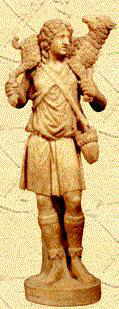
Christ the Good Shepherd, Roman sculpture, 2nd century
Now imagine that same memorial -- the same design, the same high-falutin' inscription, the same appeals to honor and nobility of heart -- dedicated to, say, an unfortunate local pioneer, dying in childbirth, whose lonely sacrifice in a drafty homesteader's cabin in the woods long ago allowed a new generation to carry on. Or a farm worker, body broken by a life of hard physical labor, injury and exposure to toxic chemicals, who nonetheless did what s/he had to do to make sure that his or her kids could grow up in America, and have more of a chance at a decent life than s/he could ever hope for.
Last night I was reading a commentary on the "Good Shepherd" passages of the Gospel of John. The author pointed out that the language and themes used in the text parallel the honors bestowed upon war heroes in Greco-Roman culture; in fact, he suggested that the good in Good Shepherd is perhaps better translated as noble.
In the classical way of thinking, a noble warrior gives his life to save others. A noble warrior owns his own actions; he does what he does of his own volition. A noble warrior honors his family name.
How ironic, then, that in the Gospel of John these images of strength and character and purpose are applied to...a shepherd; among the lowliest of the low in ancient Palestinian society. I once heard that shepherds held such a disreputable place in the Jewish community of old that they were considered ritually unclean; I'm not enough of a scholar to know if that's true, but I will hazard a safe guess that "my son the shepherd" probably didn't earn many bragging points for Jewish mothers down at the community well.
And how doubly ironic that the Noble Shepherd gives his life for...sheep. Sheep are -- how can I put this? -- dumb as a box of rocks. They're pretty helpless; one day as I was driving home from work, as I passed by one of our local petting farms I encountered an unhappily bleating sheep stuck firmly in a barbed-wire fence, like fluff in a lint trap, and I wound up having to call the farmer so he could rescue his animal. Sheep are very vulnerable to predation; even here in a relatively populated area of our county, our local sheep farmers have to contend with both coyotes and neighbors' pet dogs savaging their flocks.
Kind of stupid...easily hurt...easily led into error or misfortune; yup, sounds about right on any given day of my life.
The Gospels are incredibly subversive documents. And what is more subversive than the image of a God who stoops to conquer -- stoops as low as a sheep pen. Who picks up the pieces when the predators attack and the hired hands run away. Who rejects the world's assessment of who is "out" and who is "in," who reserves the right to gather in whomever God wants. Who will go anywhere and do anything to find us and bring us home, and who somehow empowers the "found" flock -- clueless, silly, smelly sheep that we still are -- to assist in this process. And who does all of these things not out of necessity, not out of duty, but out of...love.
The King of Love my Shepherd is. Amen!
Christ the Good Shepherd, Roman sculpture, 2nd century

Thursday, April 14, 2005
My Close Encounter With a Latte of Amish
I'm getting out of work, stopped at the corner by my office, waiting for an Amish buggy to pass so I can make a left-hand turn. I live in an Amish-intensive community, so this is not a particularly unusual occurrence.
As the buggy approaches, I notice that it is filled with pimply, peachfuzz-faced Amish boys, all dressed up in their Sunday-go-to-meetin' clothes. I also notice that they're holding takeout coffees from our local coffeehouse.
As they pass my car, they tip their heads to me, rakish grins on their faces, and lift up their coffee cups.
Good Lutheran that I am, my first thought is, "What does this mean?"
Are they thanking me for not broadsiding their horse? Are they paying homage to my Intrepid? Are they so starved for female attention that they're showing off for...well, for me? What else is in that coffee, anyway?
Being toasted by a buggyful of latte-drinking Amish...even Garrison Keillor couldn't have invented this story. Only in Outer Podunk...
Wednesday, April 13, 2005
Building a Mystery
For any mystery lovers out there looking for books with a strong female protagonist and a clerical twist: My mother and I both enjoy Julia Spencer-Fleming's series featuring the Rev. Claire Fergusson, ex-Marine-turned Episcopal priest who fights crime while serving her parish in the Adirondacks. (Now, stop laughing; because I know you're laughing. You will only be asked to suspend your disbelief for a few pages per book.) The series includes In the Bleak Midwinter; A Fountain Filled With Blood; Out of the Depths I Cry; and, coming in June, To Darkness and To Death.
The Rev. Claire is actually one of the more multidimensional sleuths I have come across in genre fiction; and the author's insights into the inner workings of parish life -- the interpersonal frictions, Vestry Members From Hell, major church controversies played out on the congregational level -- are, as they say, spot on. The Rev. Claire possesses a very real, very thought-out and lived-out Christian faith, which I find refreshing. There is also an ongoing subplot involving the priest and the local sheriff that -- well, I'm not going to spill the beans, but the last novel ended at a critical juncture, and Mom and I are both anxiously awaiting the next book to see how things will shake out.
I think the Rev. Claire is swell. She'd make a great action figure too, with major potential for accessorizing -- her Roman-collared daywear, clerical robes and vestments in appropriate liturgical colors, her old Marine dress uniform, maybe some martial-arts gear. She'd kick Barbie's butt in more ways than one.
Anyhow...check out these books. Good beach reading for the coming summer.
Tuesday, April 12, 2005
Practicing Resurrection
Everyone should have at least one arcane, eccentric interest. Cryptozoology -- the study of unknown animals -- is one of mine. So I've been quite interested in recent reports of thylacine sightings in Tasmania. (Now, there's a sentence that you won't see too many other places.) The thylacine, or Tasmanian tiger, was -- or is -- a doglike carnivorous marsupial that by most accounts was wiped out of existence by Tasmanian farmers in the first part of the 20th century; the last known specimen died in the 1930's.
Yet reports of thylacine sightings have continued -- 4,000 in the last 50 years; some very recently (see link above). Scientists and government officials, typically, tend to be highly skeptical of these reports. (The same dynamic is at work in Michigan, where despite increasing, compelling eyewitness reports of cougars -- which were thought to have gone extinct here in colonial times -- the Department of Natural Resources is loathe to acknowledge their existence. I asked a DNR officer about cougars once, and he became so officious and evasive that I wondered what was so hard about saying, "You know, we don't know if there's really a breeding population or not, but we're keeping an open mind.") If thylacines have managed to escape total annhilation at the hands of human beings, if they've succeeded in quietly keeping on keeping on in the farther reaches of the Tasmanian forest, they are canny beasts indeed.
I am one of the people rooting for the thylacine. For one thing, I'm happy whenever some wonderful, unique example of God's creative process in the world evades total destruction at the hands of human beings. For another -- well, frankly it tickles the hell out of me when experts get it wrong and just-folks get it right. And I just like to celebrate the mystery; I like the idea that we don't understand everything. It keeps us humble.
Accounts of the post-Resurrection Christ remind me a lot of the elusive thylacine. The people who see Jesus are so convinced that they've seen him that they simply can't shut up about it. They can't not say something or do something about it. That's the excitement that gripped the infant Christian community and sent the Gospel message throughout the world. That's the excitement that leads some of us to go on and on about our own varied encounters with the risen Christ. On the other hand, the people who didn't see Jesus then, and who today don't see Jesus...they think we're insane. If they can't literally get their hands on Jesus, if they can't take his photograph, if they can't solve Jesus like an algebraic equation -- then he must not exist, at least in the way that the Church has traditionally understood him to exist.
There is a certain canniness in the risen Lord's brief appearances to his friends that reminds me of the thylacine. Or Wendell Berry's fox, in his poem "The Mad Farmer Liberation Front," who makes more tracks than necessary/some in the wrong direction./Practice resurrection. I think that is why, when the living Christ chooses to make himself known to us, in any way he has, or does, or will, it is such a gift. And why, when he does, we can't help but tell others. He's risen! Risen indeed!

Yet reports of thylacine sightings have continued -- 4,000 in the last 50 years; some very recently (see link above). Scientists and government officials, typically, tend to be highly skeptical of these reports. (The same dynamic is at work in Michigan, where despite increasing, compelling eyewitness reports of cougars -- which were thought to have gone extinct here in colonial times -- the Department of Natural Resources is loathe to acknowledge their existence. I asked a DNR officer about cougars once, and he became so officious and evasive that I wondered what was so hard about saying, "You know, we don't know if there's really a breeding population or not, but we're keeping an open mind.") If thylacines have managed to escape total annhilation at the hands of human beings, if they've succeeded in quietly keeping on keeping on in the farther reaches of the Tasmanian forest, they are canny beasts indeed.
I am one of the people rooting for the thylacine. For one thing, I'm happy whenever some wonderful, unique example of God's creative process in the world evades total destruction at the hands of human beings. For another -- well, frankly it tickles the hell out of me when experts get it wrong and just-folks get it right. And I just like to celebrate the mystery; I like the idea that we don't understand everything. It keeps us humble.
Accounts of the post-Resurrection Christ remind me a lot of the elusive thylacine. The people who see Jesus are so convinced that they've seen him that they simply can't shut up about it. They can't not say something or do something about it. That's the excitement that gripped the infant Christian community and sent the Gospel message throughout the world. That's the excitement that leads some of us to go on and on about our own varied encounters with the risen Christ. On the other hand, the people who didn't see Jesus then, and who today don't see Jesus...they think we're insane. If they can't literally get their hands on Jesus, if they can't take his photograph, if they can't solve Jesus like an algebraic equation -- then he must not exist, at least in the way that the Church has traditionally understood him to exist.
There is a certain canniness in the risen Lord's brief appearances to his friends that reminds me of the thylacine. Or Wendell Berry's fox, in his poem "The Mad Farmer Liberation Front," who makes more tracks than necessary/some in the wrong direction./Practice resurrection. I think that is why, when the living Christ chooses to make himself known to us, in any way he has, or does, or will, it is such a gift. And why, when he does, we can't help but tell others. He's risen! Risen indeed!

Monday, April 11, 2005
Greetings From Podunk
You thought I was joking when I said that I live in Outer Podunk. Au contraire. There really is -- or was -- a Podunk, Michigan. This is the old Podunk School, the last intact building. Once upon a time Podunk also had a Free Methodist church and a dancehall. The dancehall was quite the hot time in the old town, I've been told -- a 35-cent cover charge; hamburgers for a dime; BYOB moonshine; knife fights; the occasional airborne body flung out the door. As you can see from this photo, the neighborhood has calmed down quite a bit.


Sunday, April 10, 2005
Guess Who's Coming To Dinner
I have to admit that I'm posting this mostly because I like the Velasquez painting below, "Kitchen Maid With the Supper at Emmaus." Check out that priceless expression: "Whoa...something really big is happening in there..."
But I also wanted to share something our pastor noted this morning in his sermon. When does Jesus tend to show up in these post-Resurrection visits to his friends? When the chips are down; when they're disheartened; when things have fallen completely apart. And he shows up in the context of community.
Our pastor talked about The Troubles in the ELCA and elsewhere in Christendom...about the radical reshaping of our economy and social safety net that's destroying any sense of security in the lives of many...the "powers and principalities" of consumerism and pop culture that continually bombard us with messages that we are not good enough and keep us in a constant state of dissatisfaction and anxiety. The world's message to us is -- You may run, you may hide, but eventually we are going to break you.
But the good news is...that's the point when Jesus comes around. And Jesus comes around when we get together as the people of God...in church this morning...next weekend when our church's confirmation class graduates plan to prepare and host a special evening supper and "welcome to confirmation class" party for the younger kids in our congregation...when we invite a friend to lunch...when we help someone out...and -- I'm absolutely convinced of this -- when we scattered pilgrims connect via the Internet and create community. Thanks be to God for the victorious Christ who always -- always -- comes to dinner, and to anywhere else where the people of God get together.

But I also wanted to share something our pastor noted this morning in his sermon. When does Jesus tend to show up in these post-Resurrection visits to his friends? When the chips are down; when they're disheartened; when things have fallen completely apart. And he shows up in the context of community.
Our pastor talked about The Troubles in the ELCA and elsewhere in Christendom...about the radical reshaping of our economy and social safety net that's destroying any sense of security in the lives of many...the "powers and principalities" of consumerism and pop culture that continually bombard us with messages that we are not good enough and keep us in a constant state of dissatisfaction and anxiety. The world's message to us is -- You may run, you may hide, but eventually we are going to break you.
But the good news is...that's the point when Jesus comes around. And Jesus comes around when we get together as the people of God...in church this morning...next weekend when our church's confirmation class graduates plan to prepare and host a special evening supper and "welcome to confirmation class" party for the younger kids in our congregation...when we invite a friend to lunch...when we help someone out...and -- I'm absolutely convinced of this -- when we scattered pilgrims connect via the Internet and create community. Thanks be to God for the victorious Christ who always -- always -- comes to dinner, and to anywhere else where the people of God get together.

As We Believe, So We Live...?
Melancthon, one of my favorite LutheranDudes in blogdom, recently wrote an excellent meditation on "Theology and Its Consequences" over at Melancthon Sins Boldly . Here's part of what he has to say:
If we imagine that the lost deserve God's wrath and receive it by God's choice, it's easier for us to justify our lack of compassion for the socially and economically disadvantaged, especially when they live in non-Christian parts of the world. God, by grace, will lift some out of their plight. The rest receive what they deserve.
But if instead our image of God is of one who cares obsessively for the lost, who would do anything for them, then surely we must be called to a different sort of action. What limit can there then be to what we must do to help our neighbor (in the universal sense) in need?
How do we reflect the love of a God who is madly in love with us? Do we?
Friday, April 08, 2005
Seeing Jesus
This coming Sunday's Gospel lesson hit home for me this morning in a rather amusing way -- not particularly surprising, if you know me, but amusing nonetheless.
I left the house for work in my usual state of rushed disarray, compounded by taking in the last half hour of the papal funeral, preoccupation with my cranky octogenarian mama and the bleariness of sleep deprivation. (I’m still looking for that hour I lost on Sunday; and my dog, for reasons known only to himself, has decided that 4:00 a.m. is now time for breakfast.) Forty-five miles later, as I was getting out of the car, I noticed that my pants were not the color that they should have been. They were navy blue. They were supposed to be black, to match the black-and-tan rest of me. The pants I thought I was reaching for this morning were still on their hanger, a county away. So today I've been a big ol’ Fashion Don’t; I look like a walking bruise.
Sometimes we just don’t see things. Because we’re not paying attention. Because we’re tired or sad or mad or multitasking or woolgathering.
I’ve done this to people too. I’ll be in the supermarket, in hyperactive mode, running around to grab some forgotten grocery…and I’ll walk right past someone I know. I just don’t see them. (Fortunately most of my friends and coworkers are used to my overcaffeinated personality, and cut me some slack.)
I love the Emmaus story. I love Jesus’ mischievous interaction with his disheartened friends: “Things happening in Jerusalem? Oh, really? What things?” I love the way he explains the story to them again, and how it still doesn’t click for them; it makes you wonder what they were thinking as they were listening to this articulate stranger doing theology as they walked along. I love the way Jesus pretends to want to keep going on down the road, and how his traveling companions urge him to stay and eat with them instead. (They at least got the table fellowship part right.) And, most of all, I love that “aha” moment when they finally see Jesus for who he really is. I’d call that the biggest surprise party of them all.
Elsewhere in the Gospels we read of Jesus encountering a blind man, asking him, “What do you want me to do for you?” and the man earnestly responding, “Lord, I want to see.”
Lord, I want to see. I want to see you. I want to see you when I’m so sad that it seems impossible to see you anywhere. I want to see you when I’m so happy that I’m in danger of floating off into the ether and forgetting you. I want to see you when I am so appalled at my own behavior and thoughts that I'm afraid to look up. I want to see you in my sisters and brothers in Christ, even when they mess up. I want to see you in the poor, the sick, the disenfranchised, the marginalized…and I also want to see you in people who make me uncomfortable and angry -- people in whom, deep down, I really don't want to see you. I want to see you in the world that surrounds me – the world that Scripture tells us came to be in you and through you and for you.
Lord, help me see you.
Les pelerins d'Emmaus by Corinne Vonaesch

I left the house for work in my usual state of rushed disarray, compounded by taking in the last half hour of the papal funeral, preoccupation with my cranky octogenarian mama and the bleariness of sleep deprivation. (I’m still looking for that hour I lost on Sunday; and my dog, for reasons known only to himself, has decided that 4:00 a.m. is now time for breakfast.) Forty-five miles later, as I was getting out of the car, I noticed that my pants were not the color that they should have been. They were navy blue. They were supposed to be black, to match the black-and-tan rest of me. The pants I thought I was reaching for this morning were still on their hanger, a county away. So today I've been a big ol’ Fashion Don’t; I look like a walking bruise.
Sometimes we just don’t see things. Because we’re not paying attention. Because we’re tired or sad or mad or multitasking or woolgathering.
I’ve done this to people too. I’ll be in the supermarket, in hyperactive mode, running around to grab some forgotten grocery…and I’ll walk right past someone I know. I just don’t see them. (Fortunately most of my friends and coworkers are used to my overcaffeinated personality, and cut me some slack.)
I love the Emmaus story. I love Jesus’ mischievous interaction with his disheartened friends: “Things happening in Jerusalem? Oh, really? What things?” I love the way he explains the story to them again, and how it still doesn’t click for them; it makes you wonder what they were thinking as they were listening to this articulate stranger doing theology as they walked along. I love the way Jesus pretends to want to keep going on down the road, and how his traveling companions urge him to stay and eat with them instead. (They at least got the table fellowship part right.) And, most of all, I love that “aha” moment when they finally see Jesus for who he really is. I’d call that the biggest surprise party of them all.
Elsewhere in the Gospels we read of Jesus encountering a blind man, asking him, “What do you want me to do for you?” and the man earnestly responding, “Lord, I want to see.”
Lord, I want to see. I want to see you. I want to see you when I’m so sad that it seems impossible to see you anywhere. I want to see you when I’m so happy that I’m in danger of floating off into the ether and forgetting you. I want to see you when I am so appalled at my own behavior and thoughts that I'm afraid to look up. I want to see you in my sisters and brothers in Christ, even when they mess up. I want to see you in the poor, the sick, the disenfranchised, the marginalized…and I also want to see you in people who make me uncomfortable and angry -- people in whom, deep down, I really don't want to see you. I want to see you in the world that surrounds me – the world that Scripture tells us came to be in you and through you and for you.
Lord, help me see you.
Les pelerins d'Emmaus by Corinne Vonaesch

Wednesday, April 06, 2005
"That They May All Be One"
I ask not only on behalf of these, but also on behalf of those who will believe in me through their word, that they may all be one. As you Father, are in me and I am in you, may they also be in us, so that the world may believe that you have sent me. -- John 17:20-21
For anyone who listened to Jesus' High Priestly Prayer during the readings of Holy Week, or read today's Gospel lesson, and sighed, "Yeah...that'll happen" -- a few recent breakings-through of the reign of God here in Lutherland and elsewhere to cheer you up:
Lutherans and Eastern Orthodox finding common ground: A book causing a big buzz in Lutheran circles these days is Christ Present in Faith: Luther's View of Justification by Finnish theologian Tuomo Mannermaa. Mannermaa's thesis is that Luther's view of justification by faith can be harmonized with the Orthodox concept of theosis, or divinization -- the idea that Christians, achieving union with the person of Christ, participate in the fullness of the life of God, becoming actual partakers of the divine nature, rather than simply having grace imputed to them. (LutheranChik feels as if she's writing a term paper; her palms are becoming moist as she wonders if she actually wrote what she meant, and if what she meant was actually what Mannermaa says in his book; it ain't exactly "Justification for Dummies.") Now, this may sound like the sort of theology-geek, angels-dancing-on-heads-of-pins stuff that drives average laypeople into the arms of the nearest happy-clappy megachurch...but it's a huge concept. For one thing, it provides new talking points in our ecumenical relations, especially with Eastern Orthodoxy, which I think has been something of a terra incognita for most Lutherans. Mannermaa is also helping reclaim the inherent mysticism of Lutheran Christianity, which has taken a beating over the decades both from what some might characterize as the soulless deconstructionism of the academy and insipid populist piety, and that has the potential to reconnect us with the mystical tradition of the historic Church. And Mannermaa's book may help our tradition strengthen what I think is its weakest theological link -- the connection between justification and sanctification, between "saved" and "saved for what?" Lutherans have historically had, because of our emphasis on grace and rejection of anything that might even suggest trying to earn our way into God's favor, a hard time articulating the transformative nature of the Christian experience...even though Luther himself wrote quite emphatically on this subject. Mannermaa will help give us, I think, another new voice with which to express the concept that, as Kelly Fryer puts it, "Love changes people." Melancthon Sins Boldly and The Thinklings have both featured thoughtful posts on this book in recent weeks.
Lutherans, Episcopalians and Catholics getting together. A bit closer to Outer Podunk, where I live: in one of the communities here in the middle of the Michigan mitten, the local ELCA, ECUSA and Catholic parishes have enjoyed very cordial relations for several years, doing everything from pulpit exchanges and joint worship services to interparish fellowship activities and educational opportunities. This past Reformation Sunday, they held a Service of Reconciliation in which the clergyperson of each parish read a confession asking forgiveness for the various ways in which his or her tradition had hurt people in the other traditions; I'm told it was a very powerful, moving event. A few weeks ago, the three parishes entered into a formal covenanted relationship with one another, saying in effect, "No matter what happens in any of our denominations, this is how we want to continue to relate to one another as sisters and brothers in Christ." You can read all about it at http://www.gladwinmi.com/placed/story/04-05-2005covenant.html In these days of fractious relations even within our three traditions, this example of three congregations embracing their catholicity in embracing one another is good news.
Lutherans and Methodists getting together. I Am a Christian Too reports that the ELCA and the United Methodist Church may soon enter into "interim Eucharistic sharing." This is something of a moot point, since both our denominations practice open Communion now, but it would formalize ELCA and UMC congregations' holding joint Eucharistic worship.
Lutherans engaging the "emergent church." Xphiles has an interesting discussion going on about the "emergent church," what Lutherans can learn from it and what it can learn from us.
Meanwhile, this week two more of my favorite blogs, Father Jake and The Topmost Apple , feature some thoughtful ponderings on what this is all about anyway...love.
Is it just me, or...is dis a movement?
I Want To Hold Your Hand
I was talking to a friend yesterday about Henri Nouwen; which got me to thinking about Nouwen's classic book about love and service, The Wounded Healer; which got me to thinking about an experience I had in church on Easter Sunday.
But first of all I have to tell you about my birthmark.
I have a vascular birthmark that covers half of my right hand. It's not a big deal...oh, it was a big deal when I was a newborn and my hand was swollen into a huge, angry-red balloon; and when I was in elementary school I remember being extremely self-conscious about my birthmark, praying to God to heal it. Now it's not all that noticeable unless you're up close and personal, and apart from a slightly decreased range of motion in my little fingers -- not even enough to slow down my keyboarding -- it doesn't give me a problem. Frankly, it wouldn't be on my short list of personal extreme makeover projects.
After I was born my maternal grandmother had told my mother that I'd been specially marked by God; while that statement I'm sure had more to do with maternal psychology than theology, in the long run I believe my birthmark really has been a kind of gift. I think it helped me develop a sense of empathy for "different" people at an early age. I think over the years it's been an effective jerk detector; I find that people who can handle my birthmark tend to be good friend material, while people who can't handle it tend to have a skin-deep mentality in other areas of life as well. My birthmark is even a good conversation starter (really); healthcare professionals especially are fascinated by my hand.
But I don't think about it too much. And I wasn't thinking about it at all on Easter Sunday, sitting near the aisle in one of the front pews, waiting to assist with the Eucharist. Next to me were a young family who've been coming to our church for a few months now; they have a couple of charmingly irrepressible little girls who are just a hoot, often doing extemporaneous junior theology with our pastor during the service. (And they're good at it; they get it.)
The point came in the service where we share the peace of Christ with one another. I automatically held out my hand to the dad, who was sitting next to me; he held out his hand, then paused, looking down. Uh-oh, I thought, suddenly recalling this scenario being played out countless times throughout my life; he has a thing about shaking my hand.
I followed my eyes down to my hand and his hand, poised in mid-air.
His hand was missing several fingers.
We glanced up again; our eyes met, just for a moment.
We shook hands, strongly.
I think this might be what they mean by "being the Church."
Tuesday, April 05, 2005
More Irrational Exuberance
O gracious light,
pure brightness of the everliving Father in heaven,
O Jesus Christ, holy and blessed!
Now as we come to the setting of the sun,
and our eyes behold the vesper light,
we sing your praises, O God: Father, Son, and Holy Spirit.
You are worthy at all times to be praised by happy voices,
O Son of God, O Giver of Life,
and to be glorified through all the worlds.
A glorious day here in Outer Podunk -- sunshine and 60 degrees; windbreaker weather. Oh, it wasn't all smiles and sunbeams. The drainage hose of our flowing well became blocked and the water backed up, spurting out of the wellhead and dribbling into our basement; but the well guys are working on it; it could be worse. (Like last winter, when the corroded main pipe sprung a major leak and I woke up one morning to find most of the basement ankle-deep in water.)
I went for a walk around the neighborhood tonight after work. Physical self-improvement is generally not a goal of Lenten discipline, but one of the lessons I came away with this year was a sense that I should not squander the good gift of life. (And, truth be told, I had a couple of Gregor Samsa moments staring at myself in the bathroom mirror...now, if this were the Paleolithic Age I'd be a babe, but we have to keep up with the times, and the Venus of Willendorf look is just so yesterday.) After several weeks of schlepping my avoirdupois up and down the stairs of our building at work, or around and around the basketball court down at the civic arena (scary flashbacks of junior high gym class strobing in my brain), it was wonderful to actually be able to walk outdoors in the fresh air, enjoying the springtime songbirds and newly budded pussy willows and indulging in a little nosy-neighbor rubbernecking.
I live on a lake, which is still partially frozen over, so every once in awhile I enjoyed a refreshing breeze coming off the receding ice as I made my way down our road and up a long, paved cul-de-sac. The open, backwater part of the lake was filled with Canada geese and passing migrants like buffleheads, little butterball-shaped black-and-white ducks that pop up and down like manic bobbers in the water, and sleek mergansers with rakish iridescent crests. I even saw a lone mute swan, enormous next to the other birds, floating like an elegant white sailboat in their midst.
Sometimes I have equivocal feelings, to say the least, about this midlife sojourn in my hometown. But -- it could be worse. And this evening, enjoying the "vesper light," it was a pretty good place to be.
Sunday, April 03, 2005
Orans
I should subtitle this post "The Week That Should Have Sucked, But Didn't."
My mother's trip to the neurologist to check out hand numbness following her wrist fracture didn't result in the sort of conclusive diagnosis and course of treatment we were hoping for...leaving her frustrated and impatient.
I found out that the Bush administration is proposing cuts in social programs for the next fiscal year that could well make my job redundant by October. And in the meantime I am going to have to spend more of my work time fundraising, just to add an extra unpleasant dimension to my walk down the plank.
Every time I listen to or read the news, the litany of geopolitical mess is like another punch in the gut. "How long, o Lord, how long?"
I watched, with the rest of the world, two slow, sad, complicated public deaths.
I continued to put up with a couple of relatively silly but persistent internal melodramas that tend to generate low-grade verklemptitude in my life.
Despite all of this, I'm -- how can I put this? -- happy. Today the old Shaker hymn, "How Can I Keep From Singing?" kept running through my mind. I was even singing the liturgy, which we don't actually do much of in our church, in the car today, on the way to Sunday dinner: Word of Life, Jesus Christ, all glory to you...our hearts burn within us while you open to us the Scriptures...Word of Life, Jesus Christ, all praise to you. (My mother giving me a quizzical look suggesting, "How much wine did you drink this morning?..." Or maybe, "Turn up Ira Glass before you break a window.")
Maybe this is sort of a delayed reaction to Easter...I tend to be slow on the uptake anyway. But I think it was also part of our Gospel text this morning: The risen Jesus visiting the frightened disciples and telling them, not once but twice, "Peace be with you." Now, The CEO and I generally have a droll, ironic sort of relationship (which, I'm learning, is entirely consistent with the inherent irony and playfulness of the Torah texts...so I'm really not just making this stuff up)...but every once in awhile, when I really need to be remedially brothered, he shows up and does that for me. (The CEO also notes that at other times I need to be remedially bothered, and he's quite happy to do that for me too.) I've felt very brothered today. That's been a gift.
All of which brings me to the title of my post. I never used to pay a great deal of attention to prayer posture, but I am finding that there are times when the orans position, hands raised, is the way I want to do it. (Even though any time now I expect the ELCA to come and pull my union card.) Tonight's one of those times. It's been a good day, one filled with the peace that passeth understanding.
Let my prayer rise before you as incense;
The lifting up of my hands as the evening sacrifice.
Friday, April 01, 2005
The Christ Who Comes Back
This Sunday most of us liturgical types will be listening to the Gospel of John, the 20th chapter, where "doubting Thomas" encounters the risen Christ. As Sarah Dylan Breuer notes in her lectionary blog (see link above), Thomas tends to get a bad rap in sermons; and I remember, back in my childhood, hearing numerous post-Easter sermons smugly contrasting Thomas' unbelief with our own superior faith. But let's take a more careful look at Thomas.
Thomas is a Realpolitik, just-give-me-the-facts kind of guy; and he's got heart. When Jesus makes it clear that he's headed for Jerusalem and big trouble, it's Thomas who says, "Hey -- we may as well follow so we can all die together." Later, during Jesus' farewell discourse, when Thomas doesn't get something Jesus says, he asks for clarification; he doesn't just sit there nodding and smiling sans clue the way that some of us (well...me) might. Now, as the other disciples are cowered in their locked room, Thomas is the one who ventures outside. And when his friends tell him about their amazing interaction with the risen Lord, Thomas -- characteristically -- says, "Wait a minute. I have to see this myself. I have to touch him myself."
And -- this is so Jesus -- Jesus comes back for Thomas. And when he does come back, he doesn't punish Thomas for needing the reassurance of sight and touch; Jesus doesn't smack Thomas upside the head or yell at him or de-commission him as an apostle. Moreover, when Jesus tells him, "Blessed are those who have not seen and yet have come to believe," Jesus is not making a negative contrast; instead, he's pointing the way to the future, where Thomas' (and the other disciples', and our) witness to the reality of Christ will continue to gather others in to the family of God, to make the peace and joy of Christ real for more and more people.
At the risk of exceeding the Lutheran load limit for spiritual self-disclosure on this blog -- once upon a time, not all that many years ago, Jesus came back for me. Unlike Thomas, I wasn't even all that keen on the reunion, because it meant admitting I had completely screwed up my life. But Jesus came back anyway. And he keeps coming back -- every week when I hear the Word and receive the Sacrament; every time I pray, or just sit and wait for him to show up; every time I talk to a friend who's "seen the Lord" too, and is trying to be Jesus for me; every time I'm out there trying to be Jesus for someone else. The Good Shepherd is like the bad penny; always turning up. Thanks be to God for the One who always comes back -- for you, for me, for all of us. And that is good news indeed.
Artwork by Hanna Cheriyan Varghese

Thomas is a Realpolitik, just-give-me-the-facts kind of guy; and he's got heart. When Jesus makes it clear that he's headed for Jerusalem and big trouble, it's Thomas who says, "Hey -- we may as well follow so we can all die together." Later, during Jesus' farewell discourse, when Thomas doesn't get something Jesus says, he asks for clarification; he doesn't just sit there nodding and smiling sans clue the way that some of us (well...me) might. Now, as the other disciples are cowered in their locked room, Thomas is the one who ventures outside. And when his friends tell him about their amazing interaction with the risen Lord, Thomas -- characteristically -- says, "Wait a minute. I have to see this myself. I have to touch him myself."
And -- this is so Jesus -- Jesus comes back for Thomas. And when he does come back, he doesn't punish Thomas for needing the reassurance of sight and touch; Jesus doesn't smack Thomas upside the head or yell at him or de-commission him as an apostle. Moreover, when Jesus tells him, "Blessed are those who have not seen and yet have come to believe," Jesus is not making a negative contrast; instead, he's pointing the way to the future, where Thomas' (and the other disciples', and our) witness to the reality of Christ will continue to gather others in to the family of God, to make the peace and joy of Christ real for more and more people.
At the risk of exceeding the Lutheran load limit for spiritual self-disclosure on this blog -- once upon a time, not all that many years ago, Jesus came back for me. Unlike Thomas, I wasn't even all that keen on the reunion, because it meant admitting I had completely screwed up my life. But Jesus came back anyway. And he keeps coming back -- every week when I hear the Word and receive the Sacrament; every time I pray, or just sit and wait for him to show up; every time I talk to a friend who's "seen the Lord" too, and is trying to be Jesus for me; every time I'm out there trying to be Jesus for someone else. The Good Shepherd is like the bad penny; always turning up. Thanks be to God for the One who always comes back -- for you, for me, for all of us. And that is good news indeed.
Artwork by Hanna Cheriyan Varghese

A Confession
I have a confession to make.
I am not the person you think I am.
Who I am, really: I am an ex-Lutheran, fundamentalist housewife in the Milwaukee suburbs, homeschooling my five children and submitting graciously unto my husband. I play tambourine in my church praise band. My favorite things are Christian radio, "The 700 Club," NASCAR and our godly President. I have a secret crush on Alan Jackson, although I am trying to repent of this, the way I repented after sneaking to the beauty parlor once without my hubby's permission and having my hair cut in an unwomanly way, contrary to Scripture, because I was tired of the split ends. (Now I wear a headscarf as a sign of my female subjection, which also solves that problem. And my husband locks me in the house during the day, for my own good.) No "L"-words here, nosiree; just lady.
And yet...this blog has been an unfortunate, misguided attempt on my part to add some excitement to my sheltered life by pretending to "walk on the wild side." I am a deceitful evildoer, full of unclean thoughts, and I know I should be publicly stoned, then fed in pieces, like Alpo, to roving packs of dogs. I repent, again, in sackcloth and ashes.
APRIL FOOL!
Anyhow, for a chuckle today read the latest issue of Ship of Fools .
Thursday, March 31, 2005
LutheranShiksa Studies Torah (and Makes Soup)
I'm just beginning my online class on "Torah, Talmud and Mishnah"...mastering the challenge of reading the Tanakh, even an English translation, from right to left, and learning about the Oral Torah, the body of laws and commentaries used in concert with the Tanakh. Among other things, it enhances my appreciation of Jesus' essential Jewishness -- the way he tells stories, the way he explains himself. Read this rabbinical parable:
B. Seder Eliyahu Zuta 2:
[A heretic asserted that] Scripture was given to us from Sinai, but not Mishnah. [Elijah answered him thus:] My son, were not both Scripture and Mishnah given by the Almighty? Does the fact that they are different from each other mean that both cannot have been given by Him? By what parable may the question be elucidated? By the one of a mortal king who had two servants, whom he loved with perfect love. To one he gave a measure of wheat, and to the other a measure of wheat; to one a bundle of flax, and to the other a bundle of flax. What did the clever one of the two do? He took the flax and wove it into a napkin. He took the wheat and made it into fine flour by sifting the grain and grinding it. Then he kneaded the dough and baked it, set the loaf of bread on the table, spread the napkin over the bread, and left it to await the coming of the king.
But the foolish one did not do anything at all.
After a while the king came into his house and said to the two servants: My sons, bring me what I gave you. One brought out the table with the loaf of bread baked of fine flour on it, with the napkin spread over the bread. The other brought out his wheat in a basket with a bundle of flax over the wheat grains.
What a shame! What a disgrace!
So, too, when the Holy One gave the Torah to Israel, He gave it as wheat to be turned into fine flour and as flax to be turned into cloth for garments.
This is great stuff; I'm looking forward to digging deeper in the weeks to come.
Perhaps it is no coincidence that, as I am writing this, a huge pot of chicken soup is simmering in the kitchen. Here is my recipe (I don't measure, so you're on your own; relax, don't stress, taste as you go, it'll be fine): I take meaty chicken parts; chicken broth; a few peppercorns; salt; chopped onion, a generous amount of garlic, celery, carrot and maybe some other root veggies like parsnips and turnips to make things a little more interesting. I put all this in a pot, top it off with water, bring it to a boil, turn down the heat and simmer it until the chicken is cooked through. I add a generous amount of dillweed (fresh if you can get it, which -- alas -- one cannot here in Outer Podunk) and a generous handful of parsley toward the end of the cooking. If you want chicken and rice soup, that's the time to add some rice. Or you can pour the soup over cooked noodles of your choice. Tonight I'm making spaetzle -- the little freeform dumplings -- and dropping them in the simmering soup.
This soup will cure most things that ail you, and it will also make your house smell wonderful. So make it already -- you look thin. Mazel tov!
Wednesday, March 30, 2005
Meet a Few Other LutheranChiks
The flowers appear on the earth; the time of singing has come, and the voice of the Peep is heard in our land.


Monday, March 28, 2005
Going Back For Mary
I enjoyed playing hooky from work today to take my mother to an out-of-town doctor's appointment (a statement indicating how boring life really is here in Outer Podunk). In addition to a pleasant road trip during which we saw a real live bluebird perched on a wire -- LutheranChik the birder became all excited and almost missed a turn -- I also got to read, while sitting in the waiting room, a recent issue of Time magazine whose cover article, "Hail, Mary," was all about Protestants' increasing appreciation of the Virgin Mary. Feminism, liberation theology, the ecumenical movement -- all have made Protestants more comfortable thinking and talking about Jesus' mother and the role she played in Scripture and in the collective mind of the early Church. It was interesting to me that two theologians in my own tradition, Robert Jenson and Carl Braaten, are in the vanguard of the "going back for Mary" movement. I also enjoyed a quote by the Rev. Peter Gomes, who tells a joke about a Protestant theologian who dies, goes to heaven and is being introduced all around by Jesus, who says, "Now, I know you know my Father, but I don't think you've met my Mother yet."
I am still trying to decide how the BVM fits into my own personal spirituality. For me she's not an end run around Christian patriarchy, because I have no problem at all integrating the feminine face of God into Christianity. I have certainly experienced a Mothering as well as Fathering God; I once compared my initially reluctant return to the Christian fold to an exhausted, red-faced, post-tantrum toddler still gasping teary protestations while Mom patiently carries her out of the supermarket and takes her home. And -- I think this may be a mortal sin in some circles -- sometimes the Holy Spirit reminds me of one of my college roommates, an alarmingly hyper, perpetually positive Irish gal a la Mary Catherine Gallagher on SNL, who was always either encouraging the downhearted or persistently nudging us toward greatness: "Go for it! You can do it! I know you can! Try it! Did you try it? Go ahead! Come on! Hey -- I have an idea!..." And, as constant readers may have noticed here, outside my formal prayer and worship time I have what some might consider a frighteningly familiar relational style with all three Persons of the Trinity.
But the Mary the Mother of Jesus...even though I see her not as some ethereal young thing but rather an earthy, tough-minded, right-on woman, for some reason she makes me feel -- how can I describe this? -- shy; I want to keep my gaze directed down at my shoes while I dig the toes nervously into the dirt, mumbling, "Yes, ma'am." I'm not sure what that's all about. But I think I'd like to get to know her better. After all, her kid's my Boss.
Sunday, March 27, 2005
"Don't cling to me as if you're going to lose me again..." Doesn't that translation of Jesus' curious "noli me tangere" comment make much more sense than the quasi-Gnostic ("Don't defile me with your corrupt human flesh!") or misogynistic ("Ooooh...girl germs!") spins sometimes given to the text in John's Gospel? I think so. And...by the way...isn't this an awesome William Morris stained glass window?
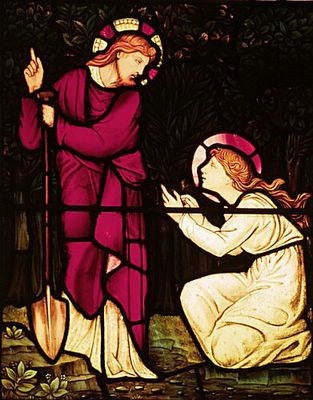

He is Risen -- He is Risen Indeed!
Seven Stanzas at Easter
by John Updike
Make no mistake: If he rose at all
it was as His body;
if the cells' dissolution did not reverse, the molecules
reknit, the amino acids rekindle,
the Church will fall.
It was not as the flowers,
each soft Spring recurrent;
it was not as his Spirit in the mouths and fuddled
eyes of his eleven apostles;
it was as His flesh: ours.
The same hinged thumbs and toes,
the same valved heart
that -- pierced -- died, withered, paused, and then
regathered out of enduring Might
new strength to enclose.
Let us not mock God with metaphor,
analogy, sidestepping, transcendence;
making of the event a parable, a sign painted in the
faded credulity of earlier ages:
let us walk through the door.
Artwork: "Easter Morning" by He Qi

Friday, March 25, 2005
Nailed It
Back when I began this blog, around the start of Lent, I described how at our church we'd been encouraged to take a nail and keep it with us for the duration of that season, living our personal failings and burdens into it. On Good Friday, we could bring back our nails and pound them into a piece of wood, symbolically nailing our pain to the cross. I said that I was going to carry my nail on behalf of all the people who, for whatever reason, don't feel they have a home in the Church.
Well, tonight, at our Tenebrae service, we pounded those nails into a rough-hewn cross at the front of the sanctuary. It wasn't a sorrowful ritual; as our pastor noted of the entire evening, "This isn't a funeral for Jesus," and there was a palpable feeling of relief and gratitude.
Somehow -- not quite sure of the logistics -- this beam is going to be incorporated into our new building addition. I love that idea -- that all the physical and other pain, all the oppression, all the trouble that we've been carrying with us, is going to be transformed into "a new thing."
Behold the Bridegroom
But at midnight there was a shout, "Look! Here is the bridegroom! Come out to meet him." -- Matthew 25:6
This is an icon of Christ as Nymphios, The Bridegroom of the soul and of the whole people of God. The irony of the Christian story is that the Bridegroom makes his trip down the aisle to meet us beaten and bloody; says his "I do" as he's being nailed to a cross. If you look at his hands here, you'll see that they're bound loosely; his suffering with us and for us is voluntary, entered into out of love...not some sort of high-minded, ethereal love, but a passionate love that will go anywhere and do anything for us.
Writes Mother Teresa, in the voice of Christ:
I thirst for you. Yes, that is the only way to even begin to describe my love for you: I thirst for you. I thirst to love and be loved by you -- that is how precious you are to me. I thirst for you. Come to me, and fill your heart and heal your wounds.
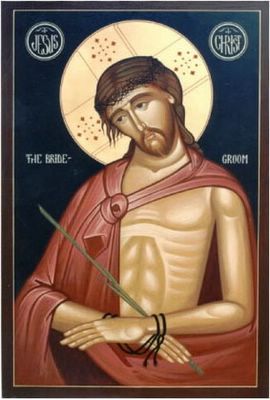
This is an icon of Christ as Nymphios, The Bridegroom of the soul and of the whole people of God. The irony of the Christian story is that the Bridegroom makes his trip down the aisle to meet us beaten and bloody; says his "I do" as he's being nailed to a cross. If you look at his hands here, you'll see that they're bound loosely; his suffering with us and for us is voluntary, entered into out of love...not some sort of high-minded, ethereal love, but a passionate love that will go anywhere and do anything for us.
Writes Mother Teresa, in the voice of Christ:
I thirst for you. Yes, that is the only way to even begin to describe my love for you: I thirst for you. I thirst to love and be loved by you -- that is how precious you are to me. I thirst for you. Come to me, and fill your heart and heal your wounds.

Thursday, March 24, 2005
Maundy Thursday
I just got back home from church.
On Maundy Thursday, in lieu of the traditional service, at our church we have...a church supper, pretty much like other church fellowship meals, with bread and stew and dessert. But at our church we incorporate John's account of the Last Supper, in word and song, into our meal, and we celebrate the Eucharist as a part of the meal. Our observance also provides "teachable moments" for our pastor to explain the Lutheran understanding of the Eucharist, and to talk about how the way we worship is grounded in Jesus' last hours on this earth with his friends. We've been observing Maundy Thursday this way ever since "we" were "they" to me, which is something like seven years ago. Every year it runs a bit more smoothly; every year we attract more people.
If I had to pick a word that encapsulated the mood of the evening, I'd choose caring. Not in a saccharine, superficial way. Real caring.
Caring when my mother almost tripped down the stairs. Back on Christmas Eve she took a header off a step elsewhere in the church and broke her wrist, an accident that has made her lose confidence in her footing, and even more prone to falling than before. This time, though, she was gripping the railing with her good hand and caught herself. A disabled woman, someone new to me who was standing next to me, approached Mom and haltingly asked, "Are you okay? Are you sure you're okay?" She let us pass her in the line so we could get down the next flight of stairs together.
Caring when members of the worship committee washed our hands and rubbed them with lotion. They do this every year. It's a very moving act. It's ironic, isn't it, that in our culture the people we entrust to bathe us and otherwise attend to our intimate needs are usually at the very bottom of the socioeconomic scale. Not too long ago I was reading a book about caregiving in which a nurse talked about how important it was to her personally to do her job in a way that minimized the shame that dependent people often feel about having to rely on others for the most basic of care; that she felt this was a part of her caring vocation. I thought about that, having my hands washed for me. I also smiled to myself, remembering my dream this morning; sometimes it's nice to just have someone touch your hands.
Caring when we served one another at table. Because my mother is so frail, because she's hard of hearing and because she can get anxious and confused in out-of-the-ordinary events like this, I find myself always on guard, watching to see if she's okay, if she needs help or prompting. And -- I'm ashamed to say this -- sometimes I feel resentful having to do this, especially in a worship setting. I think, "I wish I could just lose myself in this moment, instead of having to divide my attention." Tonight, though, looking around...I saw so many people who are also taking care of parents or grandparents or kids. In one of our church families, every member carries the burden of a different medical condition; they all have to take turns being "the strong one" for one another. Sometimes we church people make "servanthood" sound like some sort of special ascetic practice, when for most of us at some point in our lives it's just what we do; it's the attitudinal aspect that needs work, not the work itself.
Caring when we shared the peace. I had been concerned about the disabled woman we'd met on the stair landing, because I couldn't figure out who'd brought her to church, and I wanted to make sure she was sitting next to someone who would look out for her. (I think one of the silver linings of always feeling different from the norm is that we different folks tend to look out for one another.) But the woman wound up at the same table as our pastor and his wife; a good place to be. When it came time to share the peace of Christ, she got up and made a beeline for our table, where for reasons I'm not quite sure -- maybe because I had said, "Thank you," and meant it, when she'd been concerned about my mom -- she threw her arms around me: "The peace of Christ be with you!" she exclaimed with a big grin. I responded, "You know, I am so glad that you're with us tonight. Is this your first time at our church?" "Oh, yes," she responded, beaming, "and it's wonderful."
Caring when our pastor read Jesus' High Priestly Prayer from the Gospel of John, where he prays for his friends -- for all of us, at all times and in all places:
I ask not only on behalf of these, but also on behalf of those who will believe in me through their word, that they may all be one. As you, Father, are in me and I am in you, may they also be in us, so that the world may believe that you have sent me. The glory that you have given me I have given them, so that they may be one, as we are one, I in them and you in me, that they may become completely one, so that the world may know that you have sent me and have loved them even as you have loved me. Father, I desire that those also, whom you have given me, may be with me where I am, to see my glory, which you have given me because you loved me before the foundation of the world. Righteous Father, the world does not know you, but I know you; and these know that you have sent me. I made your name known to them, and I will make it known, so that the love with which you have loved me may be in them, and I in them.
Now the irony of the evening: The Jesus who prays this prayer for all of us, who has moved us all, for all our various reasons, to come together in our little parish week after week in his name, to care about him and what he has to say, and to care for others on his behalf, comes to the point in his life where the caring seems to disappear -- where his anguished prayers to be spared are not answered; where his friends won't stay awake with him in his distress; where they all run away, and leave him to his fate.
A Little Comic Relief
Our eyes have met
Our lips, not yet
But -- oh, you kid! -- I'll get you yet!
This post has nothing to do with Maundy Thursday, or with the Triduum in general, or with theological profundity of any kind. (If you can find theological profundity in it, you win an honorary doctor's beret.) No; this is one of those annoying watercooler moments when someone feels compelled to tell you all about the weird dream she had last night while you nod politely and brux your teeth because you so don't care. But this is my blog, and I can write about anything I want on it; learn to deal.
Anyway, in my dream, I'm on a first date. (The big tipoff that this is indeed a dream.) Actually, the object of my desire is spending an entire day with me, in a home I wish were mine in real life. We've just had a lovely dinner for two, which has inexplicably involved enough pots and pans to stock a Williams-Sonoma store; so we're doing dishes. Our soapy hands brush against one another. We exchange meaningful looks. I'm leaning over, just millimeters -- millimeters, gentle readers! -- from my sweet baboo's cheek, about to engage in a soulful, sudsy kiss...when someone interrupts us. And this scenario happens over and over and over again, in an escalating comedy of errors involving my deceased father come back to life, a lecherous stranger who looks like Onslow in "Keeping Up Appearances" and his vengeful wife, and the sudden realization that I'm AWOL from a very important out-of-town meeting for work. The best we two thwarted lovers can manage are occasional wistful gazes, from a distance, amidst the chaos.
"Drat," I thought when I woke up. (That's not really the word I used, but this is a family blog.)
I'm thinkin' we probably don't need to page Dr. Jung to catch the drift of this particular message from my unconscious.
Ah, well.
Suddenly I have a burning desire to wash lots and lots of dishes. Where's the Palmolive?
Wednesday, March 23, 2005
Thy Will Be Done
Whoever serves me, must follow me, and my servant will be with me wherever I am. If anyone serves me, my Father will honor him. -- from the Gospel of John
"Thy will be done," in its full extent, must be the guideline for the Christian life. It must regulate the day from morning to evening, the course of the year, and the entire of life. Only then will it be the sole concern of the Christian. All other concerns the Lord takes over. This one alone, however, remains ours as long as we live. And, sooner or later, we begin to realize this. In the childhood of the spiritual life, when we have just begun to allow ourselves to be directed by God, we feel his guiding hand quite firmly and surely. But it doesn't always stay that way. Whoever belongs to Christ must go the whole way with him. He must mature to adulthood; he must one day or other walk the way of the cross to Gethsemane and Golgotha.
-- Edith Stein
Tuesday, March 22, 2005
Loving Extravagance
Six days before the Passover, Jesus went to Bethany, where Lazarus was, whom he had raised from the dead. They gave a dinner for him there; Martha waited on them and Lazarus was among those at table. Mary brought in a pound of very costly ointment, pure nard, and with it anointed the feet of Jesus, wiping them with her hair; the house was filled with the scent of the ointment. Then Judas Iscariot—one of his disciples, the man who was to betray him—said, ‘Why was this ointment not sold for three hundred denarii and the money given to the poor?’ He said this, not because he cared about the poor, but because he was a thief; he was in charge of the common fund and used to help himself to the contents. So Jesus said, ‘Leave her alone; let her keep it for the day of my burial. You have the poor with you always, you will not always have me.’ -- from the Gospel of John
I wonder...if I let myself offer Jesus a spontaneous, irrational, non-utilitarian, extravagant act of love and worship, what might that look like?
Something to think about this week.
I wonder...if I let myself offer Jesus a spontaneous, irrational, non-utilitarian, extravagant act of love and worship, what might that look like?
Something to think about this week.
Sunday, March 20, 2005
Making an Ass of Myself
I was going to write a really fabulous essay about our Palm Sunday Gospel lesson and post it here today. I tried to compose it last night...I had clever allusions to Monty Python, San Fransisco's late Emperor Norton I and the Burger King, and I was waiting for that wonderful "aha" moment in the writing process when it all comes together, like when you're kneading bread dough and suddenly you can feel the elasticity under the heels of your hands and know it's ready for rising.
I was going to do that. But then I went to church this morning (where, incidentally, I got to play the role of Peter in a dramatic reading of the Passion -- I told my pastor, "Exciteable; clueless; fails in the clinch; yeah, I can do that") and heard a message that's much better. I don't think my pastor will mind me paraphrasing it here. Probably not. I guess. Whatever.
My pastor shared with us that, once upon a time, he was asked to deliver the sermon at the ordination of a young man who'd been active in the campus ministry of the university parish my pastor had once served. My pastor decided to use today's Gospel lesson as the sermon text, and informed the young man that he'd be preaching about...the donkeys.
"The donkeys? You're going to talk about donkeys at my ordination?"
My pastor explained: Who better to identify with, in the Palm Sunday text, than the donkeys? Standing there on the street, minding their own business, thinking their own donkey thoughts, until suddenly strangers come up to them, grab their halters and say, "The Lord has need of you"? And before they know it, they are bearing Christ into the most important event the world has ever known.
"The Lord has need of you." That's the subtext of our baptisms...our conversions, if we've had those metanoia moments as adults...our vocations. Not that many years ago I found myself being dragged by the halter -- with the reaction you'd expect of your average jackass -- back into a life of faith; back into the job of carrying Christ into the world.
Later in the morning we sang a song with lyrics that went something like, "Ride on, Jesus, in our hearts; ride on, Jesus, in our hands."
The Lord has need of us.
Amen
Friday, March 18, 2005
He Ain't Heavy...He's My Brother
I loved my first grade teacher, Mrs. Peters, with a fierce and loyal love. She thought I was smart; unlike my exasperated old kindergarten teacher, who treated me like a nuisance because I was bored to tears by school, intimidated by the other children and otherwise not easily pigeonholed in her normal-school pedagogy, Mrs. Peters encouraged me to read books and explore my interests beyond her lesson plans, and she stuck up for me. I was a sickly kid who always had to stay inside at recess, so Mrs. Peters let me help her decorate her bulletin boards. As far as I was concerned, Mrs. Peters was my savior. I would have walked over broken glass for her. And so when I heard other children say disparaging things about her -- "I hate Mrs. Peters! She's mean! She's ugly!" -- it was like someone stabbing me in the heart.
This is how I feel sometimes when I hear people who grew up in dysfunctional churches with terrible religious instruction, who were bombarded with macabre details of the Passion and taught to feel personally responsible for every whiplash on Jesus' back and every hammer-pound of nails into his flesh, say that they can't feel close to Jesus; that he creeps them out; makes them feel uncomfortable, and judged, and so they'd rather avoid him. I was listening to theologian Karen Armstrong on "Fresh Air" this evening on the way home from work, and this was her experience of Christ as a child and as a nun. I know someone on Beliefnet, a progressive Catholic who has mentioned similarly gruesome childhood catechetical messages, and who seems to feel the same way; if she's waxing theological on a topic thread and someone else mentions Jesus you can practically hear her hair stand on end. She changes the subject as quickly as possible.
This makes me want to weep; it really does. A knife in the heart again. Because this isn't the Jesus I grew up with, or the Jesus I know now. Even when I went on an extended Christianity vacation in my 30's, I was never angry with Jesus; I felt bad for him for having such insane, revolting friends, who seemed to think and teach and do the exact opposite of what he said and did in the Gospels. (A thought that still surfaces from time to time, although now I am more able to, on any given day, recognize myself in that number.)
Of all the things my old childhood Missouri Synod church and Sunday School got wrong (in my humble opinion), one of the things they got right was teaching me about a Jesus who was not only a Savior but a Friend, a Confidante, a Big Brother. One of my earliest childhood memories is of running around the sanctuary as a tiny kid, while my parents were doing janitorial duty, and being absolutely mesmerized by an old German painting of Christ the Good Shepherd at the front of the church. I was never afraid of him. I wasn't told, in graphic detail, that I had personally helped kill him. Instead I was told that he had helped me, more than I could understand, and that he would always help me.
That message, I see more and more, is a real gift. I just wish I could pass it along to Christendom's walking wounded who find Jesus someone to run away from.
'The Scariest Way to Die -- Disappearing in Plain View"
I work with older adults. One of our friends in another local agency faxed us a Mark Hare column in the Rochester Democrat and Chronicle, about a man named Charles Lyon, found dead in his home in Rochester. It's estimated that he had been dead for three months or more before he was found. He had no family in the area and no close friends.
Lyon had been ill for a long time and had regular visits from a county caseworker. When she visited the home in November and December of last year and got no response from Lyon, neighbors told her they thought he'd gone into a nursing home. When she couldn't find him in the system she called the police, who determined that they didn't have sufficient cause to enter the home. The caseworker contacted the police again, and 12 days later they did go inside the home, where they found Lyon dead.
Tony Powlowski, a neighbor of Lyon's, noted, "People need to pay more attention to each other."
Hare writes: "The death of Charles Lyon is troubling because it represents a reality none of us wants. Each of us wants to matter, to be important to the people in our lives. This is part of the human essence -- the deep desire to be a part of community, to impact those in our community, to leave something of ourselves behind, to know that we will be missed."
Hare goes on to say, "And then one day, probably in October, [Lyon] went inside his house and never left it again. Somewhere along the way, Charles Lyon became disconnected; he lost contact with family and friends. He knew his neighbors, but only superficially. It's not uncommon. We are acquainted with the people who live nearby, but that doesn't mean we have a relationship, or a key to their homes, or permission to check in when we suspect trouble...there is a natural tendency to keep our distance for the sake of our privacy. But that impulse carries a great risk. It is rare indeed to become as disconnected as Charles Lyon was at the end of life, but it is possible.
"More than 400 years ago, poet John Donne wrote that 'no man is an island, entire of itself; each man is a piece of the continent, a part of the main.' Sadly, as Tony Powlowski says, if we don't 'pay more attention to each other,' some will drift out to sea."
Thursday, March 17, 2005
Get the Net
Calling all theology geeks: Fisher's Net, which I learned about in my LMTP program, is a cool little website where you can enroll in both personal-enrichment and for-credit classes offered by various Lutheran seminaries (you don't have to be Lutheran to enroll); there's also a link to Faith and Wisdom, a more ecumenical website that also offers opportunities for adult learners. And you can hook up with some upcoming online book discussions, including "Loving Jesus" by Mark Allan Powell, and "Food For Life: The Spirituality and Ethics of Eating" by L. Shannon Jung, both of which books have gotten some positive buzz.
I recently signed up for the "Torah, Talmud and Mishnah" class, taught by Rabbi Joan Friedman -- I'm looking forward to this. Check it out.
I recently signed up for the "Torah, Talmud and Mishnah" class, taught by Rabbi Joan Friedman -- I'm looking forward to this. Check it out.
Tuesday, March 15, 2005
Pray the Psalms
Thanks to my friend Melancthon for his thoughts on Praying the Psalms . It helped me readjust my attitude today.
A good psalm for me tonight:
Psalm 32 Beati quorum
Happy are they whose transgressions are forgiven, and whose sin is put away!
Happy are they to whom the LORD imputes no guilt, and in whose spirit there is no guile!
While I held my tongue, my bones withered away, because of my groaning all day long.
For your hand was heavy upon me day and night; my moisture was dried up as in the heat of summer.
Then I acknowledged my sin to you, and did not conceal my guilt.
I said, "I will confess my transgressions to the LORD." Then you forgave me the guilt of my sin.
Therefore all the faithful will make their prayers to you in time of trouble; when the great waters overflow, they shall not reach them.
You are my hiding-place;you preserve me from trouble; you surround me with shouts of deliverance.
"I will instruct you and teach you in the way that you should go; I will guide you with my eye.
Do not be like horse or mule, which have no understanding; who must be fitted with bit and bridle,or else they will not stay near you."
Great are the tribulations of the wicked; but mercy embraces those who trust in the LORD.
Be glad, you righteous, and rejoice in the LORD; shout for joy, all who are true of heart.
Diary of a Clueless Lutheran Woman
For I do not do the good that I want, but the evil I do not want is what I do. -- St. Paul
If you knew, through your own experience, that you could do something every day that consistently made you aware of the loving embrace of God, that brought you peace, that made you feel more loving and forgiving toward others, that helped you make sense of your life...you'd do it; right?
Likewise, if you knew, through your own experience, that a behavior consistently made you angry and depressed, weakened your faith, caused occasion for you to sin against others, created disorder in your psyche...you'd avoid that behavior like the plague; right?
I've been neglecting the Daily Office and my own extemporaneous prayers lately...missing prayers, missing entire days of prayer, or else just phoning it in. Letting myself get sidetracked by stupid, stupid distractions. Not taking care of myself, then finding myself too exhausted to string two thoughts together at the end of the day.
On the other hand, I have been embroiled in a series of fruitless, circuitous theological slap-fights on Beliefnet. This after intending to make the avoidance of recreational argumentation a goal for my Lenten observance -- a vow that lasted all of, I think, two hours, to be sure, but that I've been violating with increasing vigor in the last week or so.
How foolish -- utterly foolish -- can I be?
Sigh. Sometimes this Christian thing is just so hard.
Monday, March 14, 2005
Some Belated Thoughts on Lent
...he allows some of us to fall harder and more seriously than we have ever done before, as we imagine. And then we suppose that we are not entirely wise, and that all we have begun is nothing. But this is not so. For it is necessary for us to fall, and it is necessary for us to see it.
If we did not fall, we would not know how feeble and wretched we are of ourselves, nor should we know so fully the marvellous love of our maker…. We shall see in truth that we never lost any of his love, nor were we ever of less worth in his sight. And by the test of this failure we shall have a noble and marvellous knowing of love in God…. -- from Julian of Norwich on Sin, excerpted by Elizabeth G. Melillo
I know a pastor who, in discussing Lenten disciplines, points out that the value of keeping them is not in keeping them perfectly, but rather in failing at them...that it's at that point when we've fallen flat on our faces, when we're lying there bruised and breathing in the dirt, that we find ourselves in a place where we can meet the Christ who fell under the weight of his cross; who knows.
Today I've been feeling very displeased with myself for a number of reasons, including my spotty observance of the Lenten disciplines I'd placed myself under this year. Reading Julian helped me remember what I needed to, to make sense of the last few weeks.

If we did not fall, we would not know how feeble and wretched we are of ourselves, nor should we know so fully the marvellous love of our maker…. We shall see in truth that we never lost any of his love, nor were we ever of less worth in his sight. And by the test of this failure we shall have a noble and marvellous knowing of love in God…. -- from Julian of Norwich on Sin, excerpted by Elizabeth G. Melillo
I know a pastor who, in discussing Lenten disciplines, points out that the value of keeping them is not in keeping them perfectly, but rather in failing at them...that it's at that point when we've fallen flat on our faces, when we're lying there bruised and breathing in the dirt, that we find ourselves in a place where we can meet the Christ who fell under the weight of his cross; who knows.
Today I've been feeling very displeased with myself for a number of reasons, including my spotty observance of the Lenten disciplines I'd placed myself under this year. Reading Julian helped me remember what I needed to, to make sense of the last few weeks.

Friday, March 11, 2005
Online Faith Community -- An Oxymoron?
It’s a scene out of an old movie. A train is about to leave the station. One person is inside a car, looking out; another person is standing on the platform, looking in. The two people reach up for the window; their hands align on either side of the glass . The train starts to move; the person on the platform walks, then trots, alongside the train, as long as possible, but finally is left there alone, waving, as the train steams away.
This is what the Internet community feels like to me sometimes. We form relationships; sometimes genial or even affectionate ones, sometimes antagonistic ones, sometimes a bit of both; but there’s always a pane of anonymity keeping things “virtual.” And there’s a transience as well; people come and go, often with no explanation, often after sharing their feelings and experiences in very self-disclosing ways that beg for some kind of supportive response. I know there have been countless times online when I’ve read a post that’s moved me profoundly to do something…but how do you communicate the equivalent of, “Hey – let’s take a walk outside and talk about this some more,” with a screen name? And if that person were me, how welcoming would I be of someone reacting in that way to my own gut spillage – would I be relieved, or annoyed, or frightened that I’d run into the friendly neighborhood online stalker?
How can people of faith be the Body of Christ for one another, take care of one another, in an online context? Is it even possible in any but the most superficial of ways? What about the person who, for whatever reason, has little or no connection to a flesh-and-blood faith community, who experiences Christian community primarily via the Internet? What is the best way for the rest of us to serve one another here?
This is ministry territory that I think we’re only beginning to chart, and I’d really love to explore this topic with anyone interested.
Thursday, March 10, 2005
Audire
Every true call is a call to obey God; indeed the word obedience comes from the Latin audire, which means to listen. -- from Listening Hearts: Discerning Call in Community
Okay. I'm ready to share this. Here’s my religious experience story. Some of you will read it and think, "Wow – cool." Others will read it and think, "Got sanity?" Whatever. It happened to me.
This happened to me a couple of months ago. It was maybe 3:00 or 4:00 in the morning when I awoke suddenly. (Usually this is because my little dog is standing on my fanny – his signal to me to let him out – but this time I just woke up.) I opened my eyes; tried to get my bearings; yawned.
Get on your knees and pray.
You know the monkey-mind mental chatter that runs through our heads all day? This wasn’t it. It was a thought from somewhere else, inserting itself into my own thoughts. That's the only way I can describe it.
That’s weird, I remember thinking. This must be one of those lucid dreams. I patted my face; pinched my arm. No; I’m awake; I can’t be dreaming.
Come on. Get on your knees and pray. It wasn’t an imperious, James-Earl-Jonesian/Barbara Jordanesque command...when I thought about it later, it was more like the Gnat in Alice Through the Looking Glass; a quiet, friendly Presence. The Presence almost seemed...amused. Unlike me; at this point I was starting to break into a cold sweat.
Get on your knees and pray. The Presence had an element of tease; as if the next thought might be, I double-dog dare you. Which would have been funny, if I hadn't been so frightened of what was happening inside my head.
"WHY?" I finally addressed the Presence. (I love this part; this is so me.)
Just get on your knees and pray.
So...I did. I knelt down at the side of my bed, like a little kid, my knees quivering. I was certain that I’d finally lost it. Oh, well...at least they’d find me praying and not, say, standing at the edge of the roof, ready to fly off.
"What should I pray about?"
Anything. Pray the way you always do.
So I did, there in the dark, kneeling on the carpet; for "the whole world, the whole Church of God and for all according to their needs," as I do every evening. Except at this point I was overcome by the sense that I was in the midst of something very real and important, that I was always going to remember, to the end of my days.
I finished praying, when it seemed like a good point to finish. A pause.
That’s fine. You can go back to bed now.
I got back under the covers. I was shaking all over.
"What just happened to me?"
I just wanted to see if you would do that if I asked you to.
That’s when I started crying. And laughing. You’ve got to love a God who does things like this.
But, being me, just as a reality check, when I got up later that morning I fired off an e-mail to a charismatic friend of mine, describing this encounter: "Was this God, or was this me?" The response came back quickly, "Honey, you know who it was. Keep listening."
Has this experience changed my life? Yeah; I think it has. In good ways; in ways that have underscored for me the conviction that I am being led, although I’m not quite sure where. The other day I found myself praying, "Thank you for giving me a job, even though I really don’t know what it is."
I wanted to share this story, because I suspect there are other people out there who have had similar experiences, who haven’t felt comfortable sharing them or who haven't gotten much validation from other Christians. If that describes you, and you are reading this: Don’t be afraid. Honey, you know who it is. And keep listening.
Monday, March 07, 2005
Into the Mystic
It’s Sunday morning adult class at St. Paul’s. A dozen people are sitting at the front of the sanctuary, flipping through their handouts, as Pastor Schneckenlaufen commences the next installment of “Fancy Greek Words That Lutherans Like to Use to Make Ourselves Sound Really, Really Smart.”
Pastor: I’ve been looking forward to today’s class because we’ve got not one but three great words to discuss…kairos, kenosis and kerygma. And, no, kerygma is not a skin disease. Hahahaha! That was a joke. So if Margie can get the ball rolling this morning by reading the first paragraph of our…Margie? Margie?
Margie: Oh…sorry, Pastor.
Pastor: You seem a little distracted. Is anything wrong?
Margie: Well, not wrong, but…um…hmmm…how do I…um…I guess I have something to say to you all…I just can’t keep it inside anymore…and I know this is going to be...um...difficult for some of you to hear, but this...well, this is just part of who I am…and we’re all sisters and brothers in Christ, and I hope you’ll try and understand and not judge me…the thing is, I…aw, gee whiz…oh, God, this is so hard…I haven’t even told my parents…I…I…oh, Margie, just say it…[deep breath]…I have recently had a religious experience.
A collective gasp fills the sanctuary. Someone leaps up and runs to the church office to find the emergency number for Community Mental Health. Old Mrs. Carlson faints dead away.
Pastor: I don’t mean to be insensitive, Margie, but couldn’t you have waited, at least until I got through kenosis?
*****
Lutherans don't do mysticism well. For people who grow up learning to ask, "What does this mean?" in a theological context, when that question moves from the academic realm to the experiential one, we get nervous; we tend to agree with theologian Karl Rahner, who once quipped that the problem with mysticism is, it begins in "mist" and ends in schism. I used to agree with that assessment. (Until The CEO persuaded me otherwise.)
I think the problem is less that Lutheran theology per se is antagonistic toward Christian mysticism -- we know that the medieval Rhineland mystics influenced Luther's thought, and there are certain thematic threads woven through Lutheran theology that I believe lend themselves to a more direct, receptive experience of God -- and more that, in our church culture, it's bad form to be "different" by talking about our personal encounters with God. In the words of the Lake Wobegonians, Who do you think you are?
One of the real benefits I have found in paying more attention to my prayer life and following a more structured personal spiritual practice has been an increasing feeling of closeness to God. Sometimes this has indeed manifested itself in that exciting, scary phenomenon of religious experience...things as subtle as feeling a divine hand of benediction on my shoulder in the course of the day or as dramatic as...well, I'm working myself up to sharing that incident here. And it can be rather lonely not knowing with whom I can be self-disclosing. I recall one online exchange with a fellow Lutheran -- someone I've known for years, who enjoys Godtalking with me -- during which I attempted to broach the subject of my own religious experience, and I could almost hear him, a couple of thousands of miles away, hastily sliding his chair away from his computer in distaste. Talk about the love that dare not speak its name.
Why is it so hard for us to talk about how God makes Godsself known to us?
Sunday, March 06, 2005
Greetings From The CEO
I think this is a particularly wonderful icon -- and I'm not just saying that because I work for The CEO. In the words of the Gloria in Luther's Deutsche Liedmesse, "Happy are we who have such a fine Lord!"
I keep this Christ Pantocrator on my laptop desktop, to keep me honest...frankly, some days when I turn on my computer the image is so lifelike at first glance that it startles the stuffing right out of me. The face is rendered asymmetrically -- Christ's left, our right, portrays Christ the Righteous Judge, while his right side, our left, portrays Christ the Compassionate Savior. That raised eyebrow has readjusted my attitude more than once; on the other hand, when I've had a miserable day, I see, "I know. But it' s going to be okay. Trust me." And...every once in awhile I'm sure I detect a little smile.

I keep this Christ Pantocrator on my laptop desktop, to keep me honest...frankly, some days when I turn on my computer the image is so lifelike at first glance that it startles the stuffing right out of me. The face is rendered asymmetrically -- Christ's left, our right, portrays Christ the Righteous Judge, while his right side, our left, portrays Christ the Compassionate Savior. That raised eyebrow has readjusted my attitude more than once; on the other hand, when I've had a miserable day, I see, "I know. But it' s going to be okay. Trust me." And...every once in awhile I'm sure I detect a little smile.

Saturday, March 05, 2005
So Many Books, So Little Time...
Since I've begun tackling the LMTP reading list, it's been surprising to me how much I enjoy being a student again. After several years of intellectual non-stimulation during which I felt my brain cells popping into oblivion one by one, like bubble-wrap blisters in the hands of an obsessive-compulsive, it's envigorating to actually be expected to learn things. (I wish I'd felt this way when I was, say, 20, and paying beaucoups bucks for the privilege.)
Right now for class I am reading:
the Pentateuch (with the benefit of my New Interpreter's Study Bible; worth the investment)
Life Together by Dietrich Bonhoeffer
Baptized, We Live: Lutheranism as a Way of Life by Dan Erlander (a great refresher on the basic principles of Lutheranism...the groovy hand-printed text also gets me waxing nostalgic for my crunchy-granola student days)
Listening Hearts: Discerning Call in Community by Farnham, Gill, McLean and Ward
Also on the nightstand, on the recommendation of others:
God's Politics: Why the Right Gets it Wrong and the Left Doesn't Get It by Jim Wallis. Great book...a bit self-referential, a la Matthew Fox, but Wallis issues a stinging and timely critique of both "red" and "blue" mindsets.
No Experience Necessary: On-the-Job Training For a Life of Faith by Kelly A. Fryer. This is a nifty little primer for newbie Christians, especially Gen-Xers. Long-in-the-tooth, been-around Lutheran chick that I am, I was a little hesitant to get this book because in the reviews the content sounded so basic, but I'm glad I did. I've been recommending it all over Beliefnet, where I encounter so many Christian newbies with little or no guidance as far as practical living into the faith, other than the usual pop-Christianity platitudes. Fryer is colloquial, for sure, but the book has some there there.
On deck, on the nightstand:
Quarks, Chaos and Christianity by John Polkinghorne. I have to admit that I am not in a very quarky place right now (although I am quite acquainted with chaos), so I've not gotten beyond chapter 2 of this book, which discusses the relationship of science and religion, especially in light of the "new physics"...but I'm trusting that once my brain synapses have been sufficiently massaged by all my other reading material, my ability to process Polkinghorne will improve.
Jesus of Nazareth by Dorothee Soelle and Luise Schottroff. This book presents a portrait of Jesus informed not only by the historical and cultural contexts in which he lived, but also by feminist theology, liberation theology and dialogue with contemporary Jewish theologians. Great artwork, too.
Restless in Christ by Sarah Stockton. I purchased this book only because 1) I liked the title -- when I saw it on the shelf I said, "Hey -- me too!"; and 2) I am on a mission to support our new local independent bookstore...in a semi-literate blue-collar town of 3,000, it is a quixotic venture on the scale of, "I know! Let's build an opera house in the Amazon!" So I send my book business their way. (Obviously the proprietors are loving my new academic endeavor.) I've not begun reading it; hope it lives up to the blurb on the back cover.
In answer to the anticipated question: Every once in awhile I just read a Patricia Cornwell or Dan Silva thriller, and when I get to The Big City I've even been known to purchase a Funny Times.
Friday, March 04, 2005
Slappage
An old buddy and coworker of mine – ex-Marine, Vietnam vet, Zen Congregationalist, hunter/angler, baker, gardener, musician, writer, surrogate brother; one of those riddle-in-an-enigma people we should all have on our life list of friends – was one of the most serene, peaceloving human beings I have ever known. But every so often some person or situation would rile him to the point where he could be heard to murmur, quietly but with great depth of feeling, “I’m just about ready to go out and commit slappage.”
That’s how I’ve felt for the past couple of weeks, toward a number of my sisters and brothers in Christ: I’ve wanted to commit slappage. Not only slappage, but in some cases knee-in-groinage. Hurtage.
When I encounter another bloodied casualty of Christian bigotry, ready to leave the family for good because it’s just too painful and tiring to endure any more abuse, I want to commit slappage.
When I encounter histrionic, culturally aggressive Christians like one of my state's legislators, who this week is embarking on a dog-and-pony show around Michigan with a slab bearing the Ten Commandments -- I want to commit slappage.
When I encounter Christians who so egregiously don’t get the holy mystery of the Eucharist that they kvetch about it, muttering and pointing at their watches even as it’s being celebrated (“It makes the service so loooooooong…”), I want to commit slappage.
When I encounter “usual suspects” online who delight in dropping rhetorical bombshells on Christian discussion forums because for them it’s all about “wrangling over words” and pissing people off, or who use the most tortured pseudo-logic imaginable to argue ridiculous points (“Be not yoked with unbelievers” = “We shouldn’t pay taxes”; I still haven’t been able to do the math on that one), I want to commit slappage.
If I were the Grand Wazoo of Christianity, I’d be doing the French Foreign Legion thing right about now: Leather glove in hand, stalking down a row of assorted Christian screw-ups, snarling, “You are a disgrace to the name”…miters flying, stoles ripping, WWJD necklaces yanked off necks…slap…slap…slap...slap...
So I’m reading this Sunday’s Gospel lesson. Great story. Jesus heals a blind man on the Sabbath, adding some guerilla-theater flair by kneading mud and spit into an ointment for the guy’s eyes in direct violation of the no-kneading-on-the-Sabbath rule. The religious bigshots freak out and direct their ire toward – hello – the (formerly) blind guy, kicking him out of the synagogue for having the audacity to get well on the wrong day of the week and not be as offended by this as they are. Jesus finds him, introduces himself (the guy having been...well, blind when Jesus healed him) and makes some caustic comments about who the “blind” and who the “seeing” really are in all of this.
I’m reading this, and suddenly the extremely uncomfortable thought pops into my head: I am a Pharisee. I am someone who wants to whap the rest of the Christian community into shape by making everyone else think and do all the right things, all the time. Because, deep down, I embrace the conceit that I have it right, or righter than most. Whatever noble intentions about "living Christ into the world" motivate me, in the end it all gets twisted into hitting back, into “those stupid [bleeps],” into “winning,” into what the old Transactional Analysis types called “Now I’ve got you, you SOB.” And instead of pulling more people onto the bus, I find myself wanting to push people off.
Now I want to commit slappage on myself.
Wednesday, March 02, 2005
Revolutionary Patience
From Dorothee Soelle's poem "Revolutionary Patience":
I don't as they put it believe in god
but to him I cannot say no hard as I try
take a look at him in the garden
when his friends ran out on him
his face wet with fear
and with the spit of his enemies
him I have to believe
Him I can't bear to abandon
to the great disregard for life
to the monotonous passing of millions of years
to the moronic rhythms of work leisure and work
to the boredom we fail to dispel
in cars in beds in stores
That’s how it is they say what do you want
uncertain and not uncritically
I subscribe to the other hypothesis
which is his story
that’s not how it is he said for god is
and he staked his life on this claim
Thinking about it I find
one can’t let him pay alone
for his hypothesis
so I believe him about
god
The way one believes another’s laughter
his tears
or marriage or no for an answer
that’s how you’ll learn
to believe him about life
promised to all
Tuesday, March 01, 2005
Strange Bedfellows
Thoughts from Barbara Taylor Brown, in her essay "Truth to Tell":
One of the many things [the Passion] story tells us is that Jesus was not brought down by atheism and anarchy. He was brought down by law and order allied with religion, which is always a deadly mix. Beware those who claim to know the mind of God and who are prepared to use force, if necessary, to make others conform. Beware those who cannot tell God's will from their own. Temple police are always a bad sign. When chaplains start wearing guns and hanging out at the sheriff's office, watch out. Someone is about to have no king but Caesar.
One of the many things [the Passion] story tells us is that Jesus was not brought down by atheism and anarchy. He was brought down by law and order allied with religion, which is always a deadly mix. Beware those who claim to know the mind of God and who are prepared to use force, if necessary, to make others conform. Beware those who cannot tell God's will from their own. Temple police are always a bad sign. When chaplains start wearing guns and hanging out at the sheriff's office, watch out. Someone is about to have no king but Caesar.
Subscribe to:
Posts (Atom)