We had an "incident" at church yesterday.
It was during morning announcements. These are pretty free-form in our congregation; anyone who wishes can stand up and talk about upcoming church or local events, or about situations in their own families or our extended community suggesting prayer and/or other compassionate action. This particular morning the pastor and some of our laypeople involved in our local interchurch organization had been promoting various Memorial Day remembrances at local cemetaries and churches, when another layperson suddenly stood up and more or less scolded the worship committee for having no patriotic songs in the hymns of the day; this individual compelled our organist (who'd included patriotic songs in the prelude music) into hastily switching the last hymn of the day from a hymn connected to the themes of the Scripture lessons to "America the Beautiful." Lutherans, even in our congregation, are generally not into public displays of negative emotion, least of all in church; there was some uncomfortable squirming in the pews.
Now, I like this person. As far as I know, this person is not a wild-eyed, nationalistic crypto-fundamentalist. And our church has, over the years and over the wars, seen many of its members serve in the military; that's how it goes in rural communities; so friends' and loved ones' military service has real meaning. But...we'd already heard patriotic music in the prelude. We'd gotten out the old sanctuary flags for the day. We'd just learned about, I think, three different public observances of Memorial Day in the community. We have a permanent display of past and current members in the service in our fellowship hall. What more do you want?, I thought. I also wondered, if God forbid some civilian church member had been killed abroad while doing important humanitarian work, there'd be this same outpouring of pride, support and desire for honoring that individual.
There are maybe a couple of different dynamics going on here. For one thing, most laypeople -- the ones who don't have a spiritual practice that follows the lectionary -- live in a different "time," if you will, than clergypeople and others of us who order our spiritual lives around the Church year. I don't think that a lot of laypeople follow the thematic connections from Sunday to Sunday and from season to season, partly because they don't attend church every week to pick up where each Sunday's lessons leave off, and partly because they don't really understand what the lectionary is and does. (Which begs the question, Why aren't we doing a better job explaining it to them?)
Also, many laypeople do not seem to possess the historical knowledge base that would help them understand why, especially in Lutheran churches, there has been a move over the past few decades to disassociate ourselves from real and metaphorical flag-waving in church. How many American Lutherans, for instance, know anything about how the Nazi Party infiltrated the German state church in the 1930's with the aim of expunging all things Jewish from the Christian story and instead insinuating Hitler's nutty mix of nationalism and revisionist paganism into the theology and practices of the church? How many know about the swastikas waving in Lutheran church sanctuaries back in the Nazi times? How many Lutherans even know about Dietrich Bonhoeffer and the Confessing Church?
And...I understand that families whose sons and daughters have served the country -- families who've suffered the sleepless nights, anxious days huddled around radios or televisions or computer screens, and in some cases that dreaded knock on the front door -- want attention paid. Veterans themselves -- people who've in some cases experienced terror and horror and pain that most of us can't imagine -- want attention paid.
But how do we square all of this with living in a reign that is not of this world, that crosses the boundaries of nations and political ideologies? How do we as the Church serve soldiers and veterans and their families in a way that is compassionate and respectful, yet does not suggest God's special benediction on a particular nation or a particular military action or on war as a human activity?
I thought we'd come up with a pretty good answer at our church -- recognizing our veterans on an ongoing basis outside the context of worship; participating, with other churches and community members, in Memorial Day observances outside the course of Sunday worship; including special prayers for military persons and others touched by war in our Prayers of the Day. What more do you want? At what point does "remembering our brave men and women" turn into an exercise in Kaiser Kurios?
If I were a pastor, or in another position where I had to decide how to "do" the Sunday before Memorial Day, how would I do it, with all this in mind? Good question; I don't have a good answer yet.
Monday, May 30, 2005


Sunday, May 29, 2005
My Boss is a Jewish Carpenter
Two of today's lectionary readings were enough to give a Lutheran hives: Texts where God tells us, in some pretty strong language, to do stuff. To love God with all our hearts and souls and minds and strength. To not only listen to Jesus, but to actually do what he says.
But then, sandwiched between them we heard our favorite text, the one that gets us to humming "A Mighty Fortress," there in the 3rd chapter of Romans: "For we hold that a person is justified by faith apart from the works prescribed by the law."
How do we harmonize these two concepts? -- that God has a claim on our lives, and certain guidelines for how we live them, but that despite this we do not live under the burden of the Law?
It's hard. And a lot of American Protestantism doesn't seem able or willing to try. I can't tell you how many Internet discussions I've had with "born-again" folks who are determined to turn the Gospel into the Law, and who confuse justification with sanctification -- who start out agreeing that, yes, we're saved by grace through faith and not by works, but who in the next breath add, "...and then you have to....and then you have to..." As my pastor likes to say, "That's supposed to be the Good News?..."
We Lutherans, on the other hand, often seem entirely too complacent in our justification; content to remain "the frozen chosen," in a sort of spiritual infancy -- not willing to learn to turn over on our own, to start crawling and babbling, walking and talking and otherwise growing into our faith as we live in the world. We've got the "saved" part of the equation down; the "saved for what?" not so much.
But I think I might have an insight into our dilemma, based on my own experience.
I'm a relatively new homeowner. After spending all of my early adulthood renting, I returned to my hometown, to my parents' house...which I affectionally call Cold Comfort Cottage, because like the house in Cold Comfort Farm, this house has, shall we say, maintenance issues: gutters that leak; squeaky floors; bi-fold closet doors with a tendency to run off track; external insulation around the foundation that is degrading. The place was intended to be my parents' easy-come, easy-go retirement cottage after 40 years in a big old farmhouse, and frankly toward the end my dad was too tired to care a whole lot about keeping the place up.
Enter me. Bottom-line: I am not a fixer-upper kind of person. I don't have the same home-ownership fire in the belly that makes some people spend every weekend at Home Depot learning how to build a deck or texturize paint. And when circumstances force me to learn a new home maintenance task, I don't go about it with the same relish that I would, say, learning a new language, or how to use some interesting new piece of electronics. I have to be dragged kicking and screaming into the project. And I tend not to go about it with my whole heart; I'm tentative, whiny, prone to half-measures.
After thinking about this for awhile, I realized what is holding me back in my tool-time duties is...fear; the other bad four-letter word starting with F. I'm afraid of screwing up. I'm afraid of making the situation worse. So I tend to do nothing unless I absolutely, positively have to.
I think fear is at the root of both Christian legalism and Christian complacency. Some of us process our fear by obsession-compulsion; needing to cross every T and dot every I, "or else," and getting very angry at others who don't or won't get with the program. Some of us process our fear by never taking that first step into the unknown when called upon to do "the next right thing."
That's the bad news. The good news, according to our lessons, is that we don't have to do it right; we just do it, because the God we love tells us it's our job and that makes us want to do it for God, knowing that, no matter what degree of competence or success we seem to experience, we live enfolded in God's grace -- grace that makes us bold to act.
Martin Luther actually wrote a great deal about Christians performing good works on behalf of their neighbors, noting at one point that someone in whom Christ dwells through faith can't help but do good works. Says Luther elsewhere, of Christ present in faith in the life of a Christian:
A Christian becomes a skillful artisan and a wonderful creator, who can make joy out of sadness, comfort out of terror, righteousness out of sin, and life out of death.
(This quote, by the way, was taken from Christ Present in Faith by Tuomo Mannermaa, Fortress Press, an outstanding book that finds intriguing parallels between Luther's theology of Christ's indwelling presence in the life of the Christian and the Eastern Orthodox concept of theosis.)
I'm still nervous about tackling my gutters -- but apprenticing myself to the Artisan who can give me the courage to tackle the next right thing on behalf of the people around me in my particular Sitz im Leben, minute by minute, day by day...I want that. As the hymn in With One Voice puts it, "I want to walk as a child of the light." And not just because the boss is my Brother, the benefits are swell, I won't get fired, and I won't fall off any ladders. Well, I'm not sure about that last one.
Just do it. That's what the lessons tell us today. As Augustine put it, love God and do as you like, and pretty soon what you like starts getting closer to what God likes. Christ has begun an exciting new construction project in our hearts, and is sending us out on jobs of our own. Talk about "Extreme Makeover: Home Edition."
Go in peace and serve the Lord!
Thanks be to God!
"Christ the Carpenter," Christ Church Priory

But then, sandwiched between them we heard our favorite text, the one that gets us to humming "A Mighty Fortress," there in the 3rd chapter of Romans: "For we hold that a person is justified by faith apart from the works prescribed by the law."
How do we harmonize these two concepts? -- that God has a claim on our lives, and certain guidelines for how we live them, but that despite this we do not live under the burden of the Law?
It's hard. And a lot of American Protestantism doesn't seem able or willing to try. I can't tell you how many Internet discussions I've had with "born-again" folks who are determined to turn the Gospel into the Law, and who confuse justification with sanctification -- who start out agreeing that, yes, we're saved by grace through faith and not by works, but who in the next breath add, "...and then you have to....and then you have to..." As my pastor likes to say, "That's supposed to be the Good News?..."
We Lutherans, on the other hand, often seem entirely too complacent in our justification; content to remain "the frozen chosen," in a sort of spiritual infancy -- not willing to learn to turn over on our own, to start crawling and babbling, walking and talking and otherwise growing into our faith as we live in the world. We've got the "saved" part of the equation down; the "saved for what?" not so much.
But I think I might have an insight into our dilemma, based on my own experience.
I'm a relatively new homeowner. After spending all of my early adulthood renting, I returned to my hometown, to my parents' house...which I affectionally call Cold Comfort Cottage, because like the house in Cold Comfort Farm, this house has, shall we say, maintenance issues: gutters that leak; squeaky floors; bi-fold closet doors with a tendency to run off track; external insulation around the foundation that is degrading. The place was intended to be my parents' easy-come, easy-go retirement cottage after 40 years in a big old farmhouse, and frankly toward the end my dad was too tired to care a whole lot about keeping the place up.
Enter me. Bottom-line: I am not a fixer-upper kind of person. I don't have the same home-ownership fire in the belly that makes some people spend every weekend at Home Depot learning how to build a deck or texturize paint. And when circumstances force me to learn a new home maintenance task, I don't go about it with the same relish that I would, say, learning a new language, or how to use some interesting new piece of electronics. I have to be dragged kicking and screaming into the project. And I tend not to go about it with my whole heart; I'm tentative, whiny, prone to half-measures.
After thinking about this for awhile, I realized what is holding me back in my tool-time duties is...fear; the other bad four-letter word starting with F. I'm afraid of screwing up. I'm afraid of making the situation worse. So I tend to do nothing unless I absolutely, positively have to.
I think fear is at the root of both Christian legalism and Christian complacency. Some of us process our fear by obsession-compulsion; needing to cross every T and dot every I, "or else," and getting very angry at others who don't or won't get with the program. Some of us process our fear by never taking that first step into the unknown when called upon to do "the next right thing."
That's the bad news. The good news, according to our lessons, is that we don't have to do it right; we just do it, because the God we love tells us it's our job and that makes us want to do it for God, knowing that, no matter what degree of competence or success we seem to experience, we live enfolded in God's grace -- grace that makes us bold to act.
Martin Luther actually wrote a great deal about Christians performing good works on behalf of their neighbors, noting at one point that someone in whom Christ dwells through faith can't help but do good works. Says Luther elsewhere, of Christ present in faith in the life of a Christian:
A Christian becomes a skillful artisan and a wonderful creator, who can make joy out of sadness, comfort out of terror, righteousness out of sin, and life out of death.
(This quote, by the way, was taken from Christ Present in Faith by Tuomo Mannermaa, Fortress Press, an outstanding book that finds intriguing parallels between Luther's theology of Christ's indwelling presence in the life of the Christian and the Eastern Orthodox concept of theosis.)
I'm still nervous about tackling my gutters -- but apprenticing myself to the Artisan who can give me the courage to tackle the next right thing on behalf of the people around me in my particular Sitz im Leben, minute by minute, day by day...I want that. As the hymn in With One Voice puts it, "I want to walk as a child of the light." And not just because the boss is my Brother, the benefits are swell, I won't get fired, and I won't fall off any ladders. Well, I'm not sure about that last one.
Just do it. That's what the lessons tell us today. As Augustine put it, love God and do as you like, and pretty soon what you like starts getting closer to what God likes. Christ has begun an exciting new construction project in our hearts, and is sending us out on jobs of our own. Talk about "Extreme Makeover: Home Edition."
Go in peace and serve the Lord!
Thanks be to God!
"Christ the Carpenter," Christ Church Priory

Thursday, May 26, 2005
You Say Tomato, I Say To-mah-to...
One of these days I'm going to tell you all about my recent excellent adventure on a day trip to a food cooperative -- a blast from my past -- last Sunday afternoon, and what it reminded me about "being church"...but first I need to get over stressing about an upcoming PR event at work, which is making it difficult for me to string coherent sentences together this morning. Stay tuned, as they say.
In the meantime, I will share that I brought two souvenirs back with me from the coop greenhouse -- Red Calabash and Matt's Wild Cherry tomato plants.
I'm having a tomato taste-off this summer. Living in the woods as I do, it's next to impossible to grow vegetables because of shade issues, but I do have a couple of sunny spots in the back yard where I can put potted veggies, so that's what I'm doing. Because, gosh darn it, I want REAL tomatoes, the kind that actually possess flavor and texture, and that come in all sorts of interesting colors and shapes.
(I know what some of you are thinking: Why, LutheranChik, when we read through your blog we can't help but notice that you're strapped into a neverending, full-tilt-boogie thrill ride of decadence and sensual pleasure. I know; I know. It must be that "lifestyle" thing I keep hearing so much about.)
Anyhow...my other contenders for Best Tomato 2005 include:
Mr. Stripey
Green Zebra
Amish Paste
Italian Tree
Cherokee Purple
My favorite tomato of all time is an ugly but extremely delicious li'l number called a Purple Calabash; supposedly the variety is nearly identical to the earliest tomatoes grown in Europe. The plant itself is a weedy, sprawling mess. The tomatoes' skin is a kind of purplish-bronze; the pulp and seeds are green; the flavor is pleasantly tart and intense. Unfortunately Purple Calabash tomatoes are almost impossible to find, even in seed catalogs, and their growing season makes them a challenge here in the Upper Midwest; but one year I actually grew some to maturity, and they were wonderful. I was too pokey to get seeds started for this year, though. So we'll see what the Red Calabash is like instead.
I know tomato growers get a little passionate about their 'maters (I was once on a gardening forum where two individuals almost came to blows, as much as one can on the Internet, duking it out over the virtues of Tomato X vs. Tomato Y), so if any of you are growing tomatoes this summer, let me know about your favorite varieties and how it's going for you.
In the meantime, I will share that I brought two souvenirs back with me from the coop greenhouse -- Red Calabash and Matt's Wild Cherry tomato plants.
I'm having a tomato taste-off this summer. Living in the woods as I do, it's next to impossible to grow vegetables because of shade issues, but I do have a couple of sunny spots in the back yard where I can put potted veggies, so that's what I'm doing. Because, gosh darn it, I want REAL tomatoes, the kind that actually possess flavor and texture, and that come in all sorts of interesting colors and shapes.
(I know what some of you are thinking: Why, LutheranChik, when we read through your blog we can't help but notice that you're strapped into a neverending, full-tilt-boogie thrill ride of decadence and sensual pleasure. I know; I know. It must be that "lifestyle" thing I keep hearing so much about.)
Anyhow...my other contenders for Best Tomato 2005 include:
Mr. Stripey
Green Zebra
Amish Paste
Italian Tree
Cherokee Purple
My favorite tomato of all time is an ugly but extremely delicious li'l number called a Purple Calabash; supposedly the variety is nearly identical to the earliest tomatoes grown in Europe. The plant itself is a weedy, sprawling mess. The tomatoes' skin is a kind of purplish-bronze; the pulp and seeds are green; the flavor is pleasantly tart and intense. Unfortunately Purple Calabash tomatoes are almost impossible to find, even in seed catalogs, and their growing season makes them a challenge here in the Upper Midwest; but one year I actually grew some to maturity, and they were wonderful. I was too pokey to get seeds started for this year, though. So we'll see what the Red Calabash is like instead.
I know tomato growers get a little passionate about their 'maters (I was once on a gardening forum where two individuals almost came to blows, as much as one can on the Internet, duking it out over the virtues of Tomato X vs. Tomato Y), so if any of you are growing tomatoes this summer, let me know about your favorite varieties and how it's going for you.
Wednesday, May 25, 2005
Church As a Noun
Just in case you were wondering what sort of wacko Christian outfit would sign me on as a member...here it is; the li'l white church next to the hayfield. This photo was taken on Pentecost Sunday, after the service...by the time I remembered to get my camera from my car the kids had made off with our festive red and white balloons, so you'll just have to imagine them. Also imagine more red flowers...we had 'em all over. And imagine congregants...Lutherans being the shy persons that we are, everyone fled at the sight of my Mavica.
Yes...this is where LutheranChik gets together with friends for our weekly staff meeting with The CEO, and have Sunday dinner with him too; this Sunday I'm going to be a waitron, as a matter of fact. You'll usually find me on the right-hand side of the aisle, third row back.
LutheranChik's church roost

Yes...this is where LutheranChik gets together with friends for our weekly staff meeting with The CEO, and have Sunday dinner with him too; this Sunday I'm going to be a waitron, as a matter of fact. You'll usually find me on the right-hand side of the aisle, third row back.
LutheranChik's church roost

Monday, May 23, 2005
If Church Were a Verb...
My book discussion group was on an absolute roll this weekend.
Here's another thought that was generated in discussion: "If church were a verb, what would it do?"
I'll open this question up to my readership. What do you think it should do?
Have at it, kids!
Here's another thought that was generated in discussion: "If church were a verb, what would it do?"
I'll open this question up to my readership. What do you think it should do?
Have at it, kids!
Saved For What?
When I was in college, during the Reagan years, I often found myself running a daily gauntlet of born-again Christians who'd line the more traveled walkways of our campus and attempt to evangelize passing students. A frequent challenge was, "Are you saved? Do you know you're saved?"
One of the Lutheran campus pastors, who despite or perhaps because of his ubiquitous Roman collar was also frequently confronted by these earnest individuals demanding to know his salvific status, had an excellent rejoinder:
"Saved for what?"
Unfortunately, we Lutherans often have a difficult time answering this Lutheran pastor's question. We're down with justification, the "saved" part of our relationship with God, which we believe God always initiates -- but sanctification -- the "saved for what?" part of the equation, our grateful response to God's love and forgiveness and friendship -- that concept makes us squirm. Because it can sound like works-righteousness; something we do to try and earn brownie points from God.
Heinrich Heine, the German author and humorist, himself the son of a Lutheran pastor, is said to have quipped, during a life-threatening illness that prompted his family to surround his bedside and urge him to get right with his Maker, "It's my job to keep sinning. It's God's job to keep forgiving me." But that's often not far from the truth of how Lutherans think. My own dad, on one of the rare occasions when he waxed theological, tried explaining to me that the Sermon on the Mount was designed not to actually give us guidance in living but simply to make us feel so guilty about our inability to follow Jesus' impossible instructions that we'd be driven to throw ourselves upon the mercy of God, which is what God really wants all along. Which, if you've grown up in a Pietistic Lutheran household, makes a crazy kind of sense.
In my book discussion group we've been talking about a different way to look at sanctification, one taken from the world of mathematics and theologized by people like Karl Rahner: sanctification as a process of pursuing asymptotic goals. In math (and forgive me if I don't explain this exactly right, since I pretty much have to take off my socks to count above ten), asymptotic refers to a problem that never reaches a conclusion -- for instance, dividing a number by another number ad infinitum, but never being quite able to reach zero. Isn't this also the dynamic we experience in mindfully attempting to live Christ into the world? We do our best to follow the way of Christ, knowing that we're never going to achieve perfection, but running that good race and fighting that good fight anyway, not because we're trying to bribe God into loving us more or keep God from zapping us but because we want to; because it's a good way to live; because it's sharing in the life of our Beloved, our Brother, our Friend, who goes ahead of us.
Saved for what? A good question to start each morning...even if you're Lutheran.
One of the Lutheran campus pastors, who despite or perhaps because of his ubiquitous Roman collar was also frequently confronted by these earnest individuals demanding to know his salvific status, had an excellent rejoinder:
"Saved for what?"
Unfortunately, we Lutherans often have a difficult time answering this Lutheran pastor's question. We're down with justification, the "saved" part of our relationship with God, which we believe God always initiates -- but sanctification -- the "saved for what?" part of the equation, our grateful response to God's love and forgiveness and friendship -- that concept makes us squirm. Because it can sound like works-righteousness; something we do to try and earn brownie points from God.
Heinrich Heine, the German author and humorist, himself the son of a Lutheran pastor, is said to have quipped, during a life-threatening illness that prompted his family to surround his bedside and urge him to get right with his Maker, "It's my job to keep sinning. It's God's job to keep forgiving me." But that's often not far from the truth of how Lutherans think. My own dad, on one of the rare occasions when he waxed theological, tried explaining to me that the Sermon on the Mount was designed not to actually give us guidance in living but simply to make us feel so guilty about our inability to follow Jesus' impossible instructions that we'd be driven to throw ourselves upon the mercy of God, which is what God really wants all along. Which, if you've grown up in a Pietistic Lutheran household, makes a crazy kind of sense.
In my book discussion group we've been talking about a different way to look at sanctification, one taken from the world of mathematics and theologized by people like Karl Rahner: sanctification as a process of pursuing asymptotic goals. In math (and forgive me if I don't explain this exactly right, since I pretty much have to take off my socks to count above ten), asymptotic refers to a problem that never reaches a conclusion -- for instance, dividing a number by another number ad infinitum, but never being quite able to reach zero. Isn't this also the dynamic we experience in mindfully attempting to live Christ into the world? We do our best to follow the way of Christ, knowing that we're never going to achieve perfection, but running that good race and fighting that good fight anyway, not because we're trying to bribe God into loving us more or keep God from zapping us but because we want to; because it's a good way to live; because it's sharing in the life of our Beloved, our Brother, our Friend, who goes ahead of us.
Saved for what? A good question to start each morning...even if you're Lutheran.
Sunday, May 22, 2005
Giving Grace Away
The infamous "Bush Fish" -- the President's name surrounded by the Ichthys symbol, a bumper-sticker exercise in pseudo-Christian nationalistic idolatry that's almost breathtaking in its awfulness -- has come in for some harsh and necessary criticism from my fellow citizens in the blogosphere, especially in this week when many of us who claim Christ as Sovereign have been reading Matthew 28:16-20, where he declares his authority over all things. If Jesus is Lord, then Bush...or Dean...or a particular political ideology...or a particular ecclesiastical institution...or Wall Street...or Madison Avenue...or the little highchair monarchs throwing tantrums in our psyches...can't be. (Speaking for myself, and what happens when I try to be my own sovereign, it's good not to be Queen.)
I was going to add my voice to the critics of the Bush Fish...but as the week progressed I found myself less and less able to speak from a position of moral rectitude. For one thing, I got involved in angry, sarcastic, ad hominem arguments elsewhere online -- a duking-it-out for truth and justice that turned into a petty bout of neener-neener-neener. I even found myself becoming a bit high-handed with people I consider friends. And I became short-tempered, defensive and petulant at home, saying things in a tone that I shouldn't have. All of which led to a feeling of unsettled not-quite-rightness; but I didn't really get it until I read the Sabbatheology commentary on the Gospel text linked to above, from the Crossings Community, where Lori A. Cornell describes Jesus' commissioning of the disciples as his empowering them to give grace away -- to give love, mercy, forgiveness away -- as he does.
Giving grace away. How many Christians lusting after temporal, political power understand what Jesus' delegation of authority in this text really means? How many of them want to use whatever power and influence they have to give grace away?
For that matter -- how many times did I give grace away last week?
Why is it so hard to give grace away?
A few weeks ago a pastor in one of my lay ministry trainings hit the nail on the head: If you don't really embrace the grace that's been given to you, you can't pass it on -- because you don't really believe you have any to give. You become defensive; rigid; grasping.
This morning during the Eucharist I heard the "for you" with more clarity; The CEO giving me yet another opportunity for a do-over. Afterward I prayed: Help me with this grace thing. Help me appreciate the grace I've been given, so I can give more of it away.
I was going to add my voice to the critics of the Bush Fish...but as the week progressed I found myself less and less able to speak from a position of moral rectitude. For one thing, I got involved in angry, sarcastic, ad hominem arguments elsewhere online -- a duking-it-out for truth and justice that turned into a petty bout of neener-neener-neener. I even found myself becoming a bit high-handed with people I consider friends. And I became short-tempered, defensive and petulant at home, saying things in a tone that I shouldn't have. All of which led to a feeling of unsettled not-quite-rightness; but I didn't really get it until I read the Sabbatheology commentary on the Gospel text linked to above, from the Crossings Community, where Lori A. Cornell describes Jesus' commissioning of the disciples as his empowering them to give grace away -- to give love, mercy, forgiveness away -- as he does.
Giving grace away. How many Christians lusting after temporal, political power understand what Jesus' delegation of authority in this text really means? How many of them want to use whatever power and influence they have to give grace away?
For that matter -- how many times did I give grace away last week?
Why is it so hard to give grace away?
A few weeks ago a pastor in one of my lay ministry trainings hit the nail on the head: If you don't really embrace the grace that's been given to you, you can't pass it on -- because you don't really believe you have any to give. You become defensive; rigid; grasping.
This morning during the Eucharist I heard the "for you" with more clarity; The CEO giving me yet another opportunity for a do-over. Afterward I prayed: Help me with this grace thing. Help me appreciate the grace I've been given, so I can give more of it away.
The Kids Are Alright
Our pastor is away at Synod Assembly today; one of our lay ministers is leading the service; I'm sitting in church behind a trio of young girls, sans adult supervision, in the front row. One of the kids is our acolyte; usually a very serious child, but today unable to suppress giggles at the prompting of her two squirming, whispering companions.
I love being in a church where children feel comfortable sitting in the front row so they can be up close and personal to the action, and where the grownups let them do that. I also love being in a church where little girls can watch a woman lead worship and think, "I can do that someday." But this particular morning, I'm feeling curmudgeonly enough to wish that the two wiggly-giggly kids would settle down and get with the program.
We come to the Eucharistic part of the service. It's always interesting to me how different celebrants approach the task at hand. Our pastor, who is usually so laid back during the rest of the service that visitors may momentarily wonder if they've wandered into a church of the wrong denomination, is very serious about the ritual choreography of the Great Thanksgiving. Our lay minister today, by contrast, approaches it in a very relaxed, unfussy way, like a mom getting ready to serve lunch.
Suddenly I notice the giggliest, squirmingest, most distracted girl in the trio ahead of me. She is now, all by herself, acting out the liturgical gestures of the Eucharistic prayer and Words of Institution, even though the celebrant herself isn't doing so. And the kid is nailing the ritual motions, with the grace of a dancer, at the right moments and with the right words, which she's mouthing along with the minister: She holds her hands out in the orans position; she lifts up an invisible host and breaks it; she bows toward the altar; she does likewise with an invisible chalice.
I'm astounded and delighted. The kid gets it.
What do children get out of going to church? You tell me.
I love being in a church where children feel comfortable sitting in the front row so they can be up close and personal to the action, and where the grownups let them do that. I also love being in a church where little girls can watch a woman lead worship and think, "I can do that someday." But this particular morning, I'm feeling curmudgeonly enough to wish that the two wiggly-giggly kids would settle down and get with the program.
We come to the Eucharistic part of the service. It's always interesting to me how different celebrants approach the task at hand. Our pastor, who is usually so laid back during the rest of the service that visitors may momentarily wonder if they've wandered into a church of the wrong denomination, is very serious about the ritual choreography of the Great Thanksgiving. Our lay minister today, by contrast, approaches it in a very relaxed, unfussy way, like a mom getting ready to serve lunch.
Suddenly I notice the giggliest, squirmingest, most distracted girl in the trio ahead of me. She is now, all by herself, acting out the liturgical gestures of the Eucharistic prayer and Words of Institution, even though the celebrant herself isn't doing so. And the kid is nailing the ritual motions, with the grace of a dancer, at the right moments and with the right words, which she's mouthing along with the minister: She holds her hands out in the orans position; she lifts up an invisible host and breaks it; she bows toward the altar; she does likewise with an invisible chalice.
I'm astounded and delighted. The kid gets it.
What do children get out of going to church? You tell me.
Saturday, May 21, 2005
A Trip to the Sunrise Side
Here's the way the class dynamic works in Michigan: If you're a buff, wine-drinking, white-collar professional type, "up north" means northwest lower Michigan -- Traverse City, the Leelanau Peninsula and other places along the "Gold Coast." If on the other hand you're a blue-collar, beer-drinking, four-wheeling hunter/fisherman type, "up north" means the middle and eastern counties of northern Michigan. Because I suffer from class-confusion issues -- white-collar sensibilities, blue-collar pedigree, living in a town that I don't think has a collar to describe it (dollar-store, made-in-China crew neck?), I tend to travel back and forth between stereotypically tony west and tacky east.
But times change, and the lines are blurring. Today Mom and I took a little day trip up to self-described Victorian West Branch, a charming little town on the I-75 corridor. I was half-aiming for the Kirtland's Warbler Festival next door in Roscommon, but...there's something incongruous to me about thousands of tourists descending upon the jackpines pestering an endangered little bird (even though the promoters keep most of the visitors corraled on the campus of the local community college), and besides, the logistics of schlepping around with a mobility-challenged, hard-of-hearing, wildlife-indifferent octogenarian made my head hurt. So we went to West Branch instead.
It's a fun city to just drive around -- the suburbs are filled with wonderful old restored houses from the town's heyday. There's also a really lovely, picnic-worthy local park, Irons Park, that even has a little trout stream running through it for kiddos to fish in. The stream, and attendant walkway, runs up past the local Episcopal church, which hosts a little farmer's market every Saturday during the harvest season. There are all kinds of quirky, arty little shops tucked here and there in the downtown area.
We stopped at a local greenhouse where I found some interesting heirloom tomato plants destined for my planters, and then went to a wonderful little bakery called Crust and Crumb, tucked into an historic downtown storefront, that sells European-style artisan breads, European pastries and amazing lunches. The daily sandwich menu is truly impressive in scope -- today the list included combos like goat cheese, green olive and thyme; turkey and baby spinach; Traverse City cherry chicken salad; Catalan ham and cheese; cucumber and dill havarti. Their homemade soup is also very good; today it was a garlicky chicken with grated vegetables thin egg noodles. My normally cheerful doctor had gotten all frowny-faced with me this week because my cholesterol level is too high, so I decided to make this weekend my Farewell Tour to food I love; I topped off my repast with a cannoli and a bittersweet sigh.
Driving home I was grooving to "Take Five," our local public radio station's weekend jazz/swing/blues show, hosted by the extremely cool Ray Ford. Ray da man; he is one hep cat, my favorite radio personality ever. (Well -- Terry Gross is my favorite for talkin'; Ray for announcin'; Wolfman Jack for sentimental reasons, because I listened to his show as a 13-year-old transistor sister snuggled with my AM radio under the blankets in the wee hours.) "Take Five" makes for some good windows-down warm-weather cruising music.
Anyhow...if you're ever headed up the mitten on I-75, take a West Branch detour; avoid the big-box, fast-food strip and head downtown. It's pretty cool. At least if you're from Outer Podunk.
Kirtland's Warbler, U.S. Fish and Wildlife Service

But times change, and the lines are blurring. Today Mom and I took a little day trip up to self-described Victorian West Branch, a charming little town on the I-75 corridor. I was half-aiming for the Kirtland's Warbler Festival next door in Roscommon, but...there's something incongruous to me about thousands of tourists descending upon the jackpines pestering an endangered little bird (even though the promoters keep most of the visitors corraled on the campus of the local community college), and besides, the logistics of schlepping around with a mobility-challenged, hard-of-hearing, wildlife-indifferent octogenarian made my head hurt. So we went to West Branch instead.
It's a fun city to just drive around -- the suburbs are filled with wonderful old restored houses from the town's heyday. There's also a really lovely, picnic-worthy local park, Irons Park, that even has a little trout stream running through it for kiddos to fish in. The stream, and attendant walkway, runs up past the local Episcopal church, which hosts a little farmer's market every Saturday during the harvest season. There are all kinds of quirky, arty little shops tucked here and there in the downtown area.
We stopped at a local greenhouse where I found some interesting heirloom tomato plants destined for my planters, and then went to a wonderful little bakery called Crust and Crumb, tucked into an historic downtown storefront, that sells European-style artisan breads, European pastries and amazing lunches. The daily sandwich menu is truly impressive in scope -- today the list included combos like goat cheese, green olive and thyme; turkey and baby spinach; Traverse City cherry chicken salad; Catalan ham and cheese; cucumber and dill havarti. Their homemade soup is also very good; today it was a garlicky chicken with grated vegetables thin egg noodles. My normally cheerful doctor had gotten all frowny-faced with me this week because my cholesterol level is too high, so I decided to make this weekend my Farewell Tour to food I love; I topped off my repast with a cannoli and a bittersweet sigh.
Driving home I was grooving to "Take Five," our local public radio station's weekend jazz/swing/blues show, hosted by the extremely cool Ray Ford. Ray da man; he is one hep cat, my favorite radio personality ever. (Well -- Terry Gross is my favorite for talkin'; Ray for announcin'; Wolfman Jack for sentimental reasons, because I listened to his show as a 13-year-old transistor sister snuggled with my AM radio under the blankets in the wee hours.) "Take Five" makes for some good windows-down warm-weather cruising music.
Anyhow...if you're ever headed up the mitten on I-75, take a West Branch detour; avoid the big-box, fast-food strip and head downtown. It's pretty cool. At least if you're from Outer Podunk.
Kirtland's Warbler, U.S. Fish and Wildlife Service

Friday, May 20, 2005
Good Things Come in Threes
Once upon a time I was trying to explain the idea of the Trinity -- as much as anyone can, let alone an enthusiastic but frequently clueless theological amateur -- to someone who just could not get his head around the concept. Finally in frustration I exclaimed, "God is not a problem you have to solve!"
Which, in one sense is quite true. (Although sometimes I feel as if I am a problem God has to solve.)
But on the other hand...as someone in my book discussion group put it, at heart we're all Gnostics; we all want to know. Both science and religion, at their best, honor this impulse to understand the world, both physical and spiritual, around us. Cambridge physicist-turned-Anglican-priest John Polkinghorne says, "In their search for truth, science and religion are intellectual cousins under the skin...religion is our encounter with divine reality, just as science is our encounter with physical reality."
Polkinghorne discusses the Trinity, in the context of a scientific sensibility, in this lecture . I wish I'd had this when speaking to the individual who just couldn't sign on to Christianity because of this particular doctrine; I think it might have helped.
My own favorite explanation for the Trinity, short and sweet, comes from Henri Nouwen: God loves relationships so much that God is a relationship.
I think down at the university that's called a working hypothesis. Hey -- it works for me.
Trinity, medieval German

Which, in one sense is quite true. (Although sometimes I feel as if I am a problem God has to solve.)
But on the other hand...as someone in my book discussion group put it, at heart we're all Gnostics; we all want to know. Both science and religion, at their best, honor this impulse to understand the world, both physical and spiritual, around us. Cambridge physicist-turned-Anglican-priest John Polkinghorne says, "In their search for truth, science and religion are intellectual cousins under the skin...religion is our encounter with divine reality, just as science is our encounter with physical reality."
Polkinghorne discusses the Trinity, in the context of a scientific sensibility, in this lecture . I wish I'd had this when speaking to the individual who just couldn't sign on to Christianity because of this particular doctrine; I think it might have helped.
My own favorite explanation for the Trinity, short and sweet, comes from Henri Nouwen: God loves relationships so much that God is a relationship.
I think down at the university that's called a working hypothesis. Hey -- it works for me.
Trinity, medieval German

Thursday, May 19, 2005
Enslaved By Ducks
My book discussion group, on Mark Allan Powell's Loving Jesus, is blowing my mind.
For one thing, there are a lot of very smart people in it, which is necessitating my having to think once in awhile. For another, it's become a very frank, self-disclosing conversation -- imagine a graduate seminar that's morphed into group therapy with a box of Kleenex being passed around the circle, and you'll get some idea of the flavor of the thing.
Wow.
So my next book out of the bag is Enslaved by Ducks by Bob Tarte, a music writer who lives in rural southwestern Michigan with his wife and an impressive assortment of animal friends, including ducks with names like Daphne and Trevor and a parrot named Stanley Sue. I've already laughed out loud and I'm still in the introduction, so I think it's going to be a great, no-Kleenex read. It's even got its own website...follow the link above.
For one thing, there are a lot of very smart people in it, which is necessitating my having to think once in awhile. For another, it's become a very frank, self-disclosing conversation -- imagine a graduate seminar that's morphed into group therapy with a box of Kleenex being passed around the circle, and you'll get some idea of the flavor of the thing.
Wow.
So my next book out of the bag is Enslaved by Ducks by Bob Tarte, a music writer who lives in rural southwestern Michigan with his wife and an impressive assortment of animal friends, including ducks with names like Daphne and Trevor and a parrot named Stanley Sue. I've already laughed out loud and I'm still in the introduction, so I think it's going to be a great, no-Kleenex read. It's even got its own website...follow the link above.
Wednesday, May 18, 2005
A Coffee Cantata
As long as I'm talking about marketing and mind-bending tonight, here's my shameless promotional pitch for one of my favorite companies, Green Mountain Coffee . Their Fair Trade and organic coffees are excellent -- my favorites include National Wildlife Federation, Heifer Hope, Ethiopian Yrgicheffe and Rainforest Nut. If you order online, you can also read about the origins of these coffees -- learn a little something about the people who grow them. I like that. And I like the thought that my java jones is helping some small-scale, environmentally friendly coffee growers get a good price for their crop.
My dog, by the way, being a good Lutheran, is also very concerned about coffee. Not that he drinks it, mind you -- but he has made it his job to ensure that the first person up in the morning turns on the coffeemaker. (As one dog trainer has noted, if you don't give your dog a job to do he'll invent one of his own, and you won't like it.) He herds me to the kitchen counter, then stands there looking up at the Mr. Coffee, grousing: Okay. Get on with it! If I don't get the hint, and wander away from the kitchen, he herds me back until I mumble, "Oh, all right. I'm going to make the coffee now"; at the word "coffee" his ear sproings upward and he engages in an anticipatory, tippy-tail wag. Lucky for him he's so damn cute, and I'm so addicted to caffeine.
My dog, by the way, being a good Lutheran, is also very concerned about coffee. Not that he drinks it, mind you -- but he has made it his job to ensure that the first person up in the morning turns on the coffeemaker. (As one dog trainer has noted, if you don't give your dog a job to do he'll invent one of his own, and you won't like it.) He herds me to the kitchen counter, then stands there looking up at the Mr. Coffee, grousing: Okay. Get on with it! If I don't get the hint, and wander away from the kitchen, he herds me back until I mumble, "Oh, all right. I'm going to make the coffee now"; at the word "coffee" his ear sproings upward and he engages in an anticipatory, tippy-tail wag. Lucky for him he's so damn cute, and I'm so addicted to caffeine.
Feed Your Head
The phrase for today, kids, courtesy of The Paradox of Choice by Barry Schwartz, is availability heuristic. Can you say it? Oh, I knew thatcha could! (Say it at your next staff meeting, just to impress the boss.)
Okay...so what is it? It is the psychological phenomenon that makes us give inordinate weight to one piece of information over another just because it's easier for us to mentally retrieve that information. An example would be living in a small town with a statistically tiny crime rate, but a local TV station with a tendency to go into "We're all going to die!" hysterics over every local criminal infraction. Even though you and your neighbors might never experience a crime yourselves, and even though your other local media might provide detailed, accurate data underscoring your area's low crime rate, if the image that first comes to mind when you think of criminal activity in Outer Podunk is some frothing TV reporter standing next to a strobing police car, breathlessly breaking the bad news about your 'hood, you may perceive that living in Outer Podunk is on a par with living in Baghdad. Another example might be trying to figure out which digital camera to buy, doing a valiant job with your consumer homework, and leaning toward Brand X -- until someone shares an anecdotal account of a poorly performing Brand X camera; statistically, you are inclined to give that one anecdote more weight than all the other objective information you've accumulated on Brand X.
Marketers, advertisers and politicians go to great lengths to make sure the availability heuristic works in their favor. (Once upon a time, God help me, I majored in advertising, and every so often for old times' sake I visit Reveries , an online marketing magazine that also offers some interesting insights into how marketers play with our heads.)
I was thinking about this dynamic today. If it's true that we are hardwired to retrieve and evaluate information in this "shortcut" way, wouldn't it stand to reason that, the more we feed our heads and souls with the sort of spirituality that is immediate and evocative and meaningful to us, the more readily available those thoughts and feelings and associations will become to us -- the more real that way of living in and relating to the world will be to us? Can this be a way to buffer ourselves not only against the constant barrage of marketing chatter, but also against what theologian Walter Wink calls "the powers and principalities" of this world, before they all suck the life and faith out of us? Did Paul get it right about "thinking on these things"?
Not sure where I'm going with this. Just moodlin'.
Okay...so what is it? It is the psychological phenomenon that makes us give inordinate weight to one piece of information over another just because it's easier for us to mentally retrieve that information. An example would be living in a small town with a statistically tiny crime rate, but a local TV station with a tendency to go into "We're all going to die!" hysterics over every local criminal infraction. Even though you and your neighbors might never experience a crime yourselves, and even though your other local media might provide detailed, accurate data underscoring your area's low crime rate, if the image that first comes to mind when you think of criminal activity in Outer Podunk is some frothing TV reporter standing next to a strobing police car, breathlessly breaking the bad news about your 'hood, you may perceive that living in Outer Podunk is on a par with living in Baghdad. Another example might be trying to figure out which digital camera to buy, doing a valiant job with your consumer homework, and leaning toward Brand X -- until someone shares an anecdotal account of a poorly performing Brand X camera; statistically, you are inclined to give that one anecdote more weight than all the other objective information you've accumulated on Brand X.
Marketers, advertisers and politicians go to great lengths to make sure the availability heuristic works in their favor. (Once upon a time, God help me, I majored in advertising, and every so often for old times' sake I visit Reveries , an online marketing magazine that also offers some interesting insights into how marketers play with our heads.)
I was thinking about this dynamic today. If it's true that we are hardwired to retrieve and evaluate information in this "shortcut" way, wouldn't it stand to reason that, the more we feed our heads and souls with the sort of spirituality that is immediate and evocative and meaningful to us, the more readily available those thoughts and feelings and associations will become to us -- the more real that way of living in and relating to the world will be to us? Can this be a way to buffer ourselves not only against the constant barrage of marketing chatter, but also against what theologian Walter Wink calls "the powers and principalities" of this world, before they all suck the life and faith out of us? Did Paul get it right about "thinking on these things"?
Not sure where I'm going with this. Just moodlin'.
Tuesday, May 17, 2005
"Please Hold Me"
As I've mentioned before, the late Henri Nouwen is one of my spiritual heroes. I was introduced to his books back in my college days by a number of people, including a couple who'd actually had the opportunity to meet him -- in one case, take a class taught by him. They related what I suspected from reading his work; that there was something palpably holy about him that drew people to him. People wanted to be physically close to him; people wanted to hear his voice. And whether the person was a graduate student wanting to keep the lecture conversation going or a developmentally disabled person wanting a hug, Nouwen responded with kindness and attention.
And yet this priest -- beloved around the world, eloquent communicator of God's love, someone people longed to hear and even to touch -- could himself feel lonely and disconnected from others. A friend related once finding Nouwen on his doorstep in deep emotional distress: "Please hold me," Nouwen said. And so that is what the friend did, for a couple of hours.
I thought of this incident this morning while I was praying. I'll tell you a little bit about my intercessory prayer time: It's usually precipitated by my spiritual director, a.k.a. my little dog, who presses into my rump every morning around 5-ish until I get up and let him out -- sort of like a lab rat pressing a bar for a piece of kibble. (And, in a reversal of Pavlov's experiment, I feel and obey.) Well, once this little drama acts out, getting back to sleep is impossible, so as I'm lying there in bed too sleepy to get up and too awake to doze off again, I pray for all the people in my life.
No matter how old one is and how highfalutin' one's prayer practice, intercessory prayer is just a variation on the prayers many of us lisped as tiny tots at the side of the bed: "Dear God, please bless Mommy and Daddy and Grandma and the kitty." The list gets longer over time, and in fact I find that it's no longer a list as much as a set of circles, some of them overlapping, that I trace in prayerfulness day after day. Some people are my friends; some, frankly, are my antagonists, and I pray for them because that's pretty much what's left for me to do with them. Some of my petitions are personal and specific -- people I know by name, or at least by screen name (which makes for some interesting petitions), whose situations I have some insight into; other people and situations I simply entrust into God's hands. There are times when I even wonder what "pray for" means in these latter instances, where all I have to hang onto conceptually is a name or a face on the evening news or the scream of an ambulance; all I know is it's what Christ expects us to do.
Does intercessory prayer "work"? Well...I don't try to overthink this, but I know that when I find out someone has been praying for me, it helps me. A few years ago, shortly after I'd returned to the church, I was having a tough time in the guardianship duties I have for one of my relatives, and that in turn was translating itself into scary health problems and a general state of upset. When I found out that my congregation's intercessory prayer group was keeping me in its prayers, it felt like a set of rescuers grabbing onto me and pulling me out of the water before I drowned. Awhile ago I found out that there are people regularly praying for those of us in the ministerial training program I am now a part of; to me it was another sign that, whether we feel like it or not on any given day, as members of the Body of Christ we're uplifted by and enfolded in unseen hands.
As a person of faith, "How do I live Christ into the world?" is a compelling, ongoing question for me. Some of us seem called to a living-out/pouring-out on a large scale -- the Francises and Claires, the Bonhoeffers, the Gerry Straubs (see my May 15 entry) of the world. Others of us -- perhaps because God knows it's all we're capable of, perhaps because it's all we're willing to let God do in and through us -- live out our faith and our self-giving in smaller ways.
Maybe intercessory prayer is a way to respond to "Please hold me," for all the people who are never going to physically show up on our doorstep, but who need holding nonetheless. Some mornings it frankly doesn't feel like the most, or the best, I can do for Christ or for my neighbors. But I believe it matters; I don't always understand how, but it does. So I'll keep doing it.
And yet this priest -- beloved around the world, eloquent communicator of God's love, someone people longed to hear and even to touch -- could himself feel lonely and disconnected from others. A friend related once finding Nouwen on his doorstep in deep emotional distress: "Please hold me," Nouwen said. And so that is what the friend did, for a couple of hours.
I thought of this incident this morning while I was praying. I'll tell you a little bit about my intercessory prayer time: It's usually precipitated by my spiritual director, a.k.a. my little dog, who presses into my rump every morning around 5-ish until I get up and let him out -- sort of like a lab rat pressing a bar for a piece of kibble. (And, in a reversal of Pavlov's experiment, I feel and obey.) Well, once this little drama acts out, getting back to sleep is impossible, so as I'm lying there in bed too sleepy to get up and too awake to doze off again, I pray for all the people in my life.
No matter how old one is and how highfalutin' one's prayer practice, intercessory prayer is just a variation on the prayers many of us lisped as tiny tots at the side of the bed: "Dear God, please bless Mommy and Daddy and Grandma and the kitty." The list gets longer over time, and in fact I find that it's no longer a list as much as a set of circles, some of them overlapping, that I trace in prayerfulness day after day. Some people are my friends; some, frankly, are my antagonists, and I pray for them because that's pretty much what's left for me to do with them. Some of my petitions are personal and specific -- people I know by name, or at least by screen name (which makes for some interesting petitions), whose situations I have some insight into; other people and situations I simply entrust into God's hands. There are times when I even wonder what "pray for" means in these latter instances, where all I have to hang onto conceptually is a name or a face on the evening news or the scream of an ambulance; all I know is it's what Christ expects us to do.
Does intercessory prayer "work"? Well...I don't try to overthink this, but I know that when I find out someone has been praying for me, it helps me. A few years ago, shortly after I'd returned to the church, I was having a tough time in the guardianship duties I have for one of my relatives, and that in turn was translating itself into scary health problems and a general state of upset. When I found out that my congregation's intercessory prayer group was keeping me in its prayers, it felt like a set of rescuers grabbing onto me and pulling me out of the water before I drowned. Awhile ago I found out that there are people regularly praying for those of us in the ministerial training program I am now a part of; to me it was another sign that, whether we feel like it or not on any given day, as members of the Body of Christ we're uplifted by and enfolded in unseen hands.
As a person of faith, "How do I live Christ into the world?" is a compelling, ongoing question for me. Some of us seem called to a living-out/pouring-out on a large scale -- the Francises and Claires, the Bonhoeffers, the Gerry Straubs (see my May 15 entry) of the world. Others of us -- perhaps because God knows it's all we're capable of, perhaps because it's all we're willing to let God do in and through us -- live out our faith and our self-giving in smaller ways.
Maybe intercessory prayer is a way to respond to "Please hold me," for all the people who are never going to physically show up on our doorstep, but who need holding nonetheless. Some mornings it frankly doesn't feel like the most, or the best, I can do for Christ or for my neighbors. But I believe it matters; I don't always understand how, but it does. So I'll keep doing it.
Monday, May 16, 2005
There's Fungus Among Us!
One of the consolations of my semi-monastic existence here in Outer Podunk is being able to step out the back door in the morning and find tasty $40-a-pound gourmet mushrooms. This little morel was, believe it or not, growing in the backup of my driveway...along with about a dozen others. Now you'll have to excuse me while I saute my 'shrooms in a some butter and have myself, as the shampoo commercial says, a totally organic experience...


Sunday, May 15, 2005
Man on Fire
I caught this week's "Religion and Ethics Newsweekly" on PBS today after church, and one of the features profiled a truly amazing man, Gerry Straub , a filmmaker who, after a transformative religious experience, dedicated his life to raising our consciousness about the life of the poor. Watch that segment, or read the transcript, and check out the related links. A very appropriate story on this day when we celebrate spiritual transformation.
Saturday, May 14, 2005
Strange Fire and String Theory
Tomorrow is Pentecost Sunday -- the reddest "red-letter" day in the Church year. Liturgically correct person that I am, I've ironed my strobing red blazer and am practicing my umlauts for my lectoring duties tomorrow...which is about as wild and crazy as it gets among the "frozen chosen" here in Lutherland on this day when we celebrate God's incendiary presence in our midst. Considering our love of hot dish suppers, it's probably appropriate that the Spirit takes more of a crockpot than a flamethrower approach when it comes to firing up Marty's kids.
Actually for me a better metaphor for the Holy Spirit moving through the Church is...a ball of string.
Personal flashback: It's 20 years ago, more or less, and I'm sitting in the drafty, smoky lodge of a camp somewhere in Indiana with a roomful of other rumpled, sleepy college students from around the Great Lakes states. We've just spent the past 36 hours on retreat -- Godtalking, singing, praying, meditating, laughing, weeping, eating, late-night euchre playing (it's a Lutheran thing). Despite our having arrived relative strangers to one another, community has been formed in the catalyst of quiet time away from the world, of safe space, of hospitality, of prayer. Now it's almost time to go; we're holding our final worship service.
The officiating pastor takes a ball of string, grabs onto the end, then throws the ball to one of her student parishoners. "Take hold of the string, then throw the ball to someone else," she directs. The student does so.
The ball gets thrown back and forth across the room. Some people grab for it in mid-air. Other people seem terrified when the ball lands in their laps. Some people don't quite get what's going on, and need gentle coaching from their neighbors so that they keep a grasp on the string while they throw the ball to someone else.
Finally everyone in the room has a hold on the string; it's criss-crossed in our midst like a limp fishnet.
"Everybody hold up your part of the string," directs the pastor. We do, and a spiderweb of string forms above our heads. "Keep it taut."
She gives her end of the string a tug. We all feel it. "Somebody else tug your section of string." Another worshipper does that, and we feel that too. We all give a little tug to the string, and we feel the energy move back and forth.
This, the pastor explains, is the Christian life. We are all connected as the people of God and as sisters and brothers of Christ. What we do affects all the rest of us. What happens to one of us touches all of us. Our worship, our prayer, our service, our giftedness, our common life bind us together no matter who, no matter where, we are. But we keep the ball rolling. We always look for the next person to gather into our net of love and connection.
I remembered this experience this past Sunday, when I read our Augsburg Fortress bulletin burb that talked about "bonding" and "bridging" capital. To me this sums up the dynamic of Pentecost as described in this coming Sunday's lectionary readings. The Holy Spirit draws us together in community and becomes present for us; then she sends us out, gifted and empowered, to bring others in. And so it goes, on and on, from person to person, from place to place, from age to age, all the way into eternity.
Every day I thank God for my own immediate connections to my sisters and brothers in Christ...for the moving of the Spirit that has brought us all together, somehow, in this amazing network we call the Body of Christ.
Veni Creator Spiritus.
"Pentecost" by Gisele Bauche

Actually for me a better metaphor for the Holy Spirit moving through the Church is...a ball of string.
Personal flashback: It's 20 years ago, more or less, and I'm sitting in the drafty, smoky lodge of a camp somewhere in Indiana with a roomful of other rumpled, sleepy college students from around the Great Lakes states. We've just spent the past 36 hours on retreat -- Godtalking, singing, praying, meditating, laughing, weeping, eating, late-night euchre playing (it's a Lutheran thing). Despite our having arrived relative strangers to one another, community has been formed in the catalyst of quiet time away from the world, of safe space, of hospitality, of prayer. Now it's almost time to go; we're holding our final worship service.
The officiating pastor takes a ball of string, grabs onto the end, then throws the ball to one of her student parishoners. "Take hold of the string, then throw the ball to someone else," she directs. The student does so.
The ball gets thrown back and forth across the room. Some people grab for it in mid-air. Other people seem terrified when the ball lands in their laps. Some people don't quite get what's going on, and need gentle coaching from their neighbors so that they keep a grasp on the string while they throw the ball to someone else.
Finally everyone in the room has a hold on the string; it's criss-crossed in our midst like a limp fishnet.
"Everybody hold up your part of the string," directs the pastor. We do, and a spiderweb of string forms above our heads. "Keep it taut."
She gives her end of the string a tug. We all feel it. "Somebody else tug your section of string." Another worshipper does that, and we feel that too. We all give a little tug to the string, and we feel the energy move back and forth.
This, the pastor explains, is the Christian life. We are all connected as the people of God and as sisters and brothers of Christ. What we do affects all the rest of us. What happens to one of us touches all of us. Our worship, our prayer, our service, our giftedness, our common life bind us together no matter who, no matter where, we are. But we keep the ball rolling. We always look for the next person to gather into our net of love and connection.
I remembered this experience this past Sunday, when I read our Augsburg Fortress bulletin burb that talked about "bonding" and "bridging" capital. To me this sums up the dynamic of Pentecost as described in this coming Sunday's lectionary readings. The Holy Spirit draws us together in community and becomes present for us; then she sends us out, gifted and empowered, to bring others in. And so it goes, on and on, from person to person, from place to place, from age to age, all the way into eternity.
Every day I thank God for my own immediate connections to my sisters and brothers in Christ...for the moving of the Spirit that has brought us all together, somehow, in this amazing network we call the Body of Christ.
Veni Creator Spiritus.
"Pentecost" by Gisele Bauche

Friday, May 13, 2005
You Know You Spend Way Too Much Time Online When...
...you start dreaming about your online friends.
I'm not making this up. Last night I had a dream that I was at some sort of pleasant social event with lots of other people. I don't remember seeing distinct faces, but I somehow recognized many of those present as people I've come to know and like from my various online endeavors.
I remember thinking, in my dream, "Wow...all these people I know are here...cool."
"Party dreams" are a regular part of my dream repertoire. Usually they include a mix of people from various stages of my life -- friends, family members, former coworkers -- with historical figures and celebrities dropping in from time to time. I talked to Bono once. And in one memorable dream I found myself in an apartment suspiciously like Jerry Seinfeld's in his sitcom, with Mary Magdalene and some other people I didn't recognize, and The CEO himself (clad in jeans and an Oxford shirt, yet!) cooking dinner for us while doing a sort of wry holy standup. It was, to be sure, a revelation unlikely to make Classics of Western Spirituality, but it gave me a little lift; I woke up laughing.
Once I described these nighttime festivities to a friend, and she said, "Well, maybe your dreams are a kind of glimpse into the life of the world to come. Maybe they're trying to tell you what the Communion of Saints is really like once we've lived fully into it -- like a big party, with all our beloved in Christ, that never ends."
Heavy.
But cool.
I'm not making this up. Last night I had a dream that I was at some sort of pleasant social event with lots of other people. I don't remember seeing distinct faces, but I somehow recognized many of those present as people I've come to know and like from my various online endeavors.
I remember thinking, in my dream, "Wow...all these people I know are here...cool."
"Party dreams" are a regular part of my dream repertoire. Usually they include a mix of people from various stages of my life -- friends, family members, former coworkers -- with historical figures and celebrities dropping in from time to time. I talked to Bono once. And in one memorable dream I found myself in an apartment suspiciously like Jerry Seinfeld's in his sitcom, with Mary Magdalene and some other people I didn't recognize, and The CEO himself (clad in jeans and an Oxford shirt, yet!) cooking dinner for us while doing a sort of wry holy standup. It was, to be sure, a revelation unlikely to make Classics of Western Spirituality, but it gave me a little lift; I woke up laughing.
Once I described these nighttime festivities to a friend, and she said, "Well, maybe your dreams are a kind of glimpse into the life of the world to come. Maybe they're trying to tell you what the Communion of Saints is really like once we've lived fully into it -- like a big party, with all our beloved in Christ, that never ends."
Heavy.
But cool.
Thursday, May 12, 2005
The Paradox of Choice
I’m reading, off and on, The Paradox of Choice by Barry Schwartz, a Swarthmore sociologist who maintains that we contemporary Americans are so inundated with choices, in everything from picking funds for our 401(k) to ordering a coffee at a Starbucks, that it’s driving us a little nuts; that it’s making us confused and anxious and even depressed. Instead of being a liberating force in our lives, choice can enslave us if we let it.
(I found this book in the remainder rack of our local bookstore. I told my shopping companion, “You know, I’m having a hard time choosing whether to buy this book because it looks interesting and is half-price, or buy another book, or put the money into my art-fair-dangly-earring-fund, or add it to my Roth IRA contribution this month. And all these choices are leaving me feeling confused and stressful.” “Oh, buy the book,” she grinned, “and that way you can let me read it when you’re done.” That’s what friends are for.)
Now, when people start hectoring about “too many choices” I tend to go into code orange mode. Because oftentimes the people doing the hectoring are the sort of fringe lefties for whom standing in line, ration cards in hand, outside Bread Dispensary Number 1 sounds like a beautiful day in the workers’ paradise – people who think the North Koreans just need to tweak their system a little to make it work really well; or else they’re social conservatives like the female commentator I once heard (under duress) on a Christian radio station advocating a return to arranged teenage marriages for girls, the better to rid the culture of all those unpleasant outcomes associated with letting women pick their own mates, fill their heads with dangerous book-learnin’and become immodestly engaged in worldly affairs instead of submitting graciously unto their husbands and baking cookies for the church bazaar while safely cloistered in the home. (Note: I have nothing against baking cookies, and in fact do it all the time…for church even. I bet that fact would blow this radio chick’s mind. Care for a snickerdoodle, sisterfriend?)
But Schwartz is not an idealogue. He simply suggests that thoughtful people can cut through the cultural clutter by practicing self-discipline; by developing a “gratitude attitude”; by thinking about opportunity costs; by rediscovering the concept of “good enough” and practicing what he calls “satisfice”; by not comparing one’s own life and possessions with others’. It’s the same commonsense approach to living in the world that’s echoed by the Decalogue and the Buddha and Jesus and your old junior high consumer ec teacher. It’s helpful to get a periodic reality-check update, and Schwartz does just that.
“The Paradox of Choice” is a pretty good book. Probably a better investment than the earrings. I think.
(I found this book in the remainder rack of our local bookstore. I told my shopping companion, “You know, I’m having a hard time choosing whether to buy this book because it looks interesting and is half-price, or buy another book, or put the money into my art-fair-dangly-earring-fund, or add it to my Roth IRA contribution this month. And all these choices are leaving me feeling confused and stressful.” “Oh, buy the book,” she grinned, “and that way you can let me read it when you’re done.” That’s what friends are for.)
Now, when people start hectoring about “too many choices” I tend to go into code orange mode. Because oftentimes the people doing the hectoring are the sort of fringe lefties for whom standing in line, ration cards in hand, outside Bread Dispensary Number 1 sounds like a beautiful day in the workers’ paradise – people who think the North Koreans just need to tweak their system a little to make it work really well; or else they’re social conservatives like the female commentator I once heard (under duress) on a Christian radio station advocating a return to arranged teenage marriages for girls, the better to rid the culture of all those unpleasant outcomes associated with letting women pick their own mates, fill their heads with dangerous book-learnin’and become immodestly engaged in worldly affairs instead of submitting graciously unto their husbands and baking cookies for the church bazaar while safely cloistered in the home. (Note: I have nothing against baking cookies, and in fact do it all the time…for church even. I bet that fact would blow this radio chick’s mind. Care for a snickerdoodle, sisterfriend?)
But Schwartz is not an idealogue. He simply suggests that thoughtful people can cut through the cultural clutter by practicing self-discipline; by developing a “gratitude attitude”; by thinking about opportunity costs; by rediscovering the concept of “good enough” and practicing what he calls “satisfice”; by not comparing one’s own life and possessions with others’. It’s the same commonsense approach to living in the world that’s echoed by the Decalogue and the Buddha and Jesus and your old junior high consumer ec teacher. It’s helpful to get a periodic reality-check update, and Schwartz does just that.
“The Paradox of Choice” is a pretty good book. Probably a better investment than the earrings. I think.
Monday, May 09, 2005
The Buzzkill of the Cross
My friend Dan recently began a topic thread on Beliefnet's Christian-to-Christian Debate forum about "The Dangers of the 'Prosperity Gospel'" . It's turned into quite a long and involved discussion between more mainstream Christians and adherents of what a former pastor of mine called gumball theology, where you insert X amount of faith or good works or devotion into God's cosmic gumball machine and -- ka-ching! -- health, wealth and other worldly goodies come tumbling out.
Having read through and indeed participated some in this debate, the thought crossed my mind that Lutherans and other Christians who reject the theology of glory and the gumball model of God's saving action have their work cut out for them countering this mindset in our narcissistic and entitlement-minded society.
The "kenosis hymn" of the Epistle to the Philippians praises a Christ who "emptied himself, taking the form of a slave...and became obedient, to the point of death -- even death on a cross." Dietrich Bonhoeffer writes, "When Christ calls a man, he bids him come and die." Dan Erlander writes, "We live by trust and not by certitude...we live in ambiguity. Life is joy and sorrow, pleasure and pain, good and evil, health and sickness. Having no proof that God cares, we take the 'leap of faith.'" Dorothee Soelle and Luise Schottroff, in their book Jesus of Nazareth, note, "Embracing the cross is a Christian gesture which chooses life. It means taking into account the difficulties, the lack of success, the fear of standing alone. This tradition has never promised us a garden of roses."
Compared to the happy talk of TBN preachers who promise their hearers money and stuff and success and miracles and blue skies -- what masochistic idiot would instead embrace the theology of the cross, which guarantees not a free ticket to Fat City, but rather a life that will be, in many ways, much harder than it would ever be otherwise?
But we do. We do. Sometimes we can't always articulate why we've said "yes" to this proposition...sometimes we don't even really know why, other than that we're unable to say "no."
I think the best way any of us who claim the Christ who calls us to take up our crosses and follow him can explain this holy madness of ours is to simply tell our stories as people of faith. Most of us are not going to have tales of miraculous healings or sudden material blessings or a divinely finessed life; maybe quite the opposite. But I think all of us can relate being, as C.S. Lewis put it, surprised by joy -- the joy of relationship and meaning beyond mere existence, even in the midst of sickness or failure or rejection or want.
A friend of mine says, "I don't need a theology for when I'm happy and the world is going my way. I need a theology that's there when I'm face down in a ditch, coughing up mud, unable to get up."
There's a hymn in the Lutheran Book of Worship that puts it this way: "The peace of God, it is no peace/but strife closed in the sod/yet let us pray for but one thing/the marv'lous peace of God." God help me, I think I almost know what this means.
Crucifixion at the Barton Creek Mall by James Janknegt
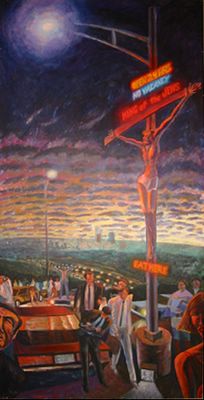
Having read through and indeed participated some in this debate, the thought crossed my mind that Lutherans and other Christians who reject the theology of glory and the gumball model of God's saving action have their work cut out for them countering this mindset in our narcissistic and entitlement-minded society.
The "kenosis hymn" of the Epistle to the Philippians praises a Christ who "emptied himself, taking the form of a slave...and became obedient, to the point of death -- even death on a cross." Dietrich Bonhoeffer writes, "When Christ calls a man, he bids him come and die." Dan Erlander writes, "We live by trust and not by certitude...we live in ambiguity. Life is joy and sorrow, pleasure and pain, good and evil, health and sickness. Having no proof that God cares, we take the 'leap of faith.'" Dorothee Soelle and Luise Schottroff, in their book Jesus of Nazareth, note, "Embracing the cross is a Christian gesture which chooses life. It means taking into account the difficulties, the lack of success, the fear of standing alone. This tradition has never promised us a garden of roses."
Compared to the happy talk of TBN preachers who promise their hearers money and stuff and success and miracles and blue skies -- what masochistic idiot would instead embrace the theology of the cross, which guarantees not a free ticket to Fat City, but rather a life that will be, in many ways, much harder than it would ever be otherwise?
But we do. We do. Sometimes we can't always articulate why we've said "yes" to this proposition...sometimes we don't even really know why, other than that we're unable to say "no."
I think the best way any of us who claim the Christ who calls us to take up our crosses and follow him can explain this holy madness of ours is to simply tell our stories as people of faith. Most of us are not going to have tales of miraculous healings or sudden material blessings or a divinely finessed life; maybe quite the opposite. But I think all of us can relate being, as C.S. Lewis put it, surprised by joy -- the joy of relationship and meaning beyond mere existence, even in the midst of sickness or failure or rejection or want.
A friend of mine says, "I don't need a theology for when I'm happy and the world is going my way. I need a theology that's there when I'm face down in a ditch, coughing up mud, unable to get up."
There's a hymn in the Lutheran Book of Worship that puts it this way: "The peace of God, it is no peace/but strife closed in the sod/yet let us pray for but one thing/the marv'lous peace of God." God help me, I think I almost know what this means.
Crucifixion at the Barton Creek Mall by James Janknegt

Sunday, May 08, 2005
Speaking in Tongues
This should be interesting...I've been tapped to read next Sunday's epistle lesson auf deutsch for Pentecost. I had three years of German in college, but...it's been a long, long time since I've read German aloud. So there will be much emotive Teutonic oratory at my house for the next few days. Lesung aus dem ersten Brief des Apostels Paulus an die Korinther, das zwölfte Kapitel...try saying that ten times fast. Gott hilfe mir!
"Pentecost" from the Deutsch Catechismus
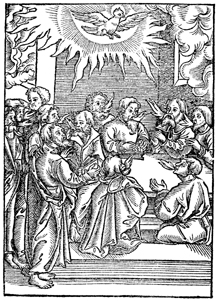
"Pentecost" from the Deutsch Catechismus

An Ecclesiastical Head-Scratcher
Here's an interesting rhetorical question that a clergy-type person posed at a roundtable I attended not too long ago:
Why is it that Lutherans seem to be willing to let any layperson, no matter how untutored or theologically off the wall, preach a lay sermon in the pastor's absence, but when it comes to presiding over the Eucharist -- an act that's had pretty much the same basic script for 2,000 years, and which isn't about the celebrant anyway -- we create all kinds of barriers that prevent laypeople from serving the Body of Christ in this important way, in the absence of a clergyperson? What is the rationale, if any, here?
This is a great question. Anyone care to respond?
Why is it that Lutherans seem to be willing to let any layperson, no matter how untutored or theologically off the wall, preach a lay sermon in the pastor's absence, but when it comes to presiding over the Eucharist -- an act that's had pretty much the same basic script for 2,000 years, and which isn't about the celebrant anyway -- we create all kinds of barriers that prevent laypeople from serving the Body of Christ in this important way, in the absence of a clergyperson? What is the rationale, if any, here?
This is a great question. Anyone care to respond?
Saturday, May 07, 2005
Wild Amish Nights!
Wild nights! Wild nights!
Were I with thee,
Wild nights should be
Our luxury! -- Emily Dickinson
A snapshot of an evening in Outer Podunk:
I'm outside shoveling mole hills out of my lawn. (Lest you think I'm the one having anything approaching a wild night.) No happy, Wind in the Willows thoughts about my furry little subterranean neighbors; in fact, no happy thoughts at all, because the lawn is a mess and needs to be professionally reseeded, and I don't want to invest the money in that project because it's money better spent fixing my house, and I hate my house because it's not really my house as in a house I would have chosen to purchase myself, it's just my parents' house that I'm now the unproud co-owner of, and it's slowly falling apart, and I want to move because living here is driving me crazy, and why is it that I wind up having all these damn problems I have to fix by myself anyway. One of those "Grrrrr" kind of days. So I'm stomping on mole tunnels and scraping off the hills with a particularly vicious vigor.
My dark ruminations are interrupted by a clip-clop of horse's hooves on the road. Many of our local Amish hire out as roofers and construction workers, and the local public access is also a popular Amish teenage hangout, so it's not unusual to have buggies rolling through the neighborhood. But then the clip-clop becomes irregular, then stops, then starts again, haltingly, and when I look up I see an Amish buggy weaving unsteadily up the road, the horse looking positively perplexed by the pull of the reins, or lack thereof. ("Done with the compass, Done with the chart...") Getting a better look inside the buggy, I see...a young couple engaged in a passionate kiss, temporarily oblivious to their navigational problems.
Good for you, I think. Good for you, you wild and crazy kids.
I even find myself grinning.
Were I with thee,
Wild nights should be
Our luxury! -- Emily Dickinson
A snapshot of an evening in Outer Podunk:
I'm outside shoveling mole hills out of my lawn. (Lest you think I'm the one having anything approaching a wild night.) No happy, Wind in the Willows thoughts about my furry little subterranean neighbors; in fact, no happy thoughts at all, because the lawn is a mess and needs to be professionally reseeded, and I don't want to invest the money in that project because it's money better spent fixing my house, and I hate my house because it's not really my house as in a house I would have chosen to purchase myself, it's just my parents' house that I'm now the unproud co-owner of, and it's slowly falling apart, and I want to move because living here is driving me crazy, and why is it that I wind up having all these damn problems I have to fix by myself anyway. One of those "Grrrrr" kind of days. So I'm stomping on mole tunnels and scraping off the hills with a particularly vicious vigor.
My dark ruminations are interrupted by a clip-clop of horse's hooves on the road. Many of our local Amish hire out as roofers and construction workers, and the local public access is also a popular Amish teenage hangout, so it's not unusual to have buggies rolling through the neighborhood. But then the clip-clop becomes irregular, then stops, then starts again, haltingly, and when I look up I see an Amish buggy weaving unsteadily up the road, the horse looking positively perplexed by the pull of the reins, or lack thereof. ("Done with the compass, Done with the chart...") Getting a better look inside the buggy, I see...a young couple engaged in a passionate kiss, temporarily oblivious to their navigational problems.
Good for you, I think. Good for you, you wild and crazy kids.
I even find myself grinning.
Radical Hospitality
After reading about East Waynesville Baptist Church in Waynesville, NC, which recently expelled nine members for refusing to "repent" for their non-support of George W. Bush and the Republican Party platform (40 other members resigned in protest)...the first thing that came to mind was...what a great outreach opportunity.
If I had a church in or around Waynesville, I'd hang a huge banner outside, EVERYONE IS WELCOME HERE. I'd put that on the church signboard. I'd run ads on the local radio station with the same message. I'd pass the hat around my congregation and do a bulk mailing. I'd throw an ice cream social on the front lawn.
And...I'd encourage the other churches in the community to do the same thing. So that East Waynesville Baptist Church would wind up surrounded by churches declaring to the community, EVERYONE IS WELCOME HERE.
That's what I'd do, anyway.
If I had a church in or around Waynesville, I'd hang a huge banner outside, EVERYONE IS WELCOME HERE. I'd put that on the church signboard. I'd run ads on the local radio station with the same message. I'd pass the hat around my congregation and do a bulk mailing. I'd throw an ice cream social on the front lawn.
And...I'd encourage the other churches in the community to do the same thing. So that East Waynesville Baptist Church would wind up surrounded by churches declaring to the community, EVERYONE IS WELCOME HERE.
That's what I'd do, anyway.
Friday, May 06, 2005
"Why Do You Stand Looking Up Toward Heaven?"
Every Ascension Sunday sermon I've ever heard preached has focused on the question, "Why Do You Stand Looking Up Toward Heaven?" -- with the message that we need to be about God's business -- feeding the hungry, clothing the naked, setting the captives free -- instead of getting, as they say, so heavenly minded that we're no earthly good.
Part of this, I think, has to do with our contemporary discomfort talking about the Ascension as an event; as someone noted in The Text This Week , what do you do with an Ascension? In choosing artwork for this blog entry, I decided upon a detail of the Vanni painting, not the entire piece, because it just looks too comical -- Jesus is flying through the air, cape flapping behind him like a Marvel superhero, with his arm outstretched: "To infinity -- and beyond!"
I personally am of the Something Happened school -- the Jesus who was killed did not seem to stay dead...appeared to both individuals and groups of his friends in surprising ways over a short period of time...then these visitations stopped; but in a way that left his friends with the understanding that their relationship with him was still going to be a real relationship,lived out in a different way. One of my friends on Beliefnet quotes someone as describing Jesus' Ascension as Jesus entering into the very heart of God and thus making himself accessible to all; I couldn't find a good illustration of that to post here, but I think the image works better for most of us than "Beam me up, Dad."
And, from a specifically Lutheran perspective -- as Garrison Keillor describes in the weekly news from Lake Wobegon, we Lutherans want to be a useful people. Baking casseroles for funeral dinners is more our discipleship style than contemplative prayer. At heart we're more comfortable with "Get back to work" sermons than "Celebrate the Mystery" sermons.
But I think Mark Allan Powell, whose book Loving Jesus I've been reading lately, would approach the Ascension from another perspective. In his book he spends a great deal of time talking about the paradox of Christ's simultaneous presence and absence. Of course Christ is present for us in the revealed Word of Scripture, in one another and in the Sacraments. But at the same time, Powell notes, we live in a state of "confident sadness." We miss Jesus' face-to-face, unmistakable presence. Powell notes, in talking about the Eucharist's foretaste of the feast to come, "Enough with the appetizers! I want the feast!" We live, as Christians, in a constant tension between the now and the not-yet. Our Love is here, yet not here.
Continues Powell: "Confident sadness allows us to live with faith that does not deny reality, faith that recognizes that life in the world is hard, and indeed, not as it should be...we are in love with a bridegroom who has gone away."
So perhaps an answer to the question, "Why do you stand looking up toward heaven?" is: Because we're happy. Because we're sad. Because we're expectant. Because we're impatient. Because we're in love.
And all of that is okay.
Detail, "Ascension," Andrea Vanni

Part of this, I think, has to do with our contemporary discomfort talking about the Ascension as an event; as someone noted in The Text This Week , what do you do with an Ascension? In choosing artwork for this blog entry, I decided upon a detail of the Vanni painting, not the entire piece, because it just looks too comical -- Jesus is flying through the air, cape flapping behind him like a Marvel superhero, with his arm outstretched: "To infinity -- and beyond!"
I personally am of the Something Happened school -- the Jesus who was killed did not seem to stay dead...appeared to both individuals and groups of his friends in surprising ways over a short period of time...then these visitations stopped; but in a way that left his friends with the understanding that their relationship with him was still going to be a real relationship,lived out in a different way. One of my friends on Beliefnet quotes someone as describing Jesus' Ascension as Jesus entering into the very heart of God and thus making himself accessible to all; I couldn't find a good illustration of that to post here, but I think the image works better for most of us than "Beam me up, Dad."
And, from a specifically Lutheran perspective -- as Garrison Keillor describes in the weekly news from Lake Wobegon, we Lutherans want to be a useful people. Baking casseroles for funeral dinners is more our discipleship style than contemplative prayer. At heart we're more comfortable with "Get back to work" sermons than "Celebrate the Mystery" sermons.
But I think Mark Allan Powell, whose book Loving Jesus I've been reading lately, would approach the Ascension from another perspective. In his book he spends a great deal of time talking about the paradox of Christ's simultaneous presence and absence. Of course Christ is present for us in the revealed Word of Scripture, in one another and in the Sacraments. But at the same time, Powell notes, we live in a state of "confident sadness." We miss Jesus' face-to-face, unmistakable presence. Powell notes, in talking about the Eucharist's foretaste of the feast to come, "Enough with the appetizers! I want the feast!" We live, as Christians, in a constant tension between the now and the not-yet. Our Love is here, yet not here.
Continues Powell: "Confident sadness allows us to live with faith that does not deny reality, faith that recognizes that life in the world is hard, and indeed, not as it should be...we are in love with a bridegroom who has gone away."
So perhaps an answer to the question, "Why do you stand looking up toward heaven?" is: Because we're happy. Because we're sad. Because we're expectant. Because we're impatient. Because we're in love.
And all of that is okay.
Detail, "Ascension," Andrea Vanni

Thursday, May 05, 2005
Let Us Pray
So today was the National Day of Prayer .
I passed by our county courthouse at lunchtime. There were maybe a dozen people rallied on the courthouse steps; not a real mainline-denominational group, from the looks of them. One woman had her hands in the air; there was a guy with a guitar. No Roman collars; no local clergy I could identify.
I couldn't hear what the group was praying for; perhaps for my and my friends' expurgation from the planet, among other things, which would not be at all nice of them, especially since I'd just come from dropping off a load of groceries at the Catholic mission. I wonder if the local residents who need those groceries ever got a mention in this Day of Prayer. Or maybe I'm just being sarcastic because I found the website linked to above and read the list of "prayer suggestions," which frankly sound more like PAC action items and less like petitions that fit into the context of praying "for the whole world, for the whole people of God and for all according to their needs."
Where are the mainline-denominational folks at the National Day of Prayer? Did the invitations get lost in the mail?
I know; I know; such stagey events are just media ops for the Religious Right in their crusade for a theocracy; they're distateful and symptomatic of bad theology; we're just not into that sort of thing.
But...just wondering...what would happen if, next year, the local mainline clergy and parishoners showed up? And when it came time to pray, they prayed out loud, not for a political platform, but for people?...for the anawim, the "little ones," the people who for whatever reasons find themselves getting regularly kicked in the teeth by the powers and principalities of this world?
Actually, this scenario actually became a reality -- not in this town, but in the town closest to my parish. Last year my pastor decided to get involved in the National Day of Prayer there. I'm not sure how he did it, but he wound up helping steer the thing; got, I think, a couple of other non-usual-suspects, like one of the local Catholic priests, to sign on too. And it turned out, he related later , to be not a day of bullhorn platitudes, but a day of genuine prayer for help and guidance focused on the residents of this particular community, who had been hit hard by the closing of several large companies that had employed hundreds of people.
What would happen if religious moderates and progressives, in communities across the country, crashed this little party on the courthouse steps next year and added some texture to the prayers? What might that look and sound like?
I passed by our county courthouse at lunchtime. There were maybe a dozen people rallied on the courthouse steps; not a real mainline-denominational group, from the looks of them. One woman had her hands in the air; there was a guy with a guitar. No Roman collars; no local clergy I could identify.
I couldn't hear what the group was praying for; perhaps for my and my friends' expurgation from the planet, among other things, which would not be at all nice of them, especially since I'd just come from dropping off a load of groceries at the Catholic mission. I wonder if the local residents who need those groceries ever got a mention in this Day of Prayer. Or maybe I'm just being sarcastic because I found the website linked to above and read the list of "prayer suggestions," which frankly sound more like PAC action items and less like petitions that fit into the context of praying "for the whole world, for the whole people of God and for all according to their needs."
Where are the mainline-denominational folks at the National Day of Prayer? Did the invitations get lost in the mail?
I know; I know; such stagey events are just media ops for the Religious Right in their crusade for a theocracy; they're distateful and symptomatic of bad theology; we're just not into that sort of thing.
But...just wondering...what would happen if, next year, the local mainline clergy and parishoners showed up? And when it came time to pray, they prayed out loud, not for a political platform, but for people?...for the anawim, the "little ones," the people who for whatever reasons find themselves getting regularly kicked in the teeth by the powers and principalities of this world?
Actually, this scenario actually became a reality -- not in this town, but in the town closest to my parish. Last year my pastor decided to get involved in the National Day of Prayer there. I'm not sure how he did it, but he wound up helping steer the thing; got, I think, a couple of other non-usual-suspects, like one of the local Catholic priests, to sign on too. And it turned out, he related later , to be not a day of bullhorn platitudes, but a day of genuine prayer for help and guidance focused on the residents of this particular community, who had been hit hard by the closing of several large companies that had employed hundreds of people.
What would happen if religious moderates and progressives, in communities across the country, crashed this little party on the courthouse steps next year and added some texture to the prayers? What might that look and sound like?
Tuesday, May 03, 2005
"1000: A Mass For the End of Time"
This recording, by Anonymous 4 -- medieval chant and polyphony for Ascension -- is just gorgeous. (And the content isn't nearly as grim as the cover art, liner notes and reviews suggest...apart from some penultimate rivers of fire and sulfur in the processional hymn, to me the chants speak to ultimate hope and triumph.) As I type I am listening to Quem creditis super astra/Viri galilei. Maybe it will inspire me as I ponder this coming Sunday's Gospel lesson.
Monday, May 02, 2005
That's the Book For Me...
Item: For anyone out there who needs a talking point while engaging with Real Christians [tm] who look down their noses at us broadly catholic folk for "not getting into the Bible" -- here's an interesting statistic I found while reading an outline on "The Liturgy, Scripture and You," from the ELCA NW Synod of Wisconsin Resource Center:
Item: One of the best book investments I made in the last year was an NRSV New Interpreter's Study Bible. It is chockful of commentary, helpful footnotes, excursuses and guides for interpretation. Schlepping this volume around to my training days is a little like dragging around The Globe Illustrated Shakespeare, but -- well, I can stand to tone up my upper arms. It's a great study Bible.
Item: Last week I decided to take the "Bonhoeffer Challenge," or a modified version thereof, and venture beyond the daily lectionary readings. Dietrich Bonhoeffer suggested a plan of reading Scripture book by book, chapter by chapter -- one chapter of Old Testament and at least a half chapter of New Testament -- morning and evening. Since this schedule is a bit overmuch for even a religion-and-lit geek like myself (I'm lucky to get out of the house in the morning wearing two shoes of the same color, let alone with two chapters of biblical edification under my belt), I've dialed it down to once a day. And since I've never read through all the Old Testament Apocrypha, I added a chapter of that. (Tobit is turning out to be an interesting story. For one thing, I've learned the importance of not letting sparrows doody in my eyes. But you'll just have to read it yourself.)
Why do this? Well, as many of us heard in church yesterday morning, from the third chapter of I Peter:
In addition to all the proactive impulses leading me to reacquaint myself with the Scriptures, I must also credit a succession of online fundamentalist antagonists for steeling my resolve to increase my biblical smarts, first by following the daily lectionary and now by reading the Bible book by book. I just got tired of always being put on the defensive. So, ironically, they've helped make me the increasingly well-read Christian I am becoming. And -- I know there's probably a sin in here somewhere, but I admit to deriving a certain satisfaction in flummoxing someone who assumes that I am a degenerate heathen, by demonstrating that I am not. It's fun to be a conundrum.
So to any fundamentalists out there who have stumbled upon this blog: Thank you ever so much for spurring me on to bigger and better things, Bible-study-wise. And...be careful what you pray for.
From David Currie's "Born Fundamentalist - Born Again Catholic" (Ignatius Press), we have the statistics that he observed: a (Roman) Catholic mass with 26% being either direct scripture (or very close paraphrase), an evangelical congregation in NW Chicago with 6% of the service as direct scripture, and a fundamentalist congregation in Indiana at 2%. As Lutheran Christians in the greater western catholic tradition, we do not need to hang our heads low and have doubts about the source of our liturgy. Every time we pray and sing the liturgy, we are rehearsing/memorizing scripture.
Item: One of the best book investments I made in the last year was an NRSV New Interpreter's Study Bible. It is chockful of commentary, helpful footnotes, excursuses and guides for interpretation. Schlepping this volume around to my training days is a little like dragging around The Globe Illustrated Shakespeare, but -- well, I can stand to tone up my upper arms. It's a great study Bible.
Item: Last week I decided to take the "Bonhoeffer Challenge," or a modified version thereof, and venture beyond the daily lectionary readings. Dietrich Bonhoeffer suggested a plan of reading Scripture book by book, chapter by chapter -- one chapter of Old Testament and at least a half chapter of New Testament -- morning and evening. Since this schedule is a bit overmuch for even a religion-and-lit geek like myself (I'm lucky to get out of the house in the morning wearing two shoes of the same color, let alone with two chapters of biblical edification under my belt), I've dialed it down to once a day. And since I've never read through all the Old Testament Apocrypha, I added a chapter of that. (Tobit is turning out to be an interesting story. For one thing, I've learned the importance of not letting sparrows doody in my eyes. But you'll just have to read it yourself.)
Why do this? Well, as many of us heard in church yesterday morning, from the third chapter of I Peter:
Now who will harm you if you are eager to do what is good? But even if you do suffer for doing what is right, you are blessed. Do not fear what they fear, and do not be intimidated, but in your hearts sanctify Christ as Lord. Always be ready to make your defense to anyone who demands from you an accounting for the hope that is in you; yet do it with gentleness and reverence. Keep your conscience clear, so that when you are maligned, those who abuse you for your good conduct in Christ may be put to shame.
In addition to all the proactive impulses leading me to reacquaint myself with the Scriptures, I must also credit a succession of online fundamentalist antagonists for steeling my resolve to increase my biblical smarts, first by following the daily lectionary and now by reading the Bible book by book. I just got tired of always being put on the defensive. So, ironically, they've helped make me the increasingly well-read Christian I am becoming. And -- I know there's probably a sin in here somewhere, but I admit to deriving a certain satisfaction in flummoxing someone who assumes that I am a degenerate heathen, by demonstrating that I am not. It's fun to be a conundrum.
So to any fundamentalists out there who have stumbled upon this blog: Thank you ever so much for spurring me on to bigger and better things, Bible-study-wise. And...be careful what you pray for.
Sunday, May 01, 2005
Personal Jesus
More from Mark Allan Powell, in Loving Jesus:
I have to say, I'm heartened to read statements like this written by a bigshot theologian at an ELCA seminary. Because, to quote Powell again, "No matter how much we love theology -- it will never love us back." The Lutheran academy has for many decades engaged in a one-sided love affair (or perhaps just a prolonged bout of intellectual self-gratification) with theology, while losing its passion for the Christ we claim as Lord -- more or less dismissing the experiential aspects of Christian spirituality as pop sentimentality. Frankly, I think that attitude has hurt our tradition. I sense the beginnings of a paradigm shift back toward an appreciation for "celebrating the Mystery," without abandoning intellectual rigor, and I welcome that...loving God with all our heart (the seat of the intellect, in ancient Hebrew thought) and all our soul and all our might.
When we understand our spirituality as a relationship with Jesus, our spiritual lives are grounded in a reality external to ourselves -- something that we are not able to manipulate or fashion to our own design (at least, not easily). This gives an integrity to our spirituality that basically keeps us honest.
If Jesus really is risen, raised from the dead and living now with a spiritual body, then we can indeed have a relationship with a Jesus who is real, not just imaginary. We can come to know this Jesus and be challenged by him. We can grow to love this Jesus in ways that are both intimate and mature. And we can experience what it means to be in a reciprocal relationship with a spiritual being who loves us back -- indeed, who loved us first (I John 4:9).
I have to say, I'm heartened to read statements like this written by a bigshot theologian at an ELCA seminary. Because, to quote Powell again, "No matter how much we love theology -- it will never love us back." The Lutheran academy has for many decades engaged in a one-sided love affair (or perhaps just a prolonged bout of intellectual self-gratification) with theology, while losing its passion for the Christ we claim as Lord -- more or less dismissing the experiential aspects of Christian spirituality as pop sentimentality. Frankly, I think that attitude has hurt our tradition. I sense the beginnings of a paradigm shift back toward an appreciation for "celebrating the Mystery," without abandoning intellectual rigor, and I welcome that...loving God with all our heart (the seat of the intellect, in ancient Hebrew thought) and all our soul and all our might.
Subscribe to:
Posts (Atom)