No; nothing to do with shooting pheasants.
My congregation's worship committee was also retreating this past week, and one of the ideas they brought back to our church was this: Beginning next week, we'll be placing a prayer request slip in every bulletin. People can fill out a prayer for themselves or others, in a completely anonymous manner. At the end of the service these slips will go into a basket. As people leave, they may take a prayer request out of the basket. If they do, their job, for the next week, becomes praying for that particular person or situation. And this is going to be an ongoing, all-hands-on-deck project from now on.
Another God thing happening in our parish. Someone upstairs must love us.
Sunday, October 30, 2005


Like Buttah!
While I was communing with God and my fellow lay ministry students in Michigan's north woods, our church youth group was busy cooking up apple butter...actually, they helped with KP duty while adults with canning expertise actually made the stuff, in a big kettle in our church's back yard.
When I got to church this morning, I got the second-to-last pint of apple butter; it had all been sold, and the kids made $270 for confirmation camp; almost enough tuition for one camper.
They have been busy raising money since this summer, doing everything from making sloppy joes at our church yard sale to hosting an evening spaghetti dinner/talent show. In a couple of weeks they're going to be selling "deer camp care packages" filled with baked goods to sell to the army of hunters that descends upon our area every November.
This is just so cool.
I never got to confirmation camp when I was a kid -- my father, balking at the cost, said, "You don't really want to go there," which in my family was code language for "Fuggetabout it." But I made up for this deficit in my spiritual formation in college, where I got involved in Lutheran Student Movement; one day early in my freshman career I'd seen a poster advertising a regional LSM retreat...thought, "That sounds interesting"...and wound up traipsing with gee-tar and bedroll almost a half mile to The Other Lutheran Student Parish. (I was in the LCMS at the time, so this was very daring behavior...ah, if they only knew it was just the beginning...) I wasn't sure what sort of reception I'd get -- but five minutes after showing up I felt as if I'd met a bunch of long-lost siblings. I had a swell time; kept going back; brought some of my other LCMS friends with me. My experiences at these retreats were so important in my spiritual formation; they played an important role in my learning to speak freely about my faith, in examining social issues from a Christian justice perspective, and in making me comfortable doing worship "front and center"; at LSM retreats I cut my eyeteeth leading small groups and helping write informal liturgies. Even when I felt the most estranged from the Christian faith, many years later, I looked back at those days with a certain discomforting wistfulness. (And in hindsight I think perhaps the Holy Spirit was messing with my head, in a good way, bringing up those happy memories despite my best attempts to shoo them away.)
Long story short, I think that youth ministry is important. I don't think that it is my particular charism, but I have nothing but respect for laypeople and pastors who work with teenagers and young adults. Any way that I can help the kids in my parish enjoy some of the same fellowship and spiritual support that I was blessed to experience in my younger years is time and money well spent, if you ask me.
And this apple butter is...mmmmm...delish. You'll have to take my word for it.
Apple butter

When I got to church this morning, I got the second-to-last pint of apple butter; it had all been sold, and the kids made $270 for confirmation camp; almost enough tuition for one camper.
They have been busy raising money since this summer, doing everything from making sloppy joes at our church yard sale to hosting an evening spaghetti dinner/talent show. In a couple of weeks they're going to be selling "deer camp care packages" filled with baked goods to sell to the army of hunters that descends upon our area every November.
This is just so cool.
I never got to confirmation camp when I was a kid -- my father, balking at the cost, said, "You don't really want to go there," which in my family was code language for "Fuggetabout it." But I made up for this deficit in my spiritual formation in college, where I got involved in Lutheran Student Movement; one day early in my freshman career I'd seen a poster advertising a regional LSM retreat...thought, "That sounds interesting"...and wound up traipsing with gee-tar and bedroll almost a half mile to The Other Lutheran Student Parish. (I was in the LCMS at the time, so this was very daring behavior...ah, if they only knew it was just the beginning...) I wasn't sure what sort of reception I'd get -- but five minutes after showing up I felt as if I'd met a bunch of long-lost siblings. I had a swell time; kept going back; brought some of my other LCMS friends with me. My experiences at these retreats were so important in my spiritual formation; they played an important role in my learning to speak freely about my faith, in examining social issues from a Christian justice perspective, and in making me comfortable doing worship "front and center"; at LSM retreats I cut my eyeteeth leading small groups and helping write informal liturgies. Even when I felt the most estranged from the Christian faith, many years later, I looked back at those days with a certain discomforting wistfulness. (And in hindsight I think perhaps the Holy Spirit was messing with my head, in a good way, bringing up those happy memories despite my best attempts to shoo them away.)
Long story short, I think that youth ministry is important. I don't think that it is my particular charism, but I have nothing but respect for laypeople and pastors who work with teenagers and young adults. Any way that I can help the kids in my parish enjoy some of the same fellowship and spiritual support that I was blessed to experience in my younger years is time and money well spent, if you ask me.
And this apple butter is...mmmmm...delish. You'll have to take my word for it.
Apple butter


Always Reforming
Today was Reformation Sunday at church -- the great annual Lutheran tribal gathering. The church was bedecked in red; the pews were packed; the air was redolent with aromas of various caloric potluck dishes warming up in the kitchen; we sang "A Mighty Fortress" and "The Church's One Foundation"; the tradition lives on for another year.
But more importantly for our congregation, this Sunday was Confirmation Sunday. This is a new thing for us, and perhaps for readers as well; at least when I was a kid, confirmations happened around the Easter season. But we have found that, at our church, we can get junior-high and high school kids involved in religious education if we put them through what amounts to a two-week theological bootcamp and a week of church camp in the summertime...this after easing them through the door with an afterschool program where kids hang out afternoon a week with the pastor, engage in Godtalk, play music, and on occasion go on pastoral-care rounds and help out with various churchly tasks.
This morning eight nervous white-robed confirmands sat in the front row. One of them had been so desperate to attend confirmation class that he intially fibbed about his age so he could get in. (We would have let him in anyway, but it's a great story.) Another, a girl with minimal evident adult support for her faith journey, who got involved with our church through her friends, was recently baptized, and when she was her adolescent peers from confirmation class stood up for her as sponsors. (Which I suspect is probably against "the rules," or falling under the dreaded category of "But we've never done it that way before." But our response as a congregation was happy wonderment -- imagine a bunch of teenagers, unprodded by adult authority figures, being the Church for their friend.)
We followed the liturgy for the Affirmation of Baptism. Each kid was asked the traditional question: "Do you renounce all the forces of evil, the devil and all his empty promises?" A series of quiet responses: "I do." "Do you believe in God the Father?" The entire congregation then joined in, response after response, to affirm the articles of the Creed.
Finally it was time for each kid to be confirmed. As he or she knelt at the altar, our pastor invited parents and godparents to join him in the laying on of hands. And when it came time for our newly baptized, sans-adults teenager to be confirmed, all the rest of her class, her friends/peers/sponsors, stood up in unison, returned to the altar and laid their hands on her.
What should the Church look like? I think at its best it looks a lot like this.
Lutherans like to describe ourselves as catholic, evangelical and reforming. We're catholic because we affirm the witness of the Apostles, the formative theologians and the ecumenical councils of the early Church, and the praxis of worship as has been handed down to us from those times. We are evangelical because our primary goal in being the Church is to proclaim the very good news of God's unconditional, no-strings-attached Yes! to a loving relationship with humankind, personified by Jesus Christ, God With Us. And we are reforming because, whenever some aspect of our life together impedes that message of God's love and grace, we believe that it's our job to make a change. That's the ideal. That's what we strive for.
I am happy and blessed to be a part of a faith community that takes this always- reforming ethos seriously; that tries its darnedest to erase the lines, whatever they may be, that work to keep people outside our church family.
After the service, I was talking with our pastor -- we were both grinning from ear to ear -- about what a great congregation we have, and he said, "I go to these pastoral conferences where other pastors talk about the problems they have keeping their congregations going, and when they ask me why ours is always bucking the trend, I tell them it's because we've made the decision to stop fighting about stuff; about who's 'in' and who's 'out.'"
When the Son sets us free, we are free indeed. Thanks be to God!
Luther Rose, stained glass David Hetland

But more importantly for our congregation, this Sunday was Confirmation Sunday. This is a new thing for us, and perhaps for readers as well; at least when I was a kid, confirmations happened around the Easter season. But we have found that, at our church, we can get junior-high and high school kids involved in religious education if we put them through what amounts to a two-week theological bootcamp and a week of church camp in the summertime...this after easing them through the door with an afterschool program where kids hang out afternoon a week with the pastor, engage in Godtalk, play music, and on occasion go on pastoral-care rounds and help out with various churchly tasks.
This morning eight nervous white-robed confirmands sat in the front row. One of them had been so desperate to attend confirmation class that he intially fibbed about his age so he could get in. (We would have let him in anyway, but it's a great story.) Another, a girl with minimal evident adult support for her faith journey, who got involved with our church through her friends, was recently baptized, and when she was her adolescent peers from confirmation class stood up for her as sponsors. (Which I suspect is probably against "the rules," or falling under the dreaded category of "But we've never done it that way before." But our response as a congregation was happy wonderment -- imagine a bunch of teenagers, unprodded by adult authority figures, being the Church for their friend.)
We followed the liturgy for the Affirmation of Baptism. Each kid was asked the traditional question: "Do you renounce all the forces of evil, the devil and all his empty promises?" A series of quiet responses: "I do." "Do you believe in God the Father?" The entire congregation then joined in, response after response, to affirm the articles of the Creed.
Finally it was time for each kid to be confirmed. As he or she knelt at the altar, our pastor invited parents and godparents to join him in the laying on of hands. And when it came time for our newly baptized, sans-adults teenager to be confirmed, all the rest of her class, her friends/peers/sponsors, stood up in unison, returned to the altar and laid their hands on her.
What should the Church look like? I think at its best it looks a lot like this.
Lutherans like to describe ourselves as catholic, evangelical and reforming. We're catholic because we affirm the witness of the Apostles, the formative theologians and the ecumenical councils of the early Church, and the praxis of worship as has been handed down to us from those times. We are evangelical because our primary goal in being the Church is to proclaim the very good news of God's unconditional, no-strings-attached Yes! to a loving relationship with humankind, personified by Jesus Christ, God With Us. And we are reforming because, whenever some aspect of our life together impedes that message of God's love and grace, we believe that it's our job to make a change. That's the ideal. That's what we strive for.
I am happy and blessed to be a part of a faith community that takes this always- reforming ethos seriously; that tries its darnedest to erase the lines, whatever they may be, that work to keep people outside our church family.
After the service, I was talking with our pastor -- we were both grinning from ear to ear -- about what a great congregation we have, and he said, "I go to these pastoral conferences where other pastors talk about the problems they have keeping their congregations going, and when they ask me why ours is always bucking the trend, I tell them it's because we've made the decision to stop fighting about stuff; about who's 'in' and who's 'out.'"
When the Son sets us free, we are free indeed. Thanks be to God!
Luther Rose, stained glass David Hetland

Thursday, October 27, 2005
Clicks For Cures
Breast cancer has always been one of those issues that, for me, was something of an abstraction, even though statistically speaking I'm at a somewhat higher risk than average for developing it. Until Melissa Etheridge was diagnosed. Because we're about the same age. And seeing her on the Grammies, while she was undergoing chemo, hit it home: That could be me.
The Breast Cancer Site , one of the sister sites to The Hunger Site , is currently running a campaign to raise money for mammograms for poor/urban/minority women. Those of you familiar with these "donate by click" websites know that all you have to do is click a button on the website, and a small amount of money will be donated by the site underwriters to the cause in question. This isn't a joke; it's the real deal. And this month, every click on The Breast Cancer Site counts triple for fundraising. (You can only click once a day per computer.) So -- g'head. Click it.
I know it's easy to roll one's eyes at these "no pain" fundraising programs. It's not costing us anything, other than a couple minutes of our time; the contributions are miniscule; the websites are junked up with a lot of fundraising bling-bling, feeding the bottomless maw of our aquisitiveness. There's just nothing noble, or sacrificial, in it.
That may be true. But I look at it this way: If I opened my back door one day to find an emaciated child holding out a plate -- I'd feed her, wouldn't I? If I were confronted by a poor woman without health insurance who needed just a couple of bucks to finally get the money to get a mammogram -- I'd dig into my jacket pocket and give her enough money to make up the difference, wouldn't I? It's the same principle. If you know that you can help someone by doing something, even if the something is a dinky little insignificant thing -- you do it. It's a no-brainer.
So -- head over to The Breast Cancer Site and click the button to help fund a mammogram. And check out all those other websites that promote health and literacy and concern for the environment, and give them a click too.

The Breast Cancer Site , one of the sister sites to The Hunger Site , is currently running a campaign to raise money for mammograms for poor/urban/minority women. Those of you familiar with these "donate by click" websites know that all you have to do is click a button on the website, and a small amount of money will be donated by the site underwriters to the cause in question. This isn't a joke; it's the real deal. And this month, every click on The Breast Cancer Site counts triple for fundraising. (You can only click once a day per computer.) So -- g'head. Click it.
I know it's easy to roll one's eyes at these "no pain" fundraising programs. It's not costing us anything, other than a couple minutes of our time; the contributions are miniscule; the websites are junked up with a lot of fundraising bling-bling, feeding the bottomless maw of our aquisitiveness. There's just nothing noble, or sacrificial, in it.
That may be true. But I look at it this way: If I opened my back door one day to find an emaciated child holding out a plate -- I'd feed her, wouldn't I? If I were confronted by a poor woman without health insurance who needed just a couple of bucks to finally get the money to get a mammogram -- I'd dig into my jacket pocket and give her enough money to make up the difference, wouldn't I? It's the same principle. If you know that you can help someone by doing something, even if the something is a dinky little insignificant thing -- you do it. It's a no-brainer.
So -- head over to The Breast Cancer Site and click the button to help fund a mammogram. And check out all those other websites that promote health and literacy and concern for the environment, and give them a click too.

More Service Stuff
I'm getting ready for my retreat tomorrow...getting packed (strange how much stuff I wind up packing for a retreat), packing two brownbag meals -- the Chik being on the economy lodging plan -- making sure I have all my assignments done. (I tried the Luther Seminary Communion bread recipe, and it didn't come out right either -- I think there's some sort of bad mojo going on with my baking capabilities -- so I wound up going to Plan C, supermarket pita bread. Sigh.)
I'm not going to write up my entire service here, because most of it is out of the hymnal, but here are the parts I tweaked:
The Confession: We confess that we have not loved you with our whole hearts, nor have we loved those whom you love. We confess that we forget "the least of these" among us. We confess that we take comfort in our prejudices, our complacency and our silence when you call us to mend the broken places in our world and to speak the liberating prophetic word, in your name and to your glory. Hear us, O God, for your mercy is great.
I chose Psalm 33 for the Psalm reading. I picked three short Scripture readings -- still, a somewhat heavy load for a Compline service, but it's my liturgy, so there: Isaiah 61:10-11; Hebrews 13:20-21; Matthew 14:14-16.
And you've read my benediction, in the post below.
Every time I read through my work I see things I want to change, but I am resisting the impulse. We'll see how it plays in Peoria (or, more accurately, out in the woods of northern Michigan).
I'm not going to write up my entire service here, because most of it is out of the hymnal, but here are the parts I tweaked:
The Confession: We confess that we have not loved you with our whole hearts, nor have we loved those whom you love. We confess that we forget "the least of these" among us. We confess that we take comfort in our prejudices, our complacency and our silence when you call us to mend the broken places in our world and to speak the liberating prophetic word, in your name and to your glory. Hear us, O God, for your mercy is great.
I chose Psalm 33 for the Psalm reading. I picked three short Scripture readings -- still, a somewhat heavy load for a Compline service, but it's my liturgy, so there: Isaiah 61:10-11; Hebrews 13:20-21; Matthew 14:14-16.
And you've read my benediction, in the post below.
Every time I read through my work I see things I want to change, but I am resisting the impulse. We'll see how it plays in Peoria (or, more accurately, out in the woods of northern Michigan).
Wednesday, October 26, 2005
Work of the People, Indeed!
I've just spent all evening working on the Friday-night service I was assigned for this weekend's retreat.
I've got to tell you -- this is hard. I used to be on my student parish worship committee back in my university days, and helped with a few home-grown liturgies, but this is the first one since my spiritual meanderings took me away, and then back, to the Church.
Our weekend is focused on justice. I wanted to address that...but I also wanted to do it in the context of the Compline, which to me doesn't exactly lend itself to the sort of revved-up prophetic words we're going to be hearing and discussing. But I somehow pulled it together, kind of. We'll see. This time tomorrow I might be Googling "Purpose-Driven Devotionals" or some such thing. (Just kidding.)
Anyway, here's my benediction, which I found elsewhere on the Internet:
I've got to tell you -- this is hard. I used to be on my student parish worship committee back in my university days, and helped with a few home-grown liturgies, but this is the first one since my spiritual meanderings took me away, and then back, to the Church.
Our weekend is focused on justice. I wanted to address that...but I also wanted to do it in the context of the Compline, which to me doesn't exactly lend itself to the sort of revved-up prophetic words we're going to be hearing and discussing. But I somehow pulled it together, kind of. We'll see. This time tomorrow I might be Googling "Purpose-Driven Devotionals" or some such thing. (Just kidding.)
Anyway, here's my benediction, which I found elsewhere on the Internet:
A Franciscan Benediction
May God bless us with discomfort,
At easy answers, half-truths, and superficial relationships,
So that we may live deep within our hearts.
May God bless us with anger,
At injustice, oppression, and exploitation of people,
So that we may work for justice, freedom, and peace.
May God bless us with tears,
To shed for those who suffer from pain, rejection, starvation, and war,
So that we may reach out our hands to comfort them and turn their pain to joy.
And may God bless us with enough foolishness,
To believe that we can make a difference in this world,
So that we can do what others claim cannot be done.
The Write Stuff
Shameless promotion alert! If you scroll down the ol' sidebar, you will see an ad for A Light Blazes in the Darkness. This anthology of Advent essays, including a couple of my own, is a collaborative effort of the RevGalBlogPals webring, of which I'm a member. Not to pressure you into buying our book or anything, but all proceeds go toward Gulf Coast hurricane relief.
And if you're sitting there thinking, "Hmmm...I wonder if I could write a devotional" -- plans are in the works for a follow-up devotional book for the long "green and growing" season after Pentecost. If you might be interested in writing for our new book -- remember, there are a LOT of days in Ordinary Time -- send an e-mail to ordinarytimebook@hotmail.com for more information.
I believe very strongly that the intentional communities we form online are an exciting "new thing" that the Holy Spirit is working in our society. This endeavor is a good read, a wonderful way to introduce others to "holy blogdom," and you'll be helping out people who need it. So journey through Advent with us!
And if you're sitting there thinking, "Hmmm...I wonder if I could write a devotional" -- plans are in the works for a follow-up devotional book for the long "green and growing" season after Pentecost. If you might be interested in writing for our new book -- remember, there are a LOT of days in Ordinary Time -- send an e-mail to ordinarytimebook@hotmail.com for more information.
I believe very strongly that the intentional communities we form online are an exciting "new thing" that the Holy Spirit is working in our society. This endeavor is a good read, a wonderful way to introduce others to "holy blogdom," and you'll be helping out people who need it. So journey through Advent with us!
Tuesday, October 25, 2005
Theses I Will Ponder Now
Since I am going to be busier than Martin Luther in an indulgence-kicking contest this coming weekend, I thought I'd pass this challenge along now: A new inductee into our RevGalBlogPals webring, Jan of A Church For Starving Artists , asks us to name 95 Ways in Which the Church Needs to Change in 2005.
What a great question.
And I'm sure there are many great answers out there.
Feel free to share your ideas here. I'll help get you started .
"In the name of our Lord Jesus Christ. Amen.
1. The Church needs to reaffirm that Jesus Christ -- not itself as an institution, nor its current or potential members, nor particular ideologies -- is at the very center of its life and mission, its reason for being and its goal, and redirect its energies accordingly, actively listening and responding to Jesus' directive to "Follow me."
2. As a sign of unity within the Body of Christ, in the interest of justice and equity, and as a prophetic message to the dominant culture, the Church needs to affirm full inclusion of all the faithful in the active life of the Church, including leadership positions, and vigorously repudiate bigotry in all its forms both within and without.
3. The Church must reclaim the Reformation's emphasis on educating the laity in the Christian faith, and must create a culture in which religious formation is seen by clergy and laity alike as a lifelong endeavor -- an endeavor which will bring challenge and growth and, yes, at times discomfort.
4. The Church must reclaim the wisdom of its great saints in teaching, promoting and supporting spiritual disciplines that assist all in the Body in their individual and collective faith walks.
5. The Church must reclaim its calling as a nurturer of the fine arts, and encourage excellence and creativity offered to God's glory in service to the people of God and the rest of humanity.
6. The Church must affirm that both religion and science are in the business of telling the truth, and as such are allies, not enemies; and must strongly oppose attempts to create false dichotomies between spiritual truth and scientific truth.
Okay...now you only have 80-something theses to come up with. Have at it!
What a great question.
And I'm sure there are many great answers out there.
Feel free to share your ideas here. I'll help get you started .
"In the name of our Lord Jesus Christ. Amen.
1. The Church needs to reaffirm that Jesus Christ -- not itself as an institution, nor its current or potential members, nor particular ideologies -- is at the very center of its life and mission, its reason for being and its goal, and redirect its energies accordingly, actively listening and responding to Jesus' directive to "Follow me."
2. As a sign of unity within the Body of Christ, in the interest of justice and equity, and as a prophetic message to the dominant culture, the Church needs to affirm full inclusion of all the faithful in the active life of the Church, including leadership positions, and vigorously repudiate bigotry in all its forms both within and without.
3. The Church must reclaim the Reformation's emphasis on educating the laity in the Christian faith, and must create a culture in which religious formation is seen by clergy and laity alike as a lifelong endeavor -- an endeavor which will bring challenge and growth and, yes, at times discomfort.
4. The Church must reclaim the wisdom of its great saints in teaching, promoting and supporting spiritual disciplines that assist all in the Body in their individual and collective faith walks.
5. The Church must reclaim its calling as a nurturer of the fine arts, and encourage excellence and creativity offered to God's glory in service to the people of God and the rest of humanity.
6. The Church must affirm that both religion and science are in the business of telling the truth, and as such are allies, not enemies; and must strongly oppose attempts to create false dichotomies between spiritual truth and scientific truth.
Okay...now you only have 80-something theses to come up with. Have at it!
Question Time
I have written homework for this weekend's lay ministry retreat. Part of the retreat will be spent in class with our synodical bishop, talking about justice in the Church. To prepare for that, we've all been asked to write responses to these two questions:
What is your understanding of justice?
In what areas should the church be responsive to injustice?
Hmmm. Hmmm.
I know what I'm writing.
In the meantime...discuss amongst yourselves.
What is your understanding of justice?
In what areas should the church be responsive to injustice?
Hmmm. Hmmm.
I know what I'm writing.
In the meantime...discuss amongst yourselves.
Monday, October 24, 2005
St. James of Jerusalem, Bishop and Martyr
James of Jerusalem’s feast day tends not to be a major red-letter day on the Lutheran calendar. Martin Luther had, as they say, issues with the emphasis on good works in the Epistle of James (thought to have been, if not actually written by James, then written for him); Luther’s friend Phil Melancthon had to do some major convincing to get Luther to consider that James’ and Paul’s respective viewpoints on grace and works were perhaps complementary and not contradictory, and even then I don’t think Marty really bought it.
So, anyway, perhaps it’s not surprising that I didn’t give St. James the blog-nod on his special day, this past Sunday. (That and my preoccupation with pancakes.) But in thinking about him, I’ve decided to take another look.
James is widely identified as Jesus’ brother – which, depending upon your theological point of view, may mean anything from biological brother to stepbrother to cousin. If this is true, then he was among those family members who didn’t get Jesus; who at one point even decided that Jesus was off his rocker, and came in an entourage to fetch him back home, presumably before he further shamed the family and got into more trouble. Yet James was one of those to whom the resurrected Jesus appeared. He became a leader of the nascent Christian movement, along with apostles Peter and John. James and Paul had a dust-up about the propriety of Jewish Christians and Gentile Christians eating together, which apparently was resolved when Paul successfully argued his case, and James and the others finally gave their blessing to Paul’s ministry. James was known throughout the early Church for his goodness, hence the moniker “James the Just,” and his piety; even his detractors among the Pharisees gave him good-behavior points for his observance of the Law. (Although James nonetheless wound up being martyred for his faith.)
As I’ve been thinking about James, and what his life may have to say to us centuries later, one of the things that comes to mind is grace...and the freedom to be wrong. How would you like to be, not only one of the many who’d gotten it wrong about Jesus, but one who was also Jesus’ own flesh and blood? I wonder how often, after Jesus’ post-Resurrection appearance to James, that James replayed the details of their life together, and the events of their last few years of apparent estrangement, thinking of all the times that he’d been dismissive of or disgusted with or ashamed of his brother. How many times do you think he pounded himself in the head? D’oh! I know that’s what I would have done. But what went on during that reunion of brothers that transformed and empowered James to become one of the great leaders of the early Church? And how did that experience of being wrong in a really big way inform James’ later experience of coming to the realization that the Holy Spirit might be moving the young Church in an unexpected, broadly inclusive direction, and having the courage to publicly change his mind?
James reminds us that we don’t always get it right. And that, thank God, we don’t have to. Jesus keeps showing up nonetheless, pulling us back on our feet and setting us in a right direction. That’s really good news. Thank you, James of Jerusalem, for reminding us of that.
St. James of Jerusalem, Bishop and Martyr

So, anyway, perhaps it’s not surprising that I didn’t give St. James the blog-nod on his special day, this past Sunday. (That and my preoccupation with pancakes.) But in thinking about him, I’ve decided to take another look.
James is widely identified as Jesus’ brother – which, depending upon your theological point of view, may mean anything from biological brother to stepbrother to cousin. If this is true, then he was among those family members who didn’t get Jesus; who at one point even decided that Jesus was off his rocker, and came in an entourage to fetch him back home, presumably before he further shamed the family and got into more trouble. Yet James was one of those to whom the resurrected Jesus appeared. He became a leader of the nascent Christian movement, along with apostles Peter and John. James and Paul had a dust-up about the propriety of Jewish Christians and Gentile Christians eating together, which apparently was resolved when Paul successfully argued his case, and James and the others finally gave their blessing to Paul’s ministry. James was known throughout the early Church for his goodness, hence the moniker “James the Just,” and his piety; even his detractors among the Pharisees gave him good-behavior points for his observance of the Law. (Although James nonetheless wound up being martyred for his faith.)
As I’ve been thinking about James, and what his life may have to say to us centuries later, one of the things that comes to mind is grace...and the freedom to be wrong. How would you like to be, not only one of the many who’d gotten it wrong about Jesus, but one who was also Jesus’ own flesh and blood? I wonder how often, after Jesus’ post-Resurrection appearance to James, that James replayed the details of their life together, and the events of their last few years of apparent estrangement, thinking of all the times that he’d been dismissive of or disgusted with or ashamed of his brother. How many times do you think he pounded himself in the head? D’oh! I know that’s what I would have done. But what went on during that reunion of brothers that transformed and empowered James to become one of the great leaders of the early Church? And how did that experience of being wrong in a really big way inform James’ later experience of coming to the realization that the Holy Spirit might be moving the young Church in an unexpected, broadly inclusive direction, and having the courage to publicly change his mind?
James reminds us that we don’t always get it right. And that, thank God, we don’t have to. Jesus keeps showing up nonetheless, pulling us back on our feet and setting us in a right direction. That’s really good news. Thank you, James of Jerusalem, for reminding us of that.
St. James of Jerusalem, Bishop and Martyr

In-a-Gadda-Da-Pita, Baby
This is what happens when little grade-school nerds grow up: One of my jobs at my retreat this weekend is bringing the Communion bread. So, around 6:00 p.m. last night, I get this brilliant idea: I'll make it myself! And then I get an even more brilliant idea: I'll make pita bread! I've never made pita bread before, but that's just a minor complication in an excellent kitchen adventure.
I get out my trusty old friend Uprisings: The Whole Grain Baker's Book, an artifact from my crunchy-granola college days. I make a sponge with two teaspoons of yeast, a cup of warm water, a tablespoon of honey and a cup of whole wheat flour. I let that sit for awhile, then stir it down and add about 3 and a quarter more cups of flour, a tablespoon and a half of oil and a half-teaspoon of salt. I knead that for awhile, then let it sit for awhile, then punch it down, roll it into about 5 balls, roll the balls into flat circles with a rolling pin and let the circles rise for about 45 minutes.
Now comes the tricky part. Pita bread has to be baked in a really, really, really hot oven, or the pockets don't pop. My recipe calls for 500 degrees -- the hottest temperature my oven is capable of. I don't think I've ever cranked up the oven to 500 degrees before. But I do it, placing a flat pan on the lowest rack to preheat.
The moment of truth: The oven light goes off and I quickly slip two dough rounds onto my preheated pan. I watch through the oven window: Yes! They're puffing up! Whoo-hoo! Another kitchen first for moi! I imagine myself pulling a Martha Stewart, smugly explaining to my admiring friends, "Oh, they look like they're a lot of work, but they're really quite easy and fast to make."
When the rounds come out of the oven I tap them on top. They sound promisingly hollow. But then I slice into one -- What has it got in its pocketses? -- and find...solid bread. I mean...it's a decent whole-wheat bread. But it's just...bread. Darn.
A serving of humility to go with my complex carbohydrates.
If anyone out there has ever managed to pop a pocket in your pitas, let me know how you did that. In the meantime, I think I need to go to Plan B...boughten bread.
Strange breadfellows

I get out my trusty old friend Uprisings: The Whole Grain Baker's Book, an artifact from my crunchy-granola college days. I make a sponge with two teaspoons of yeast, a cup of warm water, a tablespoon of honey and a cup of whole wheat flour. I let that sit for awhile, then stir it down and add about 3 and a quarter more cups of flour, a tablespoon and a half of oil and a half-teaspoon of salt. I knead that for awhile, then let it sit for awhile, then punch it down, roll it into about 5 balls, roll the balls into flat circles with a rolling pin and let the circles rise for about 45 minutes.
Now comes the tricky part. Pita bread has to be baked in a really, really, really hot oven, or the pockets don't pop. My recipe calls for 500 degrees -- the hottest temperature my oven is capable of. I don't think I've ever cranked up the oven to 500 degrees before. But I do it, placing a flat pan on the lowest rack to preheat.
The moment of truth: The oven light goes off and I quickly slip two dough rounds onto my preheated pan. I watch through the oven window: Yes! They're puffing up! Whoo-hoo! Another kitchen first for moi! I imagine myself pulling a Martha Stewart, smugly explaining to my admiring friends, "Oh, they look like they're a lot of work, but they're really quite easy and fast to make."
When the rounds come out of the oven I tap them on top. They sound promisingly hollow. But then I slice into one -- What has it got in its pocketses? -- and find...solid bread. I mean...it's a decent whole-wheat bread. But it's just...bread. Darn.
A serving of humility to go with my complex carbohydrates.
If anyone out there has ever managed to pop a pocket in your pitas, let me know how you did that. In the meantime, I think I need to go to Plan B...boughten bread.
Strange breadfellows

Sunday, October 23, 2005
Tough Love
"We Christians are really lucky," exclaimed a pastor of my acquaintance, preaching on this text one Sunday. "Our Jewish friends have 613 -- 613 -- commandments to follow, and we only have two!"
The joke, of course, was on us. Because, as the pastor explained, the two we have, that we've been given in today's Gospel reading, are the basis for Judaism's 613 mitzvot; they are the why to their what.
What does it look like, do you think, when someone loves God with all her heart...all her soul...all her mind...all her strength? What does it look like when someone loves his neighbors, looks out for his neighbors, helps his neighbors, in exactly the same way that he takes care of himself?
I have to tell you, I don't know what it would look like if I did those things, because I don't. Not all the time. Every great once in awhile I will experience perhaps a flash, a fleeting moment, where those things may be the case, but the very act of noting that introduces an element of inward-turning that effectively ends that moment.
Just two commandments: Love God with your whole heart. Love other people the way you love yourself. How difficult can that be?
Shema, stained glass, Temple Valley Beth Shalom, Encino, CA
Jesus Washing His Disciples' Feet, Tiffany, Montclair UCC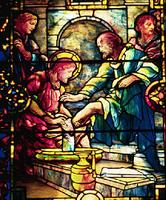
The joke, of course, was on us. Because, as the pastor explained, the two we have, that we've been given in today's Gospel reading, are the basis for Judaism's 613 mitzvot; they are the why to their what.
What does it look like, do you think, when someone loves God with all her heart...all her soul...all her mind...all her strength? What does it look like when someone loves his neighbors, looks out for his neighbors, helps his neighbors, in exactly the same way that he takes care of himself?
I have to tell you, I don't know what it would look like if I did those things, because I don't. Not all the time. Every great once in awhile I will experience perhaps a flash, a fleeting moment, where those things may be the case, but the very act of noting that introduces an element of inward-turning that effectively ends that moment.
Just two commandments: Love God with your whole heart. Love other people the way you love yourself. How difficult can that be?
Shema, stained glass, Temple Valley Beth Shalom, Encino, CA

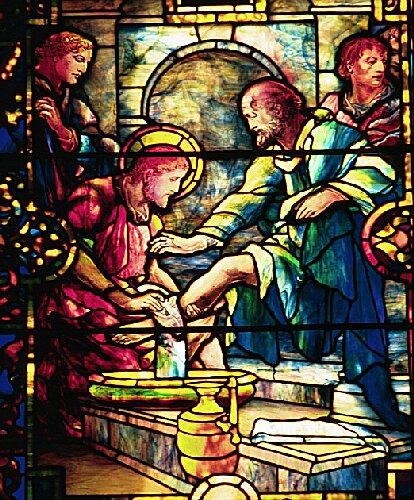
Jesus Washing His Disciples' Feet, Tiffany, Montclair UCC
Diary of a Delinquent Churchgoer
I stayed home from church today.
It was the one Sunday this month that we weren't doing anything special at our parish, and/or where I didn't have a job to do front and center. My mother -- for whom getting ready for church on Sunday mornings is equivalent to preparing for an ascent up K2; that's what happens to you when you hit your 80's -- wasn't keen on going to church today. I'm headed on retreat this coming weekend, which means a double-dose of church. The aching Gordian knot in my upper back, which only goes away on weekends, was still in the process of loosening up Saturday night. And I wanted pancakes.
So that is what we did...stayed in bed until 8:00 a.m. Then we had pancakes. They were very good. Then I prayed the Morning Prayer, and noted with irony the first appointed Psalm ("I was glad when they said to me, 'Let us go the house of the Lord'..."), and the Old Testament lesson, from the Book of Haggai, talking about the complacent and irreligious lolling around in their own houses while the house of the Lord lies in ruins. Yeah, I get it.
But sometimes -- sigh -- you just need to loll.
It was the one Sunday this month that we weren't doing anything special at our parish, and/or where I didn't have a job to do front and center. My mother -- for whom getting ready for church on Sunday mornings is equivalent to preparing for an ascent up K2; that's what happens to you when you hit your 80's -- wasn't keen on going to church today. I'm headed on retreat this coming weekend, which means a double-dose of church. The aching Gordian knot in my upper back, which only goes away on weekends, was still in the process of loosening up Saturday night. And I wanted pancakes.
So that is what we did...stayed in bed until 8:00 a.m. Then we had pancakes. They were very good. Then I prayed the Morning Prayer, and noted with irony the first appointed Psalm ("I was glad when they said to me, 'Let us go the house of the Lord'..."), and the Old Testament lesson, from the Book of Haggai, talking about the complacent and irreligious lolling around in their own houses while the house of the Lord lies in ruins. Yeah, I get it.
But sometimes -- sigh -- you just need to loll.
Friday, October 21, 2005
LC's Friday Five
What was the last CD you purchased?
"Guard Us Sleeping," by the Brothers of the Society of St. John the Evangelist
Did you like it?
Yes.
Is it the kind of music you would call your favorite?
Let's say it's on my short list.
What was the first album (CD for you youngsters) you ever owned?
The Beatles' classic "Revolver," which an extremely indulgent maiden aunt (who otherwise wouldn't have known the Fab Four from Fab detergent)bought me for Christmas one year when I was about 13, because she knew I liked the Beatles. (This was back in the day, kids, when grocery stores had bins of LP records; that's where she'd found my album.)
And what was your favorite cut from that recording?
I'm not sure I had a favorite...I remember enjoying all the musical experimentation -- George's sitar music, the electronic monkeying-around on "Tomorrow Never Knows."
"Guard Us Sleeping," by the Brothers of the Society of St. John the Evangelist
Did you like it?
Yes.
Is it the kind of music you would call your favorite?
Let's say it's on my short list.
What was the first album (CD for you youngsters) you ever owned?
The Beatles' classic "Revolver," which an extremely indulgent maiden aunt (who otherwise wouldn't have known the Fab Four from Fab detergent)bought me for Christmas one year when I was about 13, because she knew I liked the Beatles. (This was back in the day, kids, when grocery stores had bins of LP records; that's where she'd found my album.)
And what was your favorite cut from that recording?
I'm not sure I had a favorite...I remember enjoying all the musical experimentation -- George's sitar music, the electronic monkeying-around on "Tomorrow Never Knows."
Friday Botanical Blogging
A very Maxfield Parrish moment outside our satellite office this morning at about 8:00 as the sun was still rising. This tree is across the street from our building; it's absolutely gorgeous.
We are expecting wind, rain and even snow showers this weekend, meaning a soggy end to most of our autumn color. Ah, well -- it was lovely while it lasted.
Fleeting autumn beauty

We are expecting wind, rain and even snow showers this weekend, meaning a soggy end to most of our autumn color. Ah, well -- it was lovely while it lasted.
Fleeting autumn beauty

Is Dis a Movement?...
Folks who know me know that I frequently pound on my bully pulpit about Lutherans' lack of emphasis on adult spiritual formation. ("There she goes again!...") Well...yesterday my heart was cheered, perusing the Fisher's Net website for continuing education, to find an upcoming online book discussion of Lisa Dahill's Truly Present: Practicing Prayer in the Liturgy . You bet I've signed up for this. Check it out.
Tuesday, October 18, 2005
The Feast of St. Luke, Evangelist
For that beloved physician
All praise, whose Gospel shows
The healer of the nations,
The one who shares our woes.
Your wine and oil, O Savior,
Upon our spirits pour,
And with true balm of Gilead
Anoint us evermore. -- Horatio Bolton Nelson, "By All Your Saints in Warfare"
Almighty God, you inspired your servant Luke the physician to reveal in his Gospel the love and healing power of your Son. Give your Church the same love and power to heal, to the glory of your name; through your Son, Jesus Christ our Lord, who lives and reigns with you and the Holy Spirit, one God, now and forever. Amen.
St. Luke, Edward Burne-Jones, Lanercost Priory, 1877

Monday, October 17, 2005
The Apples of My Eye
Inspired by a post on Feminary about gleaning fruit, I took Mom and the dog on a leaf-peeping/apple-hunting excursion around our county yesterday afternoon...sampling wild apples growing along the side of the road. It has been a fantastic growing season for all kinds of fruit, and even the neglected "volunteer" roadside trees -- perhaps the products of a farmer's or schoolkid's discarded core lobbed over the fence many years ago -- are bent over with apples. Some of the trees were next to farm fields, or even at the edge of wooded areas; one tree grew in front of a long-abandoned township hall building. When we got home we had a little tasting party, and some of these were very good...the little ones you see in the photo below were especially tasty. I would hope that some of our financially hurting families in the area -- and there are many -- might avail themselves of some of this free bounty.
Blessed are you, our Sovereign God, Creator of the Universe, who brings forth fruit from the earth.
A different kind of road apple
Blessed are you, our Sovereign God, Creator of the Universe, who brings forth fruit from the earth.
A different kind of road apple

Sunday, October 16, 2005
What Bible is He Reading?...
What we're trying to show really is that following Christ is normal, balanced, intelligent, fun, family-centered, which is what it's supposed to be. -- Luis Palau, interviewed at his Evangelism Festival at the National Mall, as broadcast on Religion and Ethics Newsweekly on PBS.
Lord, have mercy.
"Jesus Rejected at Nazareth," Alexandre Bida

Subscribe to:
Posts (Atom)